
KUALA LUMPUR – Members of the Asean Parliamentarians for Human Rights (APHR) have urged the government to repeal repressive laws to protect parliamentarians and human rights defenders.
Speaking during a press conference here today, the group stressed the need for the new government to show its commitment to human rights by repealing the laws that are often used to criminalise government critics, as well as parliamentarians and human rights defenders.
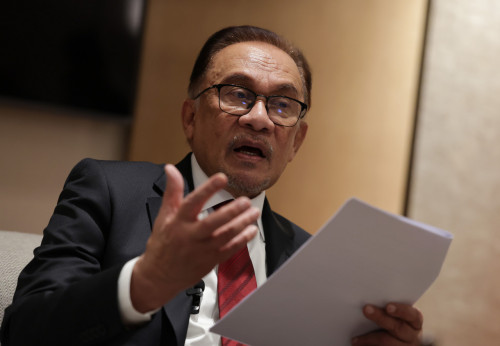
APHR chair and member of the Indonesian Parliament, Mercy Barends, said that she hopes Prime Minister Datuk Seri Anwar Ibrahim recognises the dangers posed by such legislation.
“As a long-time member of the opposition, we hope that Anwar recognises the dangers posed by overly broad and ambiguous legislation that can be easily used by those in power to target opposition politicians and human rights defenders,” she said.
According to APHR, the concerned laws are the 1948 Sedition Act and the 1998 Communications and Multimedia Act.
They added that the Sedition Act has frequently been used against opposition parliamentarians.
For example, former PKR MP and APHR member Tian Chua was sentenced to three months in prison and fined more than US$400 (RM1,774) after delivering a speech denouncing racism and corruption.
Meanwhile, APHR also explained that Section 233 of the Communication and Multimedia Act, which criminalises online content that is “obscene, indecent, false, menacing or offensive in character”, is susceptible to misuse due to its vagueness.
“The new Malaysian government must live up to its promises and prove its commitment to human rights.
“This can be done by ensuring parliamentary immunity and the right to freedom of expression for all parliamentarians are effectively upheld,” said Charles Santiago, APHR co-chair and former Klang MP.
The APHR members from Indonesia and the Philippines visited Malaysia to stand in solidarity with Santiago, who is facing a defamation suit from influential and controversial preacher Zakir Naik.
According to APHR, the targeting of opposition MPs and human rights defenders through the use of draconian laws is unfortunately not limited to Malaysia, as situations seem worse in countries like Myanmar.
They added that in Myanmar, the Parliament remains suspended since the military coup in February 2021 that ousted the elected NLD government.
They also expressed their concern for members of the national and sub-national legislative bodies who remain in detention and are facing not only the risk of torture in prison but also the possible risk of execution following the executions of four pro-democracy activists, including a former lawmaker.
Subang MP Wong Chen stressed the need for parliamentarians to be able to speak freely without fear of saying the wrong thing.
“Parliamentarians should be allowed to carry out their mandate as the people’s representatives without fear of reprisals if they said the wrong thing or offend the wrong person,” said Wong.
APHR board member and former Philippines MP, Teddy Baguilat Jr, said that disinformation and red-tagging campaigns against opposition parties and lawmakers continue, leading to widespread online threats and violence against them and their supporters in the Philippines.
“Lawmakers who have criticised the government have also faced trumped-up and politically motivated charges, including APHR board member Walden Bello, who faces cyber-libel charges, and senator Leila De Lima, who has been unjustly detained since 2017 on absurd drug charges.
“Governments and parliaments throughout Southeast Asia, including Malaysia, should learn from the Philippines, and work to repeal repressive laws to ensure that this kind of persecution against lawmakers do not occur,” added Teddy. – The Vibes, February 26, 2023













_Datuk_Rusdi_Mohd_Isa._Facebook_pic..png)
.jpeg)