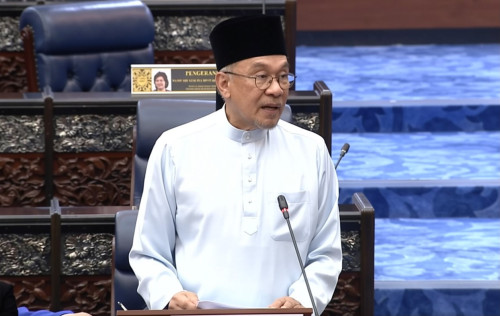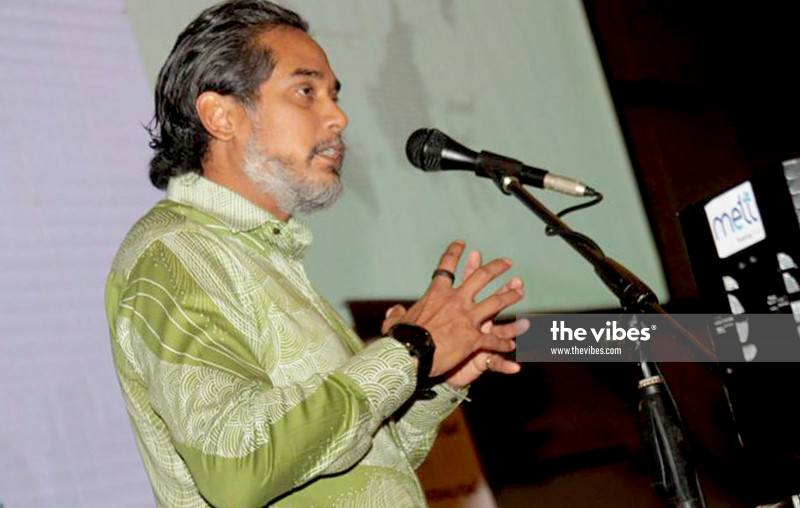
KUALA LUMPUR – Science, Technology and Innovation Khairy Jamaluddin says the National Policy on Science, Technology and Innovation (DSTIN) 2021-2030 will intensify local technology development, transforming the country from tech users to developers.
Speaking at the launch of the policy on Facebook yesterday, he said it would reduce dependence on foreign technology and labour.
He said experimental research development would be empowered by setting aside 50% from the allocation for research and development (R&D).
“The government through this ministry has formulated the new policy which will also address the issue of innovation inefficiency, where the concept of Science, Technology, Innovation and Economy (STIE) is introduced in this policy.
“An integrated approach combining the two major sectors of the country, namely ‘STI’ and ‘Economy’ as one sector to ensure that all programmes are implemented to complement each other and have a high impact, thus making STI an enabler in addressing national issues and challenges,” he said.
He said the new policy outlined six cores, along with 20 strategies and 46 initiatives, covering all sectors and living spaces of people from all walks of life.
Khairy said the six cores emphasised responsive STI governance, empowerment of research, development, commercialisation and innovation (R&D&C&I) as well as the use of local technology by the industry, STI talent development, embracing and application of STIE as well as bringing STI to the global stage.
“We are aware that STI-based economic growth efforts require the cooperation of various parties, therefore this policy emphasises strategic collaboration between government, industry, academia and society, particularly in the development of local technologies through R&D&C&I.
“This is to ensure that STI benefits all parties inclusively without marginalising any quarter ... STI talent which is the backbone of national development is also the main focus of the new DSTIN,” he said.
He said that, as such, Science, Technology, Engineering and Mathematics (STEM) based education as well as Technical Education and Vocational Training (TVET) will be fortified to ensure talents can meet industry needs in a rapidly changing global economy and technology.
Khairy said in efforts to make Malaysia a high-technology country with a GERD (Gross Domestic Expenditure on Research and Development) of 3.5% by 2030, 10 STIE leap programmes have been formulated.
Among them are the creation of Technology Commercialisation Accelerator (TCA), Malaysia Science Endowment (MSE), National Technology Innovation Sandbox (NTIS) and the establishment of the National Vaccine Centre, which will drive local technology development and commercialisation of R&D products.
He said the 10-10 MySTIE Framework was specifically designed by the Malaysian Academy of Sciences to support the implementation of DSTIN 2021-2030 and address long-debated issues pertaining to R&D results that do not meet the needs of the industry and the low level of commercialisation and technology transfer.
He said 30 priority areas had been identified which were divided into three, namely 12 priority areas that are economic boosters, seven priority areas that focus on societal wellbeing and 11 priority areas that impact both aspects.
“I believe the use of the 10-10 MySTIE framework will help strengthen TCA's role in commercialisation efforts when the set of priority areas can meet the needs of the industry, thus ensuring the progress of science and technology in line with the country's economic growth," he said.
Meanwhile, Khairy said Malaysia ranked 33rd out of 131 innovative countries in the 2020 Global Innovation Index (GII), compared to 35th last year.
“Among ASEAN countries, Malaysia is in second place behind Singapore, while among upper-middle-income group countries, we are second behind China,” he said.
Even so, from the aspect of innovative competency, Khairy said he was not satisfied as Malaysia showed a low-level of competency as it produced little innovative output compared to a high level of innovative investment.
“The situation is different from other ASEAN countries, such as Vietnam, the Philippines and Thailand, which display high levels of innovative competency compared to our country as they produce a lot of innovative output, compared to the input invested,” he said. – Bernama, December 9, 2020.