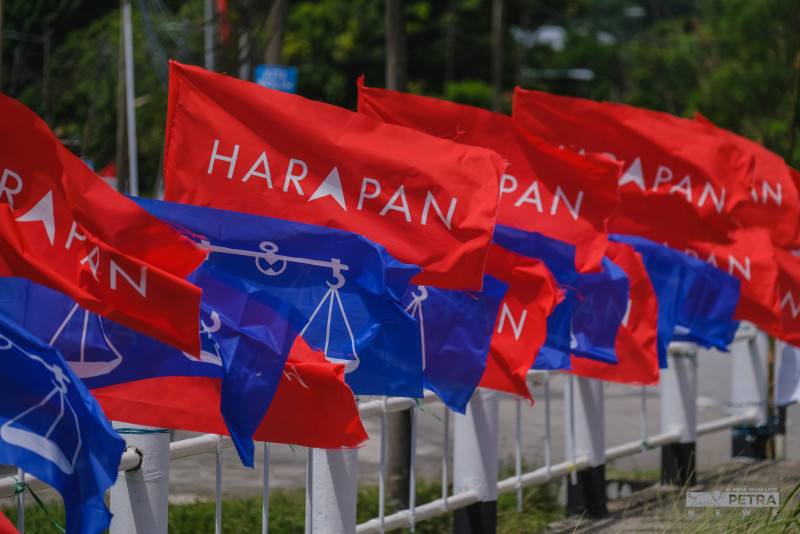
KUALA LUMPUR – Six states will create their own history by holding state elections simultaneously on August 12.
This will also be the first time for voters in these states – Kedah, Kelantan, Terengganu, Penang, Selangor and Negri Sembilan – to elect their assemblymen outside of a general election.
The Election Commission (EC) chairman Tan Sri Abdul Ghani Salleh today announced that polling for the six state elections will be held simultaneously, with nomination day set on July 29 and early voting on August 8.
In all, the six state elections will witness contests for a total of 245 seats, with Kedah having 36 seats, Penang (40), Selangor (56), Kelantan (45) and Terengganu (32), and Negri Sembilan (36).
Kelantan was the first to dissolve its state assembly on June 22, followed by Selangor on June 23, as well as Penang, Kedah and Terengganu on June 28, while Negeri Sembilan’s state assembly was dissolved after completing its full five-year term on July 1.
Prior to the change in the country’s political landscape, only the state election in Sarawak was not held simultaneously with the GE, and this has been going on since 1963.
Sabah, on the other hand, had held several series of state polls separately from GE, with the first in 1967, before synchronising the state polls with the GE in 2004.
However, following a political crisis in the state and amidst Covid-19, Sabah was forced to hold a separate state election on September 26, 2020.
Political crises also forced Melaka and Johor to hold their state polls earlier than other states on November 20, 2021, and March 12, 2022, respectively, which also saw the domination of Barisan Nasional (BN).
The elections in the two states are notable for being the first election to implement the Undi18 initiative, where 18-year-olds were allowed to vote.
According to the EC, over 9.77 million voters are eligible to cast their ballots in the state polls and the electoral rolls to be used are the latest ones until the Supplementary Electoral Roll for April 2023, updated as at June 21.
The EC also estimated the polls in the six states to cost RM420 million.
Statistics on the six states show Selangor as having the highest number of young voters between the ages of 18 and 20, totalling 274,194 people, followed by Kedah with 104,284 voters, Kelantan (96,513), Penang (67,633), Terengganu (64,264) and Negri Sembilan (55,017) – bringing the total number of voters in this category to 661,905 people.
The campaign period has been fixed for 14 days, beginning from after the announcement of candidates’ names on July 29 until 11.59pm on August 11.
The EC will also appoint 153,760 staff to handle the election process in the six states, where a total of 173 nomination centres and 186 official vote-tallying centres will be opened.
For the record, five by-elections were held after the GE in 2018, four of which were in Selangor and one in Negri Sembilan.
In Selangor, by-elections had to be held following the death of the incumbents namely for Sg Kandis, Balakong, Seri Setia and Semenyih.
Pakatan Harapan retained three of the seats, while BN managed to wrest back Semenyih.
In Negri Sembilan, the by-election was held for the Rantau seat after the Federal Court dismissed the appeal by BN deputy chairman Datuk Seri Mohamad Hasan against the Seremban election court’s decision on November 18, 2018, which nullified his victory for the seat.
Mohamad, who is also Umno deputy president, won the by-election with a 4,510-vote majority to retain the seat.
So far, five of the states holding the state elections, except Terengganu, have passed the anti-party hopping enactment in line with the Constitution (Amendment) Act (No.3) 2022 that prohibits elected representatives to change parties. – Bernama, July 5, 2023