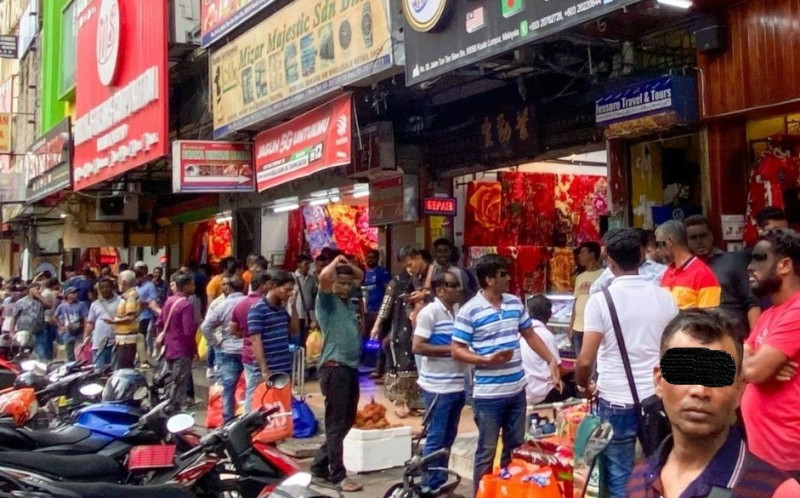
THE use of tourist, visitor and student visas by foreign nationals to carry out illegal business activities in Malaysia has been described as an escalating concern, prompting calls for stronger enforcement and coordinated government action to safeguard local economic interests.
While the issue is not new, recent remarks by Prime Minister Datuk Seri Anwar Ibrahim during the Communications Ministry’s monthly assembly on Monday have brought renewed urgency to the matter, highlighting the scale of public complaints received by the government.
Authorities have reportedly been alerted to cases involving foreign nationals operating a wide range of small and medium-scale businesses, including coffee shops, vehicle repair workshops, air-conditioning services, travel agencies, retail outlets and e-commerce activities, all conducted under visitor-related visas.
Universiti Utara Malaysia (UUM) Senior Lecturer Dr Nor Azura A Rahman told BH that what was more concerning is that there are allegations that some operations are using local business licences as proxies, while actual control of capital, labour and profits remains in foreign hands.
The Associate Fellow at the Institute of International Affairs and Asian Diplomacy (AIIAD) and at the School of International Studies said the issue is particularly sensitive given the central role of small and medium enterprises in Malaysia’s economy.
According to official Department of Statistics data, SMEs contributed 39.5 per cent of the national economy in 2024, amounting to RM652.4 billion and supporting approximately 8.10 million jobs.
Analysts warn that unfair competition from unlicensed or improperly registered foreign-run businesses places significant pressure on local entrepreneurs who operate within regulatory frameworks, pay taxes and comply with licensing requirements.
Unregulated operators may benefit from structural advantages, including lower operating costs, avoidance of tax obligations, non-participation in social protection schemes, and access to cheaper supply chains from abroad, allowing them to undercut legitimate domestic businesses.
Such distortions, experts argue, create an uneven playing field that threatens the viability of local enterprises and may result in long-term leakage of economic value from Malaysia, particularly where profits are repatriated without meaningful reinvestment into the domestic economy.
Beyond economic concerns, the issue also carries implications for governance and national security. The misuse of immigration passes for commercial purposes suggests potential gaps in monitoring and enforcement mechanisms, raising fears of a growing informal economy that could facilitate tax evasion, illicit financial flows and misuse of local identities or licences.
The tourism sector has also been cited as an area of concern, with reports of foreign-dominated networks of tour operators, transport providers and related services operating in certain high-traffic destinations, limiting the economic spillover benefits for local communities.
However, observers stress that enforcement efforts must be carefully balanced to avoid discouraging legitimate foreign investment and participation in Malaysia’s economy.
Lawful foreign investors and entrepreneurs, they note, continue to play a vital role in driving economic growth, technology transfer and job creation, and should not be conflated with illegal operators exploiting regulatory loopholes.
In this context, the Prime Minister’s call for a coordinated, multi-agency enforcement approach has been widely seen as a necessary step forward.
Relevant agencies include the Immigration Department, Inland Revenue Board (LHDN), Royal Malaysian Customs Department, Domestic Trade and Cost of Living Ministry (KPDN), Bank Negara Malaysia, Malaysian Communications and Multimedia Commission (MCMC) and local authorities.
There are also growing calls for increased use of digital technologies and artificial intelligence to detect suspicious financial transactions, track capital flows and identify business networks operating under local licences as fronts for foreign-controlled operations.
In an increasingly digitalised economy, enforcement strategies are expected to move beyond physical inspections towards data-driven monitoring and real-time surveillance of commercial activity.
Strengthening whistleblower mechanisms has also been proposed to encourage reporting from local traders and the public without fear of reprisal, alongside greater involvement from business associations and chambers of commerce in identifying irregular activities.
Ultimately, the issue extends beyond immigration violations, touching on broader questions of economic sovereignty, regulatory integrity and the ability of local businesses to compete on fair terms within their own market.
The Prime Minister’s decision to raise the matter publicly has been described as a significant acknowledgement of a growing structural challenge, signalling the government’s intent to address systemic abuse while maintaining Malaysia’s position as an open and investment-friendly economy.
The key challenge moving forward, analysts suggest, will be ensuring that enforcement is firm, coordinated and technologically enabled, without undermining legitimate international participation in the country’s economic development. - June 11, 2026