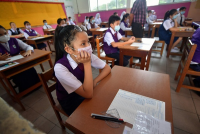
THE abolition of the Ujian Penilaian Sekolah Rendah (UPSR) examination, as announced by Education Minister Datuk Mohd Radzi Md Jidin, is a step towards ensuring today’s children are able to benefit from an education system that is of global standards. This is not something new – it is the first shift in the Malaysian Education Blueprint 2013-2025.
By shifting from a rote-based education system to one that enables our children to boost their cognitive and higher-order thinking skills, we are ensuring that our nation is future-proof and possesses a workforce that is agile and flexible, as the next generation is able to build up core skills when it matters most.
The 4W1H (who, what, when, why, how), which is the base of Inquiry-Based Science Education, needs to be amplified for higher-order thinking skills to be inculcated in our primary school pupils. This will allow them to sharpen their creative aptitude, critical thinking, and writing and presentation skills, thus increasing their confidence.
Additionally, the school-based assessment that will take place should focus on pupils’ aptitude in skills like problem-solving, decision-making, memory, sequencing and emotional self-regulation, among others. The assessment should be done for children in Years 4 to 6 (aged between 10 and 12) to ensure optimal take-up, and using systems based on high technology. We can’t escape the fact that this is the future, and we should incorporate technology into education right from the kindergarten level or Year 1.
Before we develop these assessments, though, we should reflect on the purpose of primary education in the country. What is it that we want pupils to acquire? What level of depth do we want them to have? How can we create in them a thirst to learn?
Lessons should be fun and stimulate their interest in learning, across the divide, and to the level that they want to learn.
To achieve this, teachers need to be retrained to present subjects in an engaging manner. By adopting a personalised and experiential learning approach, we can build up a primary education model that is more holistic, engaging and tailored to learners’ needs. Through this customised teaching and learning approach, aided by assistive tools and management, our pupils will be able to develop core skills and thrive in their education.
Teachers will be able to curate content that is unique to Malaysia, and aid in the holistic development of primary school learners, setting these children in good stead for their subsequent education levels.
Parents are important stakeholders, too, and should be included in their children’s education journey. This way, parents are able to appreciate the new way of teaching, and the different tools and facilities utilised.
Getting good grades should be a natural progression rather than a stressful experience. Students can get As not through a one-shot exam, but a long assessment that promotes their participation and development of knowledge, creativity and innovation concurrently. The most important thing is that they enjoy learning and are able to develop an understanding related to the subject, as well as unleash their creativity and become more innovation-oriented.
It is still dawn for us in this area. There needs to be more research on teaching and learning in the new era that is the Industrial Revolution 4.0, digital learning, artificial intelligence and the Internet of Things. We can incorporate the findings as we progress, but we need to get started.
Let’s never forget that the purpose of educating people is for social living. The more of our population attains a quality education, the better it is for our nation in the long run. A high-quality education system allows our leaders of tomorrow to have future-proof skills and competencies to adapt to market demands. – The Vibes, May 2, 2021
Prof Ahmad Ismail is a fellow at Academy of Sciences Malaysia