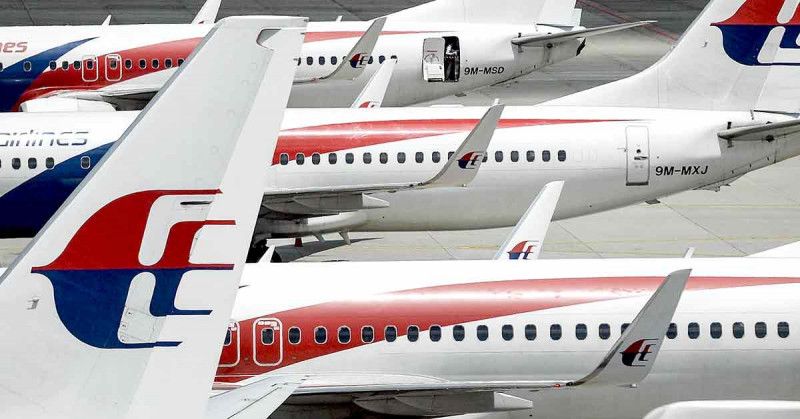

EVEN before Covid-19 hit the scene, talk of closing down Malaysia Airlines had been floating around – as recently as last year – when it continued to make losses despite its parent sovereign wealth fund Khazanah Nasional Bhd’s latest round of aid – RM6 billion committed in 2015 which has already run out.
All in all, the amount of money spent on Malaysia Airlines has exceeded RM18 billion, a huge cost to the taxpayer. Given Covid-19 and the air travel shrinkage it has caused – as much as 98% – it is therefore unsurprising that the airline may be shut down, especially if a new deal cannot be made with lessors of aircraft on much better terms.
Is it realistic to expect the airline to make money again or would it be better to let it sink and go into liquidation? Increasingly, the liquidation option looks like the best one, given the collapse of the air travel market, when even the best of airlines in normal times have had to have an injection of funds to stay afloat.
Worse, there is the possibility that air travel may stay depressed for some years yet, which may imply that conditions will remain bad indefinitely.
Does that mean that we will not have a national airline anymore? Not necessarily. We can simply start another one – and the Malaysian Aviation Group (MAG) under which Malaysia Airlines Bhd or MAB is parked has Firefly and MASwings in its fold.
It does not mean the new airline will be named Firefly or MASwings, it can be called anything, including the old name Malaysia Airlines. But we will be saying bye-bye to Malaysia Airlines as we know it now which is already very different from what it was five years or 20 years ago.
And that spans a long, long story, starting in 1947 when Malayan Airways took off on its maiden flight, a small propellor-driven plane with a mere five passengers. It became Malaysian Airways in 1963 after the formation of Malaysia and post 1965 after Singapore’s expulsion from Malaysia it became Malaysia-Singapore Airlines, which mouthful was abbreviated to MSA.
As differing national interests pulled MSA in various directions, it decided to split MSA resulting in Malaysian Airline System (MAS) and Singapore International Airlines or SIA in 1972, seven years later.
It continued operating as MAS until 2015, going through chequered periods of profits and losses and was for a time privatised to entrepreneur Tan Sri Tajudin Ramli for RM1.79 billion for a 32% stake in 1994.
Tajudin, closely linked to former finance minister Tun Daim Zainuddin, sold back his stake to the government in 2001 in a controversial deal at the same price when the share price was less than half the market price it was when the government sold him the stake.
Commenting on that deal 20 years ago I wrote in The New Sunday Times: “Tajudin should consider himself to be fortunate to have got such a good price which probably saves him from financial ruin and enables him to concentrate on his telecommunications operations which is probably what he should have done in the first place. He owes a great debt to the country which he ought to try and repay.
“His 5-year dalliance with MAS and his lofty ambition to make it the largest airline in the world has cost Malaysia Airlines dearly. Tajudin embarked on the debt route to finance the acquisition of aircraft to the tune of over RM10 billion, many of which he had to sell and lease back to reduce the financing burden and improve profits through exceptional gains on the sale of aircraft.”
That was one of those deals that marked MAS’ downturn. This was characterised by unrealistic planning and poor understanding of the very volatile airline business combined with over-ambitious, unrealistic aims.
That kind of management led MAS into various other problems until CEO Datuk Seri Idris Jala took drastic cost-cutting measures and enlightened revenue management to turn the airline around in 2007/8.
But subsequently, lack of management depth and expertise resulted in MAS losing its focus and trying to compete with low-cost airlines, an impossible task given its status as a full-service carrier with an inherently higher cost structure. Having fares consistently lower than those of low-cost airlines for a vastly superior service was a sure recipe for disaster.
This led to Khazanah’s rescue plan of 2015 which involved privatisation of the airline, injection of RM6 billion and the emergence of two consecutive foreign CEOs for the first time ever in MAS whose assets were transferred to a new company, Malaysia Airlines Bhd or MAB.
Still, it failed dramatically leading to its possible closure now, mainly because cost-cutting was the main method - good routes along with bad were chopped and a de facto low-cost approach adopted. It lost its international rankings and its ability to secure premium fares was severely curtailed.
The solution to Malaysia Airlines problems does not lie on whether it is run by the private sector or not. It does not depend on whether the airline is parked under Firefly or any other existing airline - that is merely a financial arrangement. It does not depend on foreign or local CEOs but on competent CEOs and a good team unshackled by political considerations.
What is needed is to first clearly establish its niche in the marketplace - you cannot be both low-cost and full-service at the same time, but you can be a full-service airline where costs are well-controlled. But full-service airlines simply cannot compete with low-cost ones in terms of cost, except at the margin when they have excess capacity.
For that to happen, Malaysia Airlines, no matter which airline company it eventually comes under, needs an excellent revenue management team who can optimise revenues – that maximises revenues relative to costs by judicious management of fares and use of available capacity.
If they do very well in every other area and fail here, they will still fail. It is not just a good product (in the past it has been achieved) but to get the best value for the product, where it has consistently failed.
Now, Malaysia Airlines has a bad product which needs to be improved at some cost and then optimise profits through proper revenue management. It is still floundering as far as these are concerned. The road forward is going to be long and hard.
The thing to do is to let it be simply liquidated and start a new airline when the time is opportune. That will save needless costs involved in setting up an alternative airline now when demand for air travel has totally collapsed.
P Gunasegaram says that sentiment in business is dangerous. He is editorial consultant of The Vibes