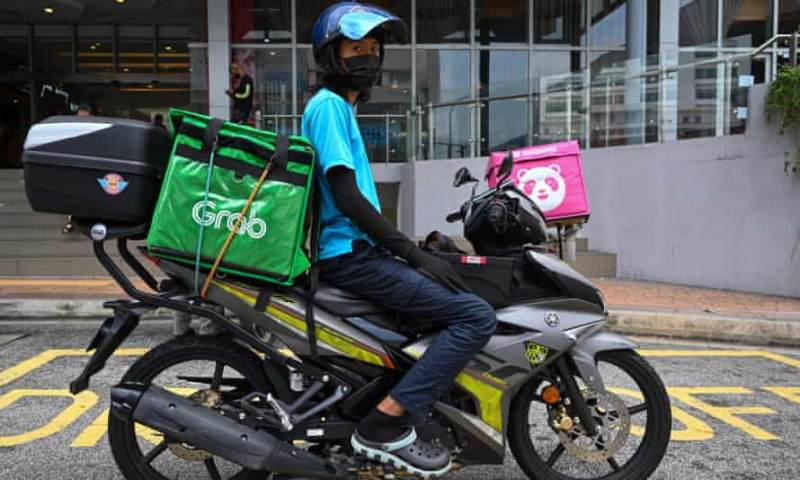
BAD road etiquette and traffic violations are usually associated with motorcyclists – youth who recklessly ride, and trigger the wrath of other motorists and residents in residential areas.
As last-mile services expand, the target of this wrath has shifted to food delivery platforms for allegedly allowing and enabling bad riding behaviour.
This has caught the attention of the government, who compelled the Transport Ministry to conceptualise a p-hailing policy paper, and highlighting yet another possible step to over-regulate the industry.
The proposed regulation is developed from studies by the Malaysia Institute of Road Safety Research since last year, and concluded that a high portion of traffic violations are caused by p-hailing riders; hence, the regulation to address this problem.
Referencing on how behaviour and traffic etiquette influence a person’s riding attitude, the key question is: is it fair to entirely blame food delivery platforms when the root issue is the riders’ personal behaviour?
Nonetheless, these platforms have always reminded their riders to practise good values and comply with road safety rules.
These platforms also hire riders based on the assumption that they have been officially instructed, tested and licensed by the Road Transport Department (RTD), thus, “qualified” to ply the streets.
Therefore, any “misbehaviour” reflects more on RTD’s systemic failure than food delivery platforms’ failure to educate their riders.
While the promotion of road safety and traffic etiquette is a collective responsibility, these platforms – including firms that hire despatch staff – have limited control over how their riders behave on the road.
The proposed regulation is interesting in that it has digressed from its original intent of addressing high traffic violations.
Centrist local think tank The Centre in a January 13 report pondered the possibility of a riding regulation as a case of “over-regulation”.
For example, food delivery platforms must inspect and verify that their riders’ vehicle is roadworthy and free from modifications, and hire riders who are 21 years old or older.
This is unrealistic, and will force these platforms to add a layer of bureaucracy that may deprive thousands of individuals of income–generating opportunities, and deny the flexibility that is the hallmark of the gig economy.
The critical question is: will this proposed regulation change riders’ attitude and behaviour to subsequently reduce accidents, deaths and traffic violations?
At face value, the regulation does not appear to be able to solve the problem that originally triggered the intent for it to be conceptualised.
Which brings us to the next question: what is the raison d’être of the proposed regulation?
Industry sources indicate that the government intends to:
- Determine fares set by food delivery platforms without a clear understanding of the business model;
- “Charge” a licensing fee on these platforms and their riders; and,
- “Curate” new training courses for riders – again highlighting what seems to be a case of the government “assuming” how the industry works.
Although the proposed regulation underscores riders’ safety and welfare, it should not adopt a “short-term populist outlook” and impede industry growth, just because the socio-economic demographics of the majority of riders are bumiputera.
If its intent is to address traffic violations and provide a safe environment for riders, then the government and industry should collaboratively promulgate a solution; a one-size-fits-all approach is not ideal.
Inculcating positive road behaviour and etiquette must start early – in schools, driving and riding schools – and needs a concerted effort by traffic enforcement authorities and industry players to ensure safe streets for all. – The Vibes, August 10, 2021
Khairil Ahmad is a consultant at Hann Partnership and an associate of the Digital Economy Group of the Malaysian International Chamber of Commerce and Industry. He quit as public affairs head of FoodPanda Malaysia to pursue a path as an expert specialising in problems affecting the food delivery industry