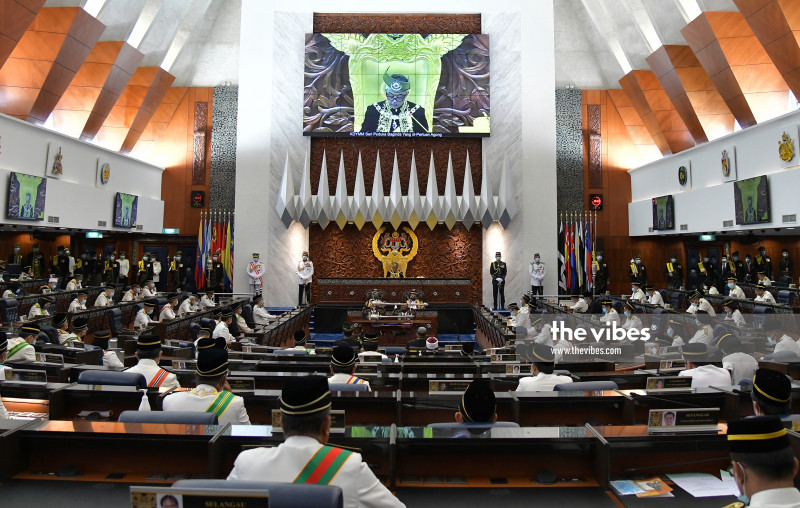
THE legislative initiative to enact an anti-hopping law, according to newspaper reports, is inching towards a reality, to be tabled in the Parliament next Monday.
The damage caused by political defection of elected representatives since the last general election is rampant and deleterious enough for the otherwise polarised political leaders on both sides of the aisle to support the bill.
Would it be enough to gather two-third majority support in Parliament? We will know soon enough.
As sporadic discussions and disagreements in the public sphere on the bill are still being aired, it is perhaps worth recalling briefly how the current anti-party-hopping sentiment gathered steam so that we do not miss the forest for the trees.
The most consequential of all party-hopping moves was evidently the political instability which ensued following the Sheraton Move, at a time when all government efforts should by right be focused on combating the multi-dimensional challenges posed by the Covid-19 infections.
Instead, the fragile Perikatan Nasional (PN) government headed by Prime Minister Tan Sri Muhyiddin Yassin had to strenuously hold his government together through “innovative” strategies such as appointing an unusually large cabinet, inducing more party defections to provide buffer for his majority, and declaring a state of emergency to avoid the threat of a no-confidence vote, rather than focusing on attending to the nation’s pressing needs in the depth of citizens’ despair and anger.
The price – political, economic, social, human and educational – to pay was enormous, aggravated in part by the political immobilism and contradictions incurred by the reality of a coalition of convenience with a razor-thin majority. Even supporters of the PN government readily agreed that the government messed it up.
Though most would agree with the need to curb “undesirable” or “unprincipled” party-hopping, it is complicated to draft an anti-hopping law which satisfies everyone, partly because the objectionableness of the act of political defection is often viewed through a partisan lens, whereas politicians from both sides were caught up in this messy process in one way or another.
But the bottom line is that rampant and liberal permissiveness of political defection makes a mockery of voters’ mandate and ruins people’s faith in the democratic system. Something needs to be done.
The argument that recall election is more democratic than anti-hopping law, which imposes an automatic vacation of the seat when a representative changes party affiliation is flawed.
Ultimately, the political legitimacy of an elected representative lies in voters’ popular support. Forcing a by-election merely requires that the representative go back to his voters to seek a fresh mandate for his changed political status, and it is most democratic to do so.
My research found that voters do not merely vote based on the consideration of party affiliation or candidate attributes alone, but based on a combination of both and/or the overall political situation. So, the mandate given to the lawmakers is not perceived only as an individual or party mandate by the voters.
So, while recognising that there may be legitimate grounds for conscientious and principled lawmakers to come into conflict with their party (in effect, most defectors justified their action with their own reasons), the argument in support for the unfettered right to political defection mid-way through their mandate should be weighed against the larger consequences of such act on the national landscape of political development.
Given the great damage political defection can inflict on the nation and the state of democracy, it is only right that the freedom of association of a lawmaker who defects be tempered by obliging a renewal of his mandate through a by-election. After all, the soundness of his political judgement would be vindicated should he succeed in getting re-elected.
The Nordin bin Salleh v Dewan Undangan Negeri Kelantan verdict, which went against the popular will of the Kelantan voters, seemingly pitched democratic mandate against the individual’s freedom of association.
I feel that framing the debate this way poses a false dichotomy. The state assemblymen could have their freedom of association, but if what they did was contrary to the people’s will, they should be principled enough to choose freedom of association while letting the voters have their democratic say as well.
After all, what other legitimacy can they stand on as the people’s representative? – The Vibes, April 6, 2022
Helen Ting is an associate professor at Ikmas, Universiti Kebangsaan Malaysia. She is the author of Electoral System Change for a More Democratic Malaysia? Challenges and Options