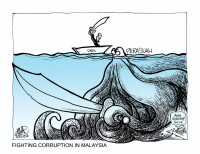
THE Malaysian Anti-Corruption Commission chief Tan Sri Azam Baki’s apparent downplay of Transparency International’s (TI) Corruption Perception Index (CPI) has set tongues wagging.
The Centre to Combat Corruption and Cronyism (C4) has lambasted Azam for taking a dig at the index, calling on the nation’s top anti-graft buster to better explain the CPI’s value rather than downplay it.
But honestly, Azam’s downplay of the CPI is nothing new. The CPI has courted controversies for some years now.
Prof Paul Heywood, who is Sir Francis Hill Professor of European Politics, Faculty of Social Sciences, University of Nottingham, has argued in an article written with Staffan Andersson, that the CPI is open to criticism on several grounds: definition problems, perception bias, false accuracy, a flawed statistical model, and a failure to capture long-term trends. (The Politics of Perception: Use and Abuse of Transparency International’s Approach to Measuring Corruption, Political Studies 2009;57(4):746-767).
As Azam rightly alluded, perceptions do not necessarily reflect reality. According to Heywood there is in fact no shortage of evidence that there is often a striking mismatch between perception and experience, at least where corruption is concerned.
The CPI is a composite index. What does this mean?
It means data are drawn from externally conducted polls and surveys and scaled into one index by a method of scaling. The data are collected by independent institutions, which are non-profit organisations and consultancy companies. (See Tina Søreide’s critical assessment of corruption indices, 2006)
Respondents to the surveys are so-called “country experts”, but are usually based outside the country in question. Respondents also include business executives.
Heywood is critical of these respondents’ view of corruption, which tended to focus on bribery (and bribe-takers) when corruption involves much more than just paying bribes.
Corruption takes on many forms and is perpetrated by various actors. But more than that, corruption is a complex and evolving phenomenon.
“The CPI struggles to distinguish not just between types of corruption, but also their impact and severity,” writes the learned don.
So yes, the CPI does not measure what the people think about corruption, but what some people think.
But to be fair, TI does acknowledge that the CPI is not presented as true facts about the actual levels of corruption. To its credit also, TI provides a detailed account of where its data comes from as well as how it uses it, and this is accessible via TI’s own website.
Now, the World Bank also has what it calls the Worldwide Governance Indicators (WGI), which reports on six broad dimensions of governance, one of which is control of corruption. This is part of its efforts to estimate the quality of governance.
Control of corruption captures perceptions of the extent to which public power is exercised for private gain, including both petty and grand forms of corruption, as well as “capture” of the state by elites and private interests.
The World Bank’s approach to estimating corruption is said to be similar to the methodology TI applies to make their ranking. Several of the sources are the same. The two indices correlate well.
And both share the objectives of raising awareness, to enable statistical research to understand and better confront the problem, and to encourage governments in their anti-corruption efforts.
Why perception-based?
The simple answer is: it is very difficult – almost an impossibility – to get truly fact-based data on corrupt activities. Data on corruption will usually have limitations since the people involved seldom will speak out about their practice. Fear or shame of admitting their experience of it may lead people to under-report corrupt activities.
Thus, the use of perceptions as a guide. Positive perceptions drive confidence, which in turn can drive investment.
On the other hand, negative perceptions erode confidence and divert investment into other territories or sectors. (See Imelda Dunlop, Why perceptions matter in the fight against corruption)
So, let’s take the positives from the CPI. As Heywood himself acknowledges, the CPI has stimulated much important academic research on the issue. But more than that also, it has generated significant media attention and helped galvanise international anti-corruption initiatives across a host of national governments and international organisations.
The CPI’s drawbacks may have led to the United Nations Office on Drugs and Crime (UNODC), in partnership with the United Nations Development Programme (UNDP), to develop the Manual on Corruption Surveys: Methodological guidelines on the measurement of bribery and other forms of corruption through sample surveys to support evidence-based indicators on corruption.
The CPI, though, is still the established go-to source for those wanting to know about levels of corruption across the world. It should be the benchmark indicator to work towards, and provide the inspiration for improvement.
Evidence-based corruption indicators may be directly relevant when designing and implementing anti-corruption policies as they can provide systematic and comprehensive evidence of where and how bribery occurs.
But as the UNODC duly acknowledges, perception-based indicators like the CPI will continue to be “useful tools to advocate for the fight against corruption and to give visibility to this topic in the international agenda”. – The Vibes, July 24, 2022
Hafiz Hassan reads The Vibes