IT started out like any ordinary day. Having completed his work at a nearby forest reserve, 38-year-old research assistant Frederick Kusam was making his way home.
His work as an elephant conservation research assistant for the Sabah Landscapes Programme (SLP) at WWF-Malaysia meant that he spent long hours in forest reserves and equally long hours to and from his forest workplaces.
This day was no different. Frederick was two hours in on his journey on the Maliau-Kalabakan road when he stopped by the side of the road for much needed rest.
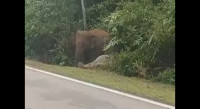
As he stretched his legs outside his car, something large caught his eye. There, not far from where he was standing, an elephant so magnificent in size came out of the adjacent forest and crossed the road only to disappear into the forest again.
But before Frederick could breathe a sigh of relief, the elephant returned to the road and to his horror, it began making its way towards the car.
The scenario that Frederick faced is not an uncommon one in parts of Sabah. Bornean elephants inhabit the forests of Sabah with a small population in northern Kalimantan.
They are the smallest subspecies of elephants in the world. However, as the smallest elephants, they are still large in stature – standing between an average of 7 and 8 feet tall (around 2.13-2.43m).
Bornean elephants are continuously faced with numerous threats to their existence. Every day, they face threats arising from human-elephant conflict and poachers, whose snares intended for smaller animals trap the elephants instead.
Elephants are also threatened by a loss of habitat where areas that they utilise – typically referred to as elephant ranges – are converted into agriculture plantations, settlements and roads.
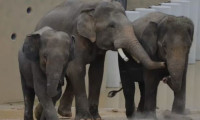
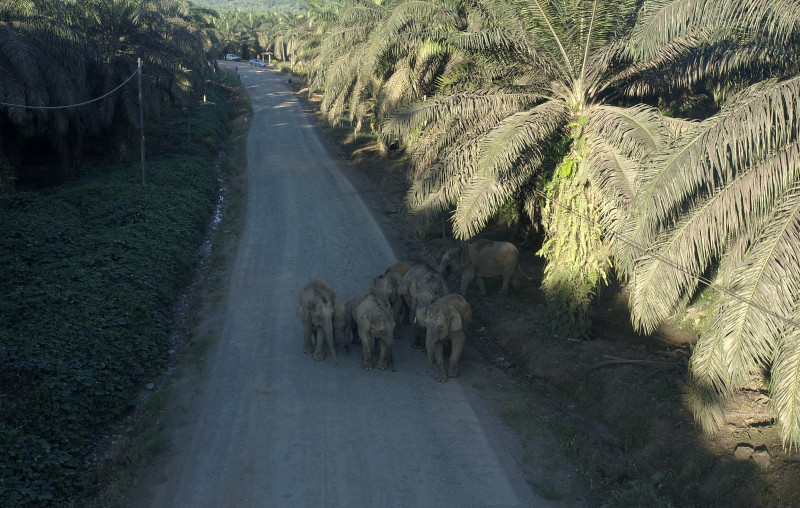
Elephants are a social species and are known to travel in groups called herds. They move in search of food and shelter. The routes that they take come from knowledge and experience passed down from generation to generation.
Even when those routes become our roads, elephants will still journey through.
.jpg)
For road users in parts of Sabah, the sight of elephants crossing is not new. Elephants are known to forage along roads where grasses grow abundantly.
Like Frederick, many who frequent the Sapulut-Maliau-Kalabakan road would have had a chance encounter with elephants.
It is on roads such as these that the needs of humans and elephants intersect. For us humans, roads give us access to our homes. It gives us access to our work and thus contributes to our livelihoods.
But more than this, roads also provide access to healthcare facilities. They are crucial for the transport of commodities and thus contribute to economic growth and trade.
For the elephants, the same road is a memorable path that gives them access to food and larger foraging grounds.
It is on roads such as these, where humans and elephants encounter each other, that humans can be empowered to ensure that any encounter is one of coexistence and not conflict.
When Frederick saw that the elephant was heading towards him and his car, he didn’t panic. Instead he moved backwards slowly. The elephant eventually stopped and made its way into the forest.
Frederick’s actions were in contrast with the actions of several individuals who filmed an elephant encounter recently.
In a video that went viral on social media, the individuals were seen approaching a group of elephants with young ones crossing the same stretch of road, trying to get the elephants to move away.
Alarmingly, the individuals were also seen to be trying to capture close-up photos or videos of the elephants.
Startled and perhaps sensing danger in the situation, maternal instincts kicked in and the adult female elephants started to mock charge towards the individuals.
While the elephants stopped charging and the individuals made it to the safety of their cars, the situation could have gone horribly wrong. The encounter could have ended in tragedy and another statistic of human-elephant conflict would have been recorded.
-Danau_Girang_Field_Centre_Facebook_pic.jpg)
The narrative today should no longer be an “us versus them” scenario. Humans and elephants can coexist and in incidents where humans and elephants encounter each other, we should take precautions to protect both ourselves and the elephants.
Under the SLP, elephant conservation efforts are underway to safeguard the Bornean elephant population and promote human-elephant coexistence. SLP, through its three pillars – protect, produce and restore – conducts elephant satellite collaring to identify the Bornean elephant’s key space requirements, which in turn will be used to reduce future conflicts.
Additionally, the SLP works to restore ecological corridors to connect fragmented habitats, which facilitates the movement of wildlife like elephants. These corridors are also crucial to increasing gene flow to reduce the negative effects of inbreeding, as well as to provide connectivity to areas of higher elevation in the event of climate change.
Together with the state government, private corporations and other non-governmental organisations (NGOs) in Sabah, the SLP will continue to play its role in the conservation of Bornean elephants.
There are less than 1,500 Bornean elephants left in the wild. As the state government, NGOs and corporations do their part to continue securing the future of the Bornean elephant, so too should individuals play their role.
Individuals encountering elephants in the wild have both a privilege and a responsibility – a privilege to come across the largest land mammal in its natural habitat and a responsibility to allow these majestic creatures a safe space to inhabit.
Let this World Elephant Day be a reminder that we can do something to safeguard our iconic species. Let us be empowered to take action to protect our largest land mammals.
Here are several ways that we can do that:
Seven road safety awareness tips when encountering an elephant
1. Stop your vehicle and give way to the passing elephants.
2. Don’t attempt to get down from the vehicle to take close-up photos of the elephants.
3. Maintain a safe distance of at least 50m between yourself and the elephants at all times.
4. Don’t panic when encountering an elephant. Keep calm and wait until it has passed.
5. Don’t feed the elephants. They will come to associate people with food and may approach vehicles more frequently in the future.
6. Don’t honk at the elephants. Loud sounds may startle or agitate them.
7. Dim your car lights if you happen to encounter the elephants on the road at night. – The Vibes, August 12, 2022
WWF-Malaysia, established in 1972, currently runs more than 90 projects covering a diverse range of environmental conservation and protection work