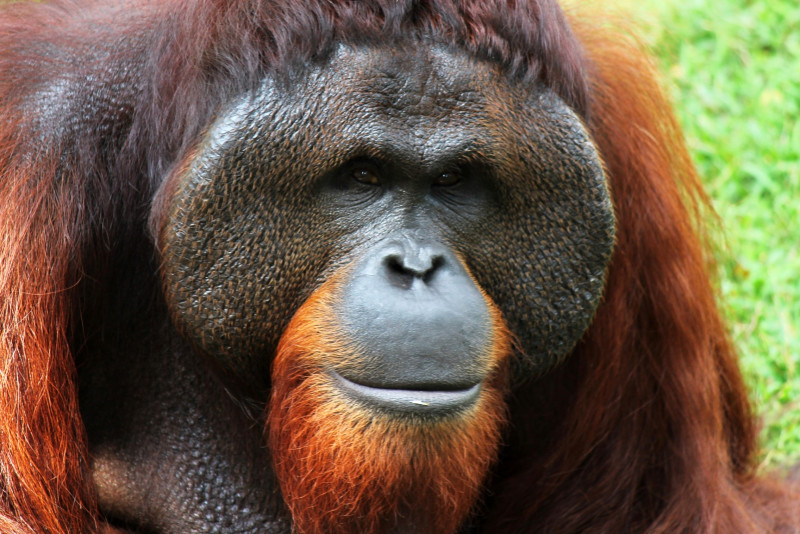
IN conjunction with International Orangutan Day, which is celebrated every year on August 19, the Plantation Industries and Commodities Ministry (MPIC) wishes to clear the air over allegations of palm oil being the biggest threat to orangutans, with some quarters even going to the extent of branding the golden oil as an orangutan killer.
In the guise of wanting to save the orangutans, some campaigners have embarked on disseminating provocative statements such as “an area the equivalent size of 300 football fields of rainforest is cleared each hour to make way for palm oil production”, “25 orangutans are lost every day” and “orangutans will be extinct within the next five to 10 years”.
While it is true that orangutans in Borneo have become an endangered species, it is also equally true that many other animal species have become endangered due to the explosion of the human population on planet Earth.
Recent evidence revealed that hunting is among the biggest contributors to the Bornean orangutan population decline over the last 200 years. In Kalimantan, Bornean orangutans are often shot for their meat or as a result of human-orangutan conflict.
In fact, historical data shows that the decline of orangutans was observed as far back as the 19th century, way before the start of significant oil palm development in the 1970s.
According to Statista, changes in land and sea use in Asia Pacific make up only 43% of the factors threatening wildlife populations.
More than 50% is due to species over-exploitation, invasive species and diseases, hunting, pollution and climate change. In the research conducted by Statista, all wildlife – not just orangutans – are threatened across the world.
They are not limited to other monkey and animal species that inhabit Borneo per se, but spread across North America, Europe, Central Asia, Latin America, the Caribbean and Africa.
Asserting that oil palm is the sole reason that threatens wildlife such as orangutans selectively negates the facts causing the population decrease of all endangered animal species.
As a showcase that humans and nature can coexist in harmony, Malaysia has allotted 43 sq km of protected land at the edge of the Kabili-Sepilok Forest Reserve in Sabah as a rehabilitation site for orangutans.
Today around 60 to 80 orangutans are living independently in the reserve while approximately 25 orphaned orangutans are housed in its nurseries.
With the exponential growth of the planet’s human population, a world without palm oil can surely lead to a global food crisis given that the golden oil makes up over 60% of the global edible oils market.
In the quest to find a middle ground between oil palm cultivation and minimising the destruction of nature, Malaysia has implemented various initiatives to conserve and protect its wildlife and biodiversity. The country is also totally committed to reducing its greenhouse gas emissions under the United Nations Climate Change Conference’s 21st Conference of Parties agreement on climate change.
At the ministerial level, MPIC has initiated the Malaysian Palm Oil Green Conservation Foundation (MPOGCF), through the Malaysian Palm Oil Council, as a sustainability platform funded by the palm oil industry through the collection of cesses to reflect the industry’s commitment towards ensuring palm oil players and smallholders remain sustainable in their practices.
In this regard, MPOGCF is joining forces with the Sabah Wildlife Department to support wildlife rescue and conservation efforts.
This includes the establishment of Sabah’s Wildlife Rescue Unit, which was set up by the Sabah Wildlife Department in collaboration with MPOGCF, with the main task of rescuing and translocating distressed wildlife, including orangutans.
In addition, MPOGCF initiated the 1-Million Forest-Tree Planting programme in 2019 – a 10-year project to rehabilitate the habitat of orangutans in collaboration with the Sabah Forestry Department at Lower Kawag, Ulu Segama Forest Reserve in Lahad Datu, Sabah – as part of the industry’s initiative, with an estimated investment of RM28 million.
MPOGCF has also funded two key orangutan conservation initiatives in the Borneo states: a population survey on the orangutans living in Sabah’s agricultural landscape by the Borneo Conservation Trust together with HUTAN, which was completed in 2018, with survey areas that include assessing the status of orangutan conservation as well as the trends in orangutan distribution, densities and conservation threats, among others; and the Orangutan Conservation Programme in Sarawak, a collaboration with Sarawak Forestry Corp since 2014, which was completed in 2017 with the publication of a full scientific report alongside orangutan conservation efforts in Sarawak’s protected areas – the national parks of Ulu Sebuyau, Sedilu, Gunung Lesung and Maludam.
According to Donna Simon, a researcher and the orangutan conservation manager at the World Wide Fund for Nature, in her research article, “Changes to Sabah’s orangutan population in recent times: 2002–2017”, the population of orangutans in Sabah has been stable for 15 years (2002 – 2017).
Apart from the above, MPOGCF is also collaborating with Zoo Negara in funding the upgrading works of its Ape Centre, with a total estimated investment of RM 1.1 million.
In tandem with clearing the gross misconceptions over the well-being of orangutans, it is equally vital for MPIC to counter misinformation and false information on Malaysia’s golden oil via The Global Movement to Champion the Goodness of Palm Oil campaign. – The Vibes, August 19, 2022
Datuk Zuraida Kamaruddin is plantation industries and commodities minister