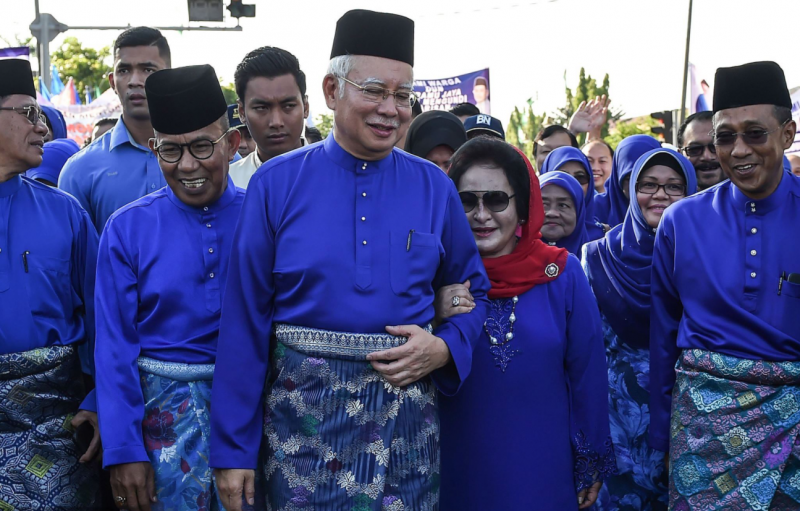
ON August 23, former prime minister Datuk Seri Najib Razak was handed a 12-year jail sentence for abuse of power, criminal breach of trust, and money laundering of SRC International Sdn Bhd funds amounting to RM42 million. He was also fined RM210 million.
On September 2, his wife Datin Seri Rosmah Mansor was found guilty of soliciting RM187.5 million and receiving RM6.5 million in bribes from a company that is trying to secure an RM1.25 billion solar hybrid project that would provide electricity for 369 schools in rural Sarawak. She was sentenced to 10 years in jail and ordered to pay a fine of RM970 million.
Najib’s sentencing sends a strong message: no matter how high an office one has attained, one is not above the law.
After the verdict, however, some quarters have attempted to whitewash both convicts’ crimes and paint Najib as a falsely-accused martyr along the likes of Nelson Mandela.
An example is the criminal couple’s daughter professing feelings of guilt while grocery shopping because her father couldn’t get his favourite Starbucks caramel macchiato in Kajang Prison. She also used her son to garner pity on Instagram.
Instead of posting sob stories, perhaps she should pay her taxes of RM10.3 million.
Najib more Marcos than Mandela
The 2022 Philippine election provides some stark lessons for Malaysia. Najib is no Mandela, but more Marcos.
Some parallels are obvious. Rosmah really liked her Birkin bags while Imelda Marcos splurged on shoes. A 2004 Transparency International report estimated the Marcos’ corruption at around US$5 billion (RM22.4 billion) to US$10 billion.
Other parallels are more insidious. Both Najib and Marcos were dictators: Marcos’ declaration of martial law began in 1972 and was formally lifted in January 1981. Human rights groups such as Amnesty International reported 3,257 known extrajudicial killings, 35,000 documented tortures, and 70,000 incarcerations.
Najib’s dictatorial tendencies were subtler. He pushed for the 2015 National Security Council Bill which gave the prime minister sweeping power to designate “security areas”. In those areas, authorities like the police and armed forces could search and arrest without needing a warrant. The bill also disposed of the need for inquests into extrajudicial killings.
We must never forget several killings which had some form of relation to Najib’s corruption cases: Altantuya Shaariibuu (2006), Ambank founder Hussain Najadi (2013), and deputy public prosecutor Datuk Anthony Kevin Morais (2015). During Najib’s term, there were also enforced disappearances: Amri Che Mat, Pastor Joshua Hilmy and his wife Ruth Sitepu (2016), and Pastor Raymond Koh (2017).
Najib also curtailed press freedom, targeting news portals covering the 1MDB scandal. In 2014, The Malaysian Insider was forced to close down after the Malaysian Communications and Multimedia Commission (MCMC) blocked local access to its site. In 2015, MCMC blocked two publishing/blogging platforms, Sarawak Report and Medium.
Police and MCMC officials also raided Malaysiakini’s office and seized their property after the latter released an article about a public prosecutor’s sudden transfer from a unit probing 1MDB allegations.
Beware whitewashing and historical revisionism
Despite the horrors of Ferdinand Marcos’ dictatorship, his son Bongbong scored a landslide victory to become the 17th Philippines president. His victory was driven by a well-oiled social media machine amidst public dissatisfaction with previous governments.
Freshly-made Twitter accounts operated as a network, amplifying pro-Marcos messages and attacking critics. TikTok videos targeted voters under 40 years old, who form approximately 56% of the 65.7 million electorate and had little or no memory of Marcos senior’s era.
Bongbong embarked on historical revisionism and whitewashing, portraying the martial law era as a golden, crime-free period while staying silent on the violence perpetrated against Filipinos.
Similarly, Najib has rehabilitated his image using social media. In January 2019, pro-Najib cybertroopers launched the “Malu Apa Bossku?” campaign. His team has projected Najib as a more down-to-earth, influencer-like persona who generates buzz on Facebook and Twitter while denying involvement in the 1MDB and SRC scandals.
However, some were able to see through the smokescreen. While Najib trolled the opposition and sometimes his own people on social media, he was quiet as a mouse in Parliament.
Retaking the narrative
After the Sheraton Move, endless political turbulence, and the stresses of Covid-19, the abuses of the Najib administration feel like a hazy memory. Najib’s jailing is a wake-up call: tackling corruption is necessary in correcting socioeconomic injustices, so that public funds can directly benefit the people, like the 369 schools in rural Sarawak awaiting electricity.
Going forward, know that Najib’s propaganda machine will continue spreading disinformation as he files for his royal pardon. Malaysians must be vigilant and fight disinformation among our communities. This can be done by being cautious, verifying information before sharing, and reporting fake accounts and bots that try to paint Najib as falsely accused.
Second, expect more racial and religious rhetoric to distract us from Perikatan Nasional and Barisan Nasional’s infighting and their bloated cabinet’s failure to govern. Malaysians wanting a better future must stand together and resist attempts to stir up racial or religious tensions as GE15 approaches. This is a class war between the people against the morally compromised elite.
They say that history is written by the victors. On August 23 and September 2, 2022, the people won. To those who cast their votes for Pakatan Harapan on May 9, 2018, know that your votes made a difference which enabled the opening of Najib’s cases, and the courts to deliver justice.
With the Anti-Hopping Law in place, your vote will matter come GE15. As Nelson Mandela said, "May your choices reflect your hopes, not your fears.” – The Vibes, September 6, 2022
Lim Yi Wei is the assemblyman for Kampung Tunku