_and_Pak_Samad_(right)_with_other_media_personalities_Datuk_Aziz_Bakar_(second_left)_and_Datuk_A._Kadir_Jasin._–_Pix_by_Tan_Sri_Johan_Jaaffar.jpg)
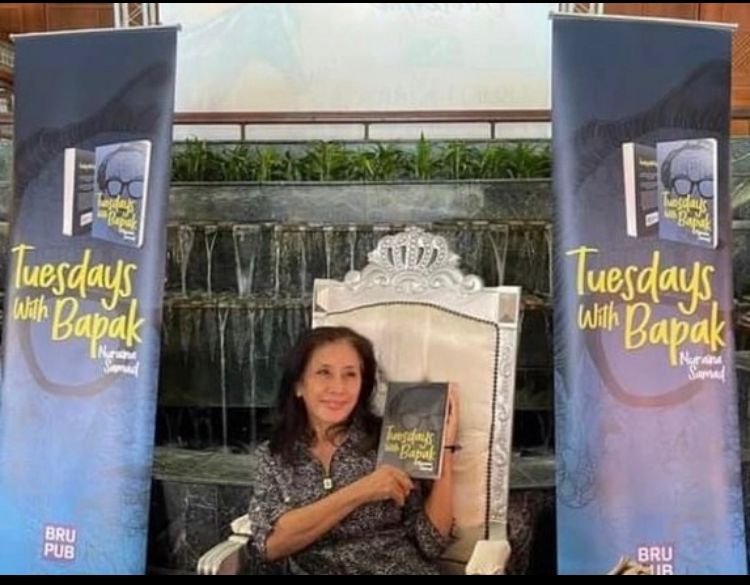
DATUK Nuraina Samad’s Tuesdays With Bapak moved me. It is a poignant account of a daughter whose father was incarcerated under the draconian Internal Security Act. For any family, it would have been a traumatic experience.
It is one of the best books ever written by children of detainees that I have read. An accomplished writer and a well-known journalist herself, Nuraina weaves a narrative with sincerity and honesty, detailing sadness, anger and disappointment, as it were.
What happened to her father, Tan Sri A. Samad Ismail, impacted upon her, her siblings and her mother tremendously.
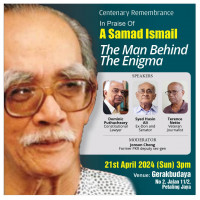
Nuraina’s father was no ordinary bloke. He was a man of many colours and of many seasons. He loomed large within many worlds – the media, literature and politics. He was a giant among men who gambled the comfort and security of his own family for the cause. He was an integral player in the history of this nation and that of Indonesia during its most tumultuous years.
He was first and last a nationalist and a believer in a bigger Malay unity and agenda, which includes Indonesians. He was indeed one of the movers and shakers at a time when nationalistic intent could easily be misconstrued as a threat to some factions in the political realm. He was labelled a communist or worse at their own convenience. His deeds were never taken into account by unscrupulous politicians wanting to prove a point.
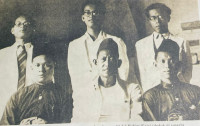
It is not that her father had not been incarcerated before. Did anyone even remember why he was detained in 1946 and in 1951? In 1946, he was hardly 22, and his wife was carrying their first child.
When Special Branch officers took her father away that fateful night of June 23, 1976, it was the third time it happened.
Her father was already 52 then. Nuraina was in semester three at Institut Teknologi Mara, now Universiti Institut Teknologi Mara.
The late Pak Samad, as he was popularly known, was a legend in more ways than one. He was one of the best-known journalists the country has ever known. He was a great sasterawan (literary man) too.
There were many facets of his life that remained a mystery to many, even to his family. Little did they know about his involvement in Indonesia’s struggle for independence. He was, in fact, smuggling weapons for the freedom fighters there.
His wife, the late Puan Sri Hamidah Hassan, admitted in a book compiled by Cheah Boon Kheng, A. Samad Ismail: Journalism and Politics, “Perhaps his friends know him better than I do.”
Pak Samad was in the thick of things back then. He was among one of the first reporters recruited by A. Rahim Kajai, the first editor of Utusan Melayu.
The paper was first published on May 29, 1939. Rahim himself was handpicked by one of the founders of Utusan Melayu, Yusof Ishak. Yusof later became the first President of the Republic of Singapore.
Utusan Melayu was home to personalities like Kamaluddin Muhamad (Keris Mas), Dahari Ali, Othman Wok, Zainal Abidin Haji Alias (Zabha), Asraf Wahab and later Usman Awang, Samani Mohd Amin and Hussein Jahidin.
Pak Samad was also close to the then young lawyer, Lee Kuan Yew, an indefatigable defender of trade unions. In fact, together with Lee, he was one of the founding members of People’s Action Party, the party that still rules Singapore today.
Seen as the bastion of the most recalcitrant media fraternity during its time, Utusan Melayu was a thorn in the side of the Malay ruling elite after Malaya gained its Independence.
Umno decided to take over the editorial of Utusan Melayu in 1961.
The journalists rebelled. They launched the strike known as Mogok Utusan Melayu that lasted 90 days. The editor at the time, the late Said Zahari, was taken under ISA, which he endured 17 long years of incarceration. Pak Samad’s role during the mogok was the stuff of mystery. Many believed he was sent to Indonesia at the time.
Pak Samad was a changed man during his incarceration beginning in 1976. He was 60 when he was released in 1981, shortly after Tun Dr Mahathir Mohamad became the prime minister.
One of the best parts of the book was how Nuraina saw the transformation of his father during those five years of living dangerously.
Nuraina is not writing about the history of journalism or to appropriate her father’s position within the context of Berita Harian or the New Straits Times, the newspapers that he edited at Jalan Riong. It is about those trying years when family members were only allowed to meet Pak Samad on Tuesdays.
Tuesdays were precious. For Pak Samad, it was a special day, too. When one’s liberty is mercilessly taken away, moments like that mean a lot. Freedom is better understood by those whose freedom is being deprived.
In 1981, “Bapak”, as Nuraina and her siblings called him, came home. A car zoomed into Lorong 6/7C, and Pak Samad came out of the car, a free man.
“He was wearing the same red and white checked shirt which he wore the night he was arrested,” wrote Nuraina.
“Bapak was home!”
I was a second-year student at the University of Malaya in 1975 when I first met Pak Samad. It was the late Shahril Lembang, one of the senior editors of Berita Harian, who brought me to see the man.
Pak Samad did not say much. He did not even smile. I could still remember his stare, the menacing eyebrows, and his booming voice.
He knew I was a writer, contributing regularly for Berita Minggu, Berita Harian and publications of the Utusan Melayu group.
I told him I liked his novels, especially Hud and Kail Panjang Sejengkal.
“Tongkat yang habiskan ending tu.” (He was referring to Usman Awang, whose pseudonym was Tongkat Warrant). I wasn’t sure which novel he meant, and I dare not ask.
Usman later confirmed that Pak Samad threw a manuscript at him, “Aku tak tahu nak habiskan.” (I don’t know how to end it). It was not just one, according to Usman, but “a few” which he helped Pak Samad complete his works.
The fact that I met one of the most admired sasterawan and wartawan was a proud moment of my life.
I have read all his novels by then. He wrote 11 novels, beginning with Patah Sayap Terbang Jua in 1966 and the last one, Sutinah in 1975. I have read almost all his short stories.
I was working twice a week at a motorcycle shop at Jalan Bangsar at the time.
I bought a motorcycle, but I always missed my instalment of RM27.
My scholarship was hardly enough to cover my food expenses. I pleaded with the owner of the shop to work there so that I don’t have to pay the instalments. He was kind enough to agree. I got pocket money as well.
Someone from the newly built NSTP complex came one day to ask the proprietor if there was anyone who could help with the cleaning. I volunteered.
Twice a week, I was at the NSTP building to clean the place, including the toilets.
Ironically, 34 years later, I was the chairman of Media Prima Bhd, the company that owned the NSTP. – The Vibes, October 16, 2022
Tan Sri Johan Jaaffar was a journalist and former chairman of DBP and Media Prima. He is the 12th recipient of the National Journalism Laureate (Tokoh Wartawan Negara). He is working on his memoir, 1998: An Editor’s Story.
Next segment: Adapting Pak Samad’s short story for the stage