

The mere mention of the word flow evokes a sense of calm, ease and relaxation.
It’s a key principle that aims to infuse all Pilates exercises, from the Roll-Down to the Jack-Knife, with a smooth, uninterrupted quality. The psychological concept of flow was first coined by Hungarian-American psychologist Mihaly Csikszentmihalyi.
It’s an intrinsically-rewarding state with five characteristics: deep concentration or focus on the task, loss of self-consciousness, sense of control over performance or outcome, transformation of time and the merging of action and awareness (which I spoke about in my last article).
In other words, it’s a state of optimal experience, where you’ve lost all sense of time doing something enjoyable, that challenges your existing skill level.
However, as we can’t live in a state of flow all the time, what happens when the flow is interrupted? I experienced it rather abruptly this week when my computer just gave up.
I was in the middle of something important when my screen went blank and a flashing question mark appeared ─ not the best news on the eve of the Lunar New Year.
Surprisingly, the most frustrating part wasn’t the computer glitching, but the loss of rhythm to my workflow. I was in ‘the zone’ and felt pretty accomplished when my plans were disrupted abruptly.
In this scenario, we have two choices: to panic and get anxious, or take a couple of deep breaths and find a solution.
To be honest, I definitely went through both. My initial emotion was panic. I started sorting through my mental filing cabinet and asked myself, ‘when was the last time I backed-up my laptop’ and ‘did I have anything on there that would be gone forever?’
Eventually, I stopped this train of thought, calmed myself down with a few deep diaphragmatic breaths (like all good Pilates teachers) and proceeded to figure out the best practical solution.
Thankfully, with the help of Google and my husband, we found a few options that offered some hope.
That’s one of the key takeaways you’ll learn from Pilates. It trains your mind to overcome stressful situations and not give in to the panic. The next time the burn takes over your body and you feel like calling it quits, take a deep breath and lean into the flow.
How to set yourself up for a successful Pilates flow
1. Clear the space: Working out where your laundry is, where there are tangled-up wires or where your pet is sitting, will pull you out of the flow. Choose an area in your home where you can move without distractions and not be tempted to check the time or pick up your phone.
2. Set the tone: Curate a playlist of your favourite workout music or use an aroma diffuser. This will merge action (your movement) with awareness, ensuring you remain present in the moment.
3. Know your why: Setting a clear goal or intention at the start of your workout will steer your focus in the right direction. Whether it’s a set number of repetitions in your squats or adding a heavier weight to your single-leg exercises, you’ll be able to clearly track your progress.
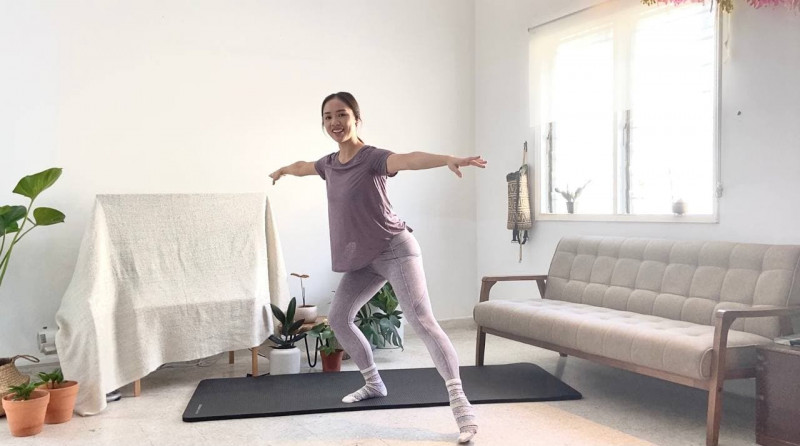
Put the principle of flow into practice in this week’s Pilates Workout: Single Leg Skaters. Remember, it should be challenging. If it isn’t, add weight or increase the repetitions.
Ready to flow with Jo? Let’s go. ─ The Vibes, 17 February, 2021