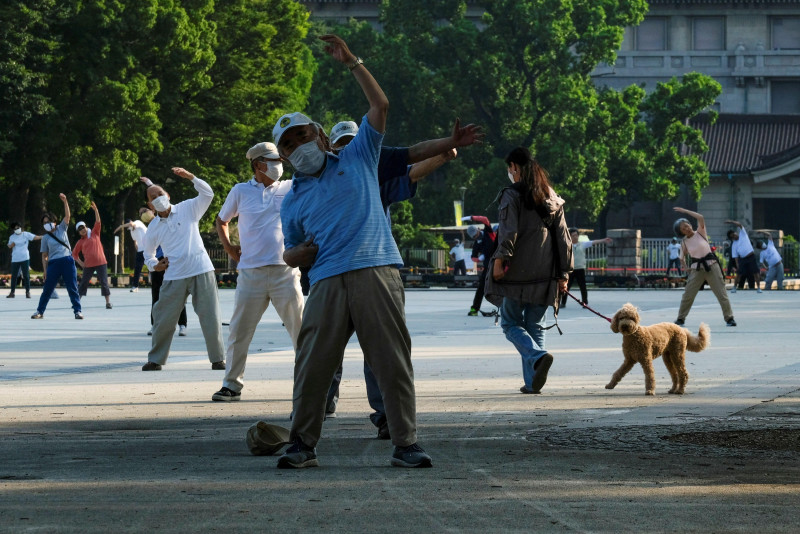
TOKYO - It might not make the cut for Olympians at Tokyo 2020, but each day in Japan's parks, schools and offices millions perform the country's most popular stretching routine: radio taiso.
The three-minute drills, usually done to piano music with encouraging shouts of "one, two, three, four!" in Japanese, are broadcast several times a day on public radio and television.
And while workout videos and podcasts soared in popularity worldwide during virus lockdowns, Japan's taiso tradition dates back nearly 100 years - even surviving a post-war ban by the Americans, who deemed the group activity too militaristic.
Radio taiso's 13 bending, reaching and twisting moves are familiar to almost everyone in the country, which is preparing to host the postponed Tokyo Olympics this summer under strict anti-virus rules.
"First, lift your arms and stretch your body... next, rotate your arms," the presenter says as the old-fashioned music plays.
"Now forward bend softly, with rhythmic bounces three times. And then bend backwards."
The phenomenon began in the 1920s, when Japan's state-run life insurance firm took inspiration from fitness programmes on American radio sponsored by a US insurance company, and lobbied for an easy-to-follow routine to be promoted in Japan.
The first taiso - meaning exercise - programme was broadcast on national radio in 1928.
It became embedded in the national psyche as a popular summer holiday activity, with children competing to attend the most early-morning stretching sessions.
Now, around 27 million people do radio taiso at least twice a week in Japan, often in groups, according to the government.
They include school children, construction workers and corporate employees - some of whom have kept the tradition going even as they switched to remote working during the pandemic.
Himori Reiko, a senior cabin crew member at Japan Airlines, used to do the drills with team members just once a year for fun before coronavirus.
But since December, she and colleagues have done the stretches together regularly on Zoom.
At 3pm sharp, the team - some dressed smartly in the office, others logged on at home - begin to sweep their arms above their heads in unison.
"As remote working increased, some people felt lonely. By doing radio taiso, we can see each other face-to-face at least once a day," she told AFP.
'Properly stretched'
The routine is also enormously popular with older people, in a country that boasts a famously healthy population of retirees.
Older people often gather in parks and at shrines for the first radio taiso broadcast of the day at 6:30am.
"Our daily lives have become more difficult during the coronavirus. But we need to move our bodies more than ever," Mitsutoshi Watanabe, who leads a group of around 250 people every morning in Tokyo's Ueno Park, told AFP at a recent socially distanced practice.
"The number of participants has actually increased since last year," the 79-year-old, dressed in gleaming white sports clothes and gloves, added. Most are retirees, but younger people are joining in as telework increases.
When the group has made its way through the two classic radio taiso routines - one gentle, the other more vigorous - it quickly scatters.
"We look around to see who is attending, checking each other's health... When someone doesn't show up, we wonder if that person is alright," Kenny Takahashi, 55, who runs a jewellery business, told AFP after the session.
He and his wife Hisako, 52, discovered the group while walking to work and now attend every day, rain or shine.
"Your body is properly stretched from the morning. And my joints can now move smoothly," Hisako said.
Japan has the world's oldest population, according to the World Bank, and Watanabe recommends radio taiso as a way to stay fit as a fiddle - if not quite up to Olympic standards.
"I will be 80 years old next year. And I am healthy because of radio taiso," he beamed. - AFP. July 2, 2021