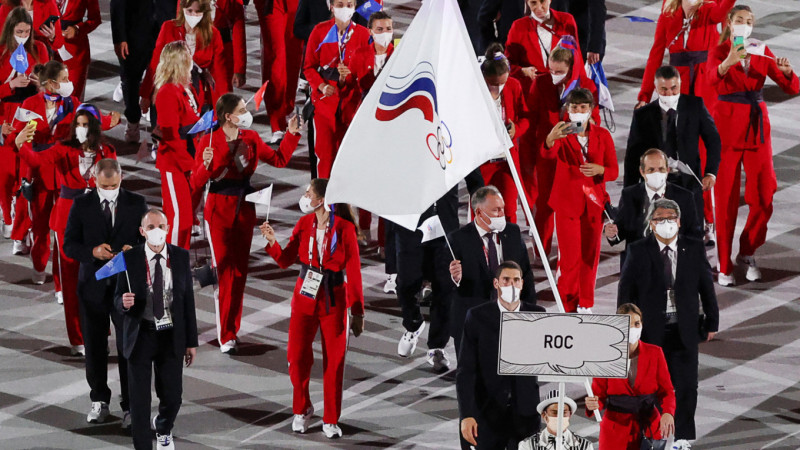
Tokyo - IT is rather strange not seeing Russia at the Tokyo 2020 Olympic Games. But this is the result from the aftermath of the doping scandal that saw a ban on Russian athletes from competing in international events being imposed.
That being the case it was strange to see Russian athletes finding their way to Tokyo under a different banner – Russian Olympic Committee (ROC). A request to the International Olympic Committee (IOC) for their athletes to still take part but under that banner has apparently been approved as technically it does not include the word “Russia” which is currently under a ban.
This way, they also got the chance to use the symbols of the ROC, whose colours refer to the banned Russian national flag. And instead of the national Russian anthem (which was also banned), the IOC permitted a fragment of Pyotr Tchaikovsky's Piano Concerto No. 1 to be played instead.
In fact, the ROC has its own long history and deserves to act separately.
It was founded in 1911 and celebrated its 100th anniversary in 2011.
Athletes of the Russian Empire did not take part in the first three Games of the revived Olympics. Eight Russian athletes participated in the 1908 London Olympics and even won several medals. While, in 1912, the newly founded Russian Olympic Committee sent 178 athletes to the 5th Olympic Games in Stockholm, who participated in all disciplines but unfortunately did not win any gold medals.
The next Olympic Games after their cancellation during World War I were held in 1920. Russia had already faced the Revolution by that moment, but the IOC did not recognise the new Soviet authorities. So, no invitation was given to participate.
While it was already the Soviet Union it ignored invitations to take part. Instead, Soviet athletes participated in alternative competitions arranged internationally.
The Soviet Union also skipped the first Games after World War II, the 1948 Olympiad in London, as the country had to recover after the war. At the same time, the Soviet state was also pushing sports and healthy lifestyles to the masses and had strong athletes, so, soon, the Soviets took a course to integrate in international sports.
In 1951, the Soviet Olympic Committee was founded and immediately recognised by the IOC. Soviet athletes took part in the 1952 Games in Helsinki where they won 22 gold medals and were level with the United States at the top of the standings.
In 1980, the Soviet Union hosted the Summer Olympics in Moscow, which the US boycotted and, in response, they did not take part in the 1984 Games in Los Angeles - the only Olympiad the Soviets skipped after the Committee was founded.
In 1989, even before the disintegration of the Soviet country, Russia founded its own committee and after the collapse, in 1992, the IOC recognised the Russian Olympic Committee as the successor.
In 2014, Russia held its first Olympics in modern history and it was a tremendous success.
In 2017, Russia faced a huge doping scandal, suspected of having a state-sponsored doping program and ignoring international Olympic rules. The Russian membership in the IOC was suspended, but restored in 2018, as almost all the athletes had passed the latest drug tests.
In 2019, Russia faced another scandal and the World Anti-Doping Agency (WADA) sentenced Russia to a four year long ban from international sports, including the Olympics. Later, in 2020, the Court of Arbitration for Sport allowed Russian athletes to take part in competitions, but on condition they do not perform under the Russian name, flag, or use the national anthem for the remainder of the ban and perform as “neutral athletes”.
So, this is the reason spectators around the world will still see Russian athletes in action and the Tokyo 2020 Olympics is no exception. Thus, the mysterious ‘ROC’ name. - Agencies July 24, 2021