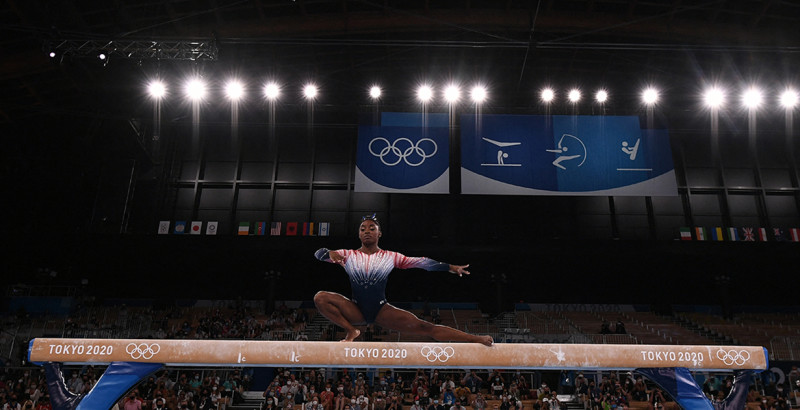
IF you caught the gymnastics event at the recent Tokyo Olympics, you would have seen the wolf turn. It's basically a spin on one foot while your other leg is stretched out in a squatting position. Don’t be fooled by its apparent simplicity. Try it for yourself if you find it hard to believe.
It's not only a super complicated gymnastics element, but understanding the physics clearly helps. Let's start with the centre of mass. On Earth, the centre of mass and the centre of gravity are basically in the same location for any object.
Luckily, it turns out that you can assume that the gravitational force acts at just one single point in the body— that point is the centre of mass.
Now let's see what this has to do with the wolf turn. It starts with a simple experiment that you can do at home. Stand up on your left foot. Now, take your other leg and stick it out to the right. In order to prevent yourself from falling over, the rest of your body has to lean a little bit to the left.
If you don't want to fall over, your centre of mass has to be over your contact point with the floor. With two feet on the ground, you essentially have a much larger contact area (the distance between your feet), so it's much easier to stay upright. If you’re on only one leg, it’s harder. And this is what a gymnast does with the wolf turn. She has to centre her mass over her foot or she will fall over.
The centre of mass is right in the centre over the contact point such that it remains "balanced". But what if you want to do a wolf turn? In that case, you would have a smaller mass sticking out farther and a heavier mass closer to the pivot point, or the balancing foot. It seems clear that it should work — humans do this all the time to stay upright.
If the wolf turn was just about balancing on one foot, it probably wouldn't be in an Olympic-level beam routine. It's the spin that really makes this thing difficult.
Another real-life situation that would clear this up would be balancing the wheels on your car. Even if the centre of mass for a car wheel is right on the axis of rotation (its actual axle, in this case), the wheel can still try to wobble while spinning. The solution is to add some extra small masses to the rim of the wheel until its axis of rotation is in the same direction as the axle.
But what about the wolf turn? How does a gymnast keep rotating about a vertical axis? A person has the ability to change the location of different body parts, like their arms. During the turn, the gymnast has to remain balanced on the beam and dynamically adjust her body to keep her axis of rotation vertical. It's obviously not easy, but that's what makes it an Olympic move. – Agencies, August 17, 2021