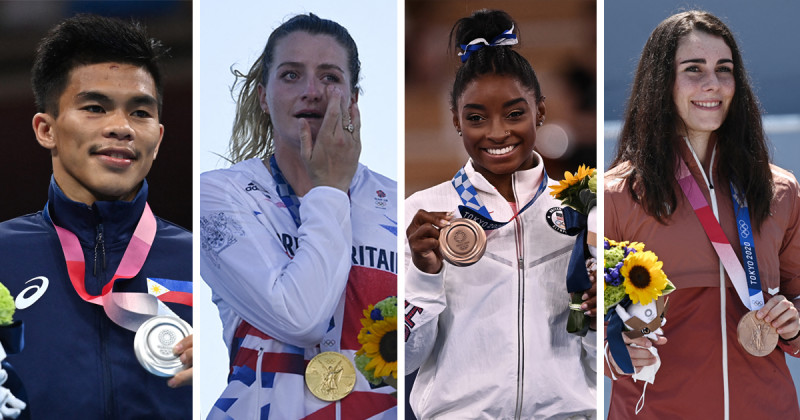
WHEN Carlo Paalam became the first man representing the Philippines to claim an Olympic medal in any sport for 25 years, it was a momentous occasion for the champ, who had just won silver in the men’s flyweight event. Yet, all the athlete could think about when he looked at the medal was his early poverty-stricken upbringing.
“The silver medal symbolises what I went through because when I was a young boy, I was a scavenger and I collected junk and garbage,” Paalam commented after the fight.
“I know this medal is made out of recycled materials, and I can identify with it because it is also made from waste material and garbage.”
Paalam’s personal account is one that draws attention to sustainability, an important focus for organisers of Tokyo 2020.
Podiums were made out of recycled plastic, the Olympic torch used recycled aluminium and the notorious cardboard beds in the athletes’ village owed their existence to sustainability and sturdiness.
In fact, the 5,000 Olympic medals at the Tokyo Olymoics were made from gold, silver and bronze elements extracted from mobile phones. The Tokyo 2020 Medal Project, which collected 78,985 tons of electronic devices, including 6.21 million mobile phones from across Japan, gave the Japanese a sense of doing something good together.
The most successful female Olympic sailor ever, Hannah Mills may have added Tokyo gold to her haul of medals but her advocacy of ocean health is just as important to her.
Mills co-created the Big Plastic Pledge, with the aim of acting and uniting the sporting world to help tackle single-use plastic, an initiative backed by the International Olympic Committee (IOC).
She also joined a Tokyo 2020 initiative, Challenge 6000, which encouraged the sailing community and beyond to remove 6,000 pieces of litter from the sea between the opening and closing ceremony of the Games.
Mental health awareness was brought to the fore when artistic gymnast Simone lost her aerial awareness on the first piece of apparatus, the vault.
The phenomenon, known in sport circles as the ‘twisties’, means a gymnast or diver or trampolinist, loses their aerial awareness during complicated twisting somersaults, something the athlete has trained a thousand times before but now the mind suddenly goes blank in mid-air.
Biles immediately relayed to her teammates that she couldn’t continue safely but would do everything she could to help them, including cheering them on, fetching them chalk or a drink, whatever they needed.
More importantly, the athlete, who was arguably the face of the Games, made it okay to say she was not okay.
Swiss-American BMX freestyle bronze medallist, Nikita Ducarroz, has also used her platform to talk openly about her mental health challenges, which include crippling anxiety.
As a teen, Ducarroz was unable to leave the house at one point and the 25-year-old still has episodes to this day. Talking about it, she says, helps her, so she figures it could help others too.
To this end she co-started an Instagram Project called m1ndtricks with her friend Patrick Kelly, in an effort to fix the lack of conversation around mental health in the action sports world.
In a world that has undergone separation due to the pandemic, we are reminded by the courageous acts of a few Olympic athletes that we are stronger together. – Agencies, August 17, 2021