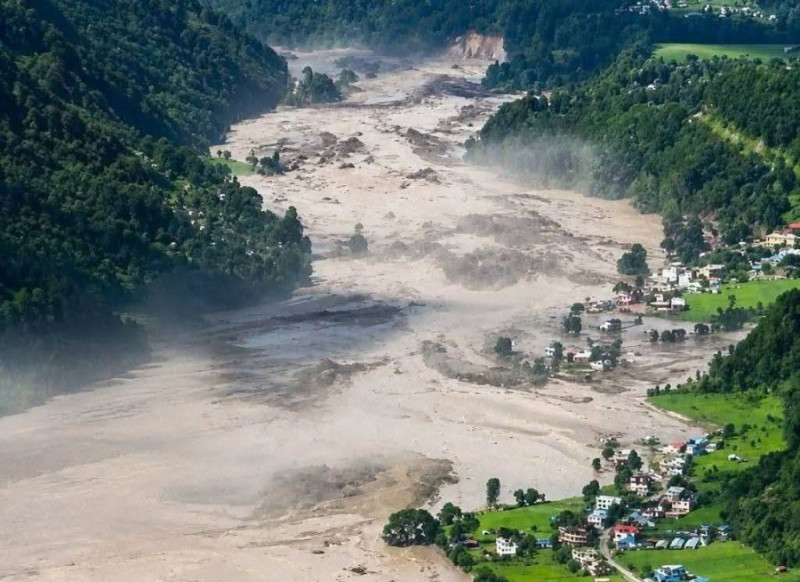
CLIMATE change is highly likely to have contributed to the catastrophic collapse of glaciers and rock in the Himalayas that triggered devastating floods across parts of Nepal and Tibet in late August, scientists said on Thursday.
The disaster killed about 1,400 people and left thousands still missing, according to previous reports.
Researchers from the World Weather Attribution (WWA) group said rapidly rising temperatures had thinned glaciers and melted permafrost deep within the Himalayan bedrock, creating conditions that made the collapse more likely.
While the precise role of climate change in the collapse of about 2 sq km of rock wall and glacier ice on Langtang Lirung mountain was difficult to determine, researchers said extreme warmth had created important preconditions for the disaster.
“There’s absolutely no doubt that human induced climate change played a role here in the preconditioning of the disaster through permafrost thawing, through thinning of the glaciers, through having more rainfall instead of snow,” said Friederike Otto, a climatologist at Imperial College London.
The study found mean temperatures across the Himalayan region were about 5 degrees Celsius above normal in August, with climate change accounting for about 1.5 C of the increase.
Unusually heavy snowfall in October and November last year also increased the amount of meltwater released as temperatures rose, potentially helping to trigger the collapse, the researchers said.
Glaciers in the region have been thinning by about half a metre a year since 2000, altering stresses on the surrounding rock, while thawing permafrost is also likely to have weakened the rock wall, according to the study.
The slope may also have been weakened by a magnitude 7.8 earthquake that struck the same mountain in 2015, although the precise impact of the earthquake remains unclear.
“We conclude that this was a geologically vulnerable slope, potentially weakened by the 2015 earthquake, but it was destabilised further by glacier and permafrost retreat and by the excessive meltwater and exceptional warmth in the final period before the collapse,” said Walter Immerzeel, a mountain hydrologist at Utrecht University.
WWA uses peer-reviewed methods to assess the contribution of global warming to extreme weather events, according to the group’s website. - September 17, 2026