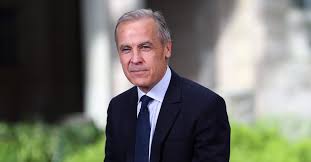
HE was born near the Arctic, led the central banks of two major economies, and is about to become Canada's next prime minister despite never having served in parliament.
Mark Carney's path to the top job in Canadian politics has been unusual but, as he said when he launched his campaign to replace Prime Minister Justin Trudeau, so are the circumstances.
"Our times are anything but ordinary," Carney told supporters in the Western city of Edmonton in January.
AFP reported today that Carney has called the threats posed by President Donald Trump "the most serious crisis of our lifetime" and said Sunday (Mar 9) that the United States wants "our resources, our water, our land, our country".
He says his experience leading the Bank of Canada through the 2008 to 2009 financial crisis and then heading the Bank of England after the Brexit vote there has equipped him for the moment.
Carney won 85.9 per cent of the ballots cast in the Liberal Party leadership vote and will become prime minister over the coming days.
Unique Background
Carney may not be prime minister for long, with a general election due soon that the opposition Conservatives are slight favorites to win, according to polls.
No matter how long he serves, his tenure will be unique.
Carney will be the first Canadian prime minister with no political experience. He has never held an elected public office or served in a government Cabinet.
He was born in Fort Smith, a small town in the Northwest Territories, where his parents were teachers, but he was raised in Edmonton, Alberta's capital.
Like many Canadians, he played hockey in his youth. He studied at Harvard in the United States and Oxford in England, and the initial part of his career saw him make a fortune as an investment banker at Goldman Sachs, working in New York, London, Tokyo and Toronto.
Carney then joined the Canadian civil service, eventually being appointed governor of the Bank of Canada by former Conservative prime minister Stephen Harper in 2008.
In 2013, the government of then-British prime minister David Cameron tapped him to lead the Bank of England, making Carney the first non-Briton to lead the bank in its more than 300-year history.
Boring" But "Reassuring"
Daniel Beland, director of the Institute for the Study of Canada at McGill University, described Carney as a "technocrat".
"He's a boring guy who in general doesn't have a lot of charisma," Beland said.
But he noted that with Canada rattled by Trump's trade chaos and attacks on its sovereignty, rigorous competence with no flash may be appealing.
Carney presents "the image of a reassuring guy who knows what he is talking about", Beland said.
Lori Turnbull of Dalhousie University cautioned that Carney's potential struggles to connect with the public could prove a liability.
"He's not a particularly great communicator when it comes to the public," she said.
"He is unusually well-equipped to deal with economic crises" but "it's very hard to see how anybody would be successful in politics if you can't bring people on board with you", she told AFP.
The Conservatives are running attack ads branding Carney as "sneaky" - an early look at how they might plan to wage the campaign against him.
Carney is personally wealthy, spent significant parts of his career outside of Canada, worked for US-based Goldman Sachs and was chairman at one of Canada's largest corporations, Brookfield.
"The Conservatives are trying to cast him as an elite who doesn't understand what regular people go through. And I think if he can't communicate well, then he runs the risk of being typecast in that way," Turnbull said.
Climate change, and Carney's plans to address it, are also certain to play a key role in the campaign.
"Carbon Tax Carney" has emerged as a favorite Tory attack line, seeking to tie Carney to a deeply unpopular Trudeau policy that saw some homes face a marginal tax to offset emissions.
Climate has been central to the latter part of Carney's career, but he says his focus is on investment-led solutions, like green technology, that create profit and jobs.
"Very much we are emphasizing the commercial aspect of it, the competitiveness aspect," he said recently in an interview with The Rest Is Politics podcast.
"This is where the world is going." – March 10, 2025