LAST week, a pack of rice crackers at Sun Vin Grocery store on Mulberry Street in New York City’s Chinatown cost US$4.99.
But this week, after President Donald Trump’s tariffs on items imported from China took effect, the same crackers have a new price, US$6.99.
Reuters reported today, Chinatowns across the U.S. are feeling the effects of the escalating tariff war, as prices of household goods imported from China, including traditional Chinese medicine, dried noodles and jade jewelry have already started to rise.
While Trump paused his tariffs on most of the world for 90 days, his tit-for-tat trade war with China has resulted in a steep 145% tariff on Chinese goods, and that’s hitting mostly family-owned small businesses in Chinatown hard. Many immigrant Chinese communities rely on businesses in local Chinatowns across the country for goods that are central to Chinese culture, for which there are few, if any, alternatives.
“It will impact a lot,” said Jasmine Bai, the manager of Sun Vin Grocery, a small store stocked mostly with products imported from China, including ingredients that are rarely found in American grocery stores, like bean thread noodles and lotus seed paste. “In the future, maybe we have less clients and they will buy less food.”
Chinatown residents in Lower Manhattan spend $1.15 billion each year on retail goods and services, and about 80% of local businesses in the neighborhood directly serve the Chinese community, according to New York City’s Small Business Services.
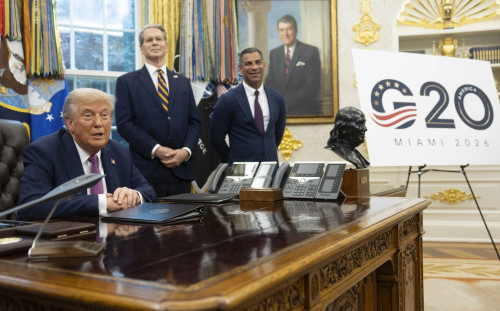
Trump has said that he believes the United States could make a deal with China, but maintains that Beijing has "really taken advantage" of the U.S. for a long time.
"Every Nation, including China, wants to meet!” Trump said in a post on Truth Social on Thursday, although Beijing officials have not yet indicated that they are planning to meet with the White House. China has retaliated with tariffs of up to 125% on U.S. imports.
On Thursday, China's commerce ministry urged the U.S. to stop putting "extreme pressure" on the country and said the two sides remained at an impasse over who should start trade talks.
That back-and-forth has injected a sense of chaos into Chinatown businesses, said Eva Sam, the owner of Popular Jewelry in New York City, a family business known for chains and pendants with ornate gemstones popular with hip hop artists.
"The sudden changes and escalating tariffs make it nearly impossible to stabilize prices or offer consistent quotes to our clients," she said.
Popular Jewelry sources its 24-karat gold as well as cut and polished jade stones from China. The store has already had to raise prices by 10% on imported jewelry, Sam said.
"It's very hard to make long-term and short-term decisions, because you don't know if the tariffs are going to be permanent or where he's going to put the tariffs, or if he's going to take them off," said William Wong, Sam's son who also works at Popular Jewelry.
Most Chinatown stores in New York City only have one or two months of supplies stockpiled, according to Welcome to Chinatown, a local nonprofit aimed at supporting businesses in the neighborhood.
That includes Villy KX Pharmacy, which doesn’t “keep a lot of stuff” on hand, said Daniel Dellaratta, a pharmacist who has been working in Chinatown for 30 years.
“We are expecting, within the next 90 days, to see significant increases on most of the generic products,” he said.
Eliz Digital Inc, a photo shop in New York City’s Chinatown, has also seen the prices of supplies, like paper and chemicals sourced in China and used for developing photographs, increase.
Although the store has not raised prices “for a long, long time,” the tariffs could force their hand, said the store’s owner, who asked only to be referred to by her last name, Kesh.
“I think eventually we might have to do something, because, as you see, everything has gone up a lot, and our supply has definitely gone up so much,” she said.
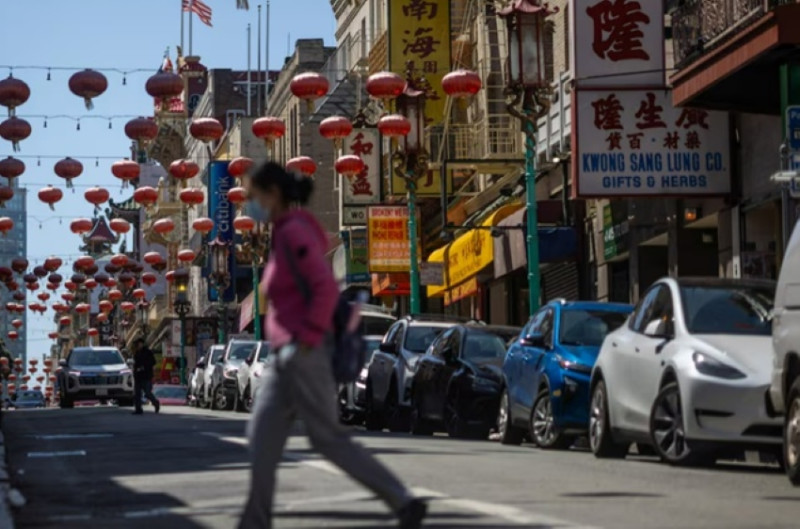
San Francisco’s Chinatown is also experiencing uncertainty among its businesses as owners hope for productive negotiations between the U.S. and China, said Edward Siu, chairman of the Chinatown Merchants United Association of San Francisco.
“A lot of people don’t know what will be next. They are so worried and frustrated right now,” said Siu, who has been operating a travel agency in the neighborhood for 40 years.
The neighborhood, which spans 30 densely populated blocks, constitutes the oldest Chinese American community in the United States, according to the city's planning department.
It’s a tight-knit network of residents and businesses has weathered multiple crises since the COVID-19 pandemic, including supply chain issues and slow economic recovery in the city.
Selena Lee, who owns Linda Boutique, a jade jewelry store on Chinatown's iconic Grant Avenue, said the prices on her latest delivery tripled as the tariffs took effect. While the raw jade material in her jewelry is from Myanmar, the finished products are imported from China.
“If we change, we have to change the whole format of the business, which is not easy,” she said.
Mei Zhu, who runs a small grocery store on Stockton Street, is also concerned about running short on inventory as customers have tried to stock up on products in anticipation of higher prices.
“There’s nothing left to sell,” Zhu said, pointing to an empty cardboard box labeled “salt,” explaining that many customers have bought as many as ten cans at once, even though her store does not import salt from China.
Siu urged the American and Chinese governments to consider the people affected by their policies, such as him and other Chinese American business owners.
“Right now, we’re in the danger zone,” he said. “I don’t want the trade war to be a war.”
Reporting by Hannah Lang in New York and Judith Langowski in San Francisco; additional reporting by Bing Guan in New York. Editing by Michael Learmonth. – April 19, 2025