U.S. PRESIDENT Donald Trump threatened on Friday to ratchet up his trade war again, pushing for a 50% tariff on European Union goods starting June 1 and warning Apple he may slap a 25% levy on all imported iPhones bought by U.S. consumers.
Reuters reported the twin threats, delivered via social media, roiled global markets after weeks of de-escalation had provided some reprieve in the tariff battle. Major U.S. stock indexes and European shares fell and the dollar weakened, while the price of gold, a safe-haven for investors, rose. U.S. Treasury yields fell on fears about tariffs' effect on economic growth.
Trump's broadside against the EU was prompted by the White House's belief that negotiations with the bloc are not progressing fast enough. His saber-rattling also marked a return to Washington's stop-and-start trade war that has shaken markets, businesses and consumers and raised fears of a global economic downturn.
And the president's attack on Apple is his latest attempt to pressure a specific company to move production to the United States, following automakers, pharmaceutical companies and chipmakers. The United States, however, does not mass-produce smartphones - even as U.S. consumers buy more than 60 million phones annually - and moving production would likely increase the cost of iPhones by hundreds of dollars.
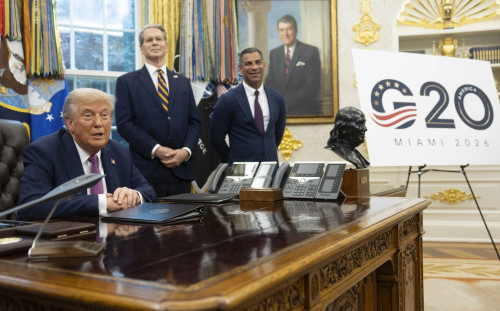
Later on Friday, Trump told reporters inside the Oval Office that his proposed tariff on Apple would also apply to "Samsung and anybody that makes that product," apparently referring to smartphones. He said he expected the new phone levy to be in place by the end of June.
Trump reiterated his complaint that the European Union treated the U.S. badly and restricted the U.S. from selling cars into the EU. "And I just said, 'It's time that we play the game the way I know how to play the game.'"
"I'm not looking for a deal," Trump said when asked whether he expected a deal before June 1. "We've set the deal – it's at 50%. But again, there's no tariff if they build their plant here."
EU trade Chief Maros Sefcovic said the European Commission, the EU's executive arm, was fully committed to securing a deal that worked for both sides, following a Friday phone call with U.S. counterpart Jamieson Greer and U.S. Commerce Secretary Howard Lutnick. He added that EU-U.S. trade "must be guided by mutual respect, not threats."
Speaking to reporters in The Hague, Dutch Prime Minister Dick Schoof backed the EU's strategy in trade talks and said the EU was likely to see this latest announcement as part of the negotiations.
"We have seen before that tariffs can go up and down in talks with the U.S.," he said.
The White House paused most of the punishing tariffs Trump announced in early April against nearly every country in the world after investors furiously sold off U.S. assets including government bonds and the U.S. dollar. Trump left in place a 10% baseline tax on most imports, and later reduced his massive 145% tax on Chinese goods to 30%.
A 50% levy on EU imports could raise consumer prices on everything from German cars to Italian olive oil.
The EU's total exports to the United States last year totaled about 500 billion euros ($566 billion), led by Germany (161 billion euros), Ireland (72 billion euros) and Italy (65 billion euros). Pharmaceuticals, cars and auto parts, chemicals and aircraft were among the largest exports, according to EU data.
Disputes Over Tariffs
The White House has been in trade negotiations with numerous countries, but progress has been unsteady. Finance leaders from the Group of Seven industrialized democracies tried to downplay disputes over the tariffs earlier in the week at a forum in the Canadian Rocky Mountains.
"The EU is one of Trump's least favorite regions, and he does not seem to have good relations with its leaders, which increases the chance of a prolonged trade war between the two," said Kathleen Brooks, research director at XTB.
Talks with Japan appeared less fraught.
After meeting separately with Lutnick and Greer on Friday, Japan's top trade negotiator, Ryosei Akazawa, said the two sides discussed expanding trade, non-tariff barriers and economic security issues. He described their talks as franker and more in-depth than before.
Speaking to reporters, Akazawa said that while it would be great if an agreement could be reached when Trump and Japanese Prime Minister Shigeru Ishiba meet at the Group of Seven summit next month in Canada, he would not rush just to secure a deal.
"Our country has national interests that must be protected, so it is not sufficient simply to forge an agreement quickly," Akazawa said. "As a negotiator, I can tell you that in negotiations the party stuck to a deadline usually loses."
U.S. Treasury Secretary Scott Bessent would not comment on other potential trade deals, but said on Fox News that there would be more announced as the end of the 90-day pause on reciprocal tariffs approaches in July.
Apple declined to comment on Trump's threat, which would reverse exclusions he granted on smartphones and other electronics imported largely from China in a break for Big Tech firms that sell consumer goods. Apple shares fell 3% after Trump said in an early Truth Social post that he told company CEO Tim Cook "long ago" that "I expect their iPhones that will be sold in the United States of America will be manufactured and built in the United States, not India, or anyplace else."
Cook and Trump met on Tuesday, according to a source familiar with the situation.
Apple is speeding up plans to make most iPhones sold in the United States at factories in India by the end of 2026 to navigate potentially higher tariffs in China.
But the odds on moving production to the U.S. are slimmer. In February, Apple said it will spend $500 billion over four years in nine American states, but that investment was not intended to bring iPhone manufacturing to the U.S.
"It is hard to imagine that Apple can be fully compliant with this request from the president in the next 3-5 years," D.A. Davidson & Co analyst Gil Luria said. - May 24, 2025