U.S. President Donald Trump has reignited trade tensions with China, announcing a fresh round of sweeping tariffs and export controls, in a move that threatens to unravel a fragile economic truce between the world’s two largest economies.
Reuters reported on Saturday that Trump declared that from 1 November, all US-bound exports from China would face a 100% tariff. In parallel, the US will impose new restrictions on the export of “any and all critical software”, a move likely to severely disrupt China’s technology sector, particularly in areas such as cloud computing and artificial intelligence.
The measures come in response to Beijing’s decision to tighten its grip on rare earth exports—materials vital to industries ranging from defence to renewable energy.
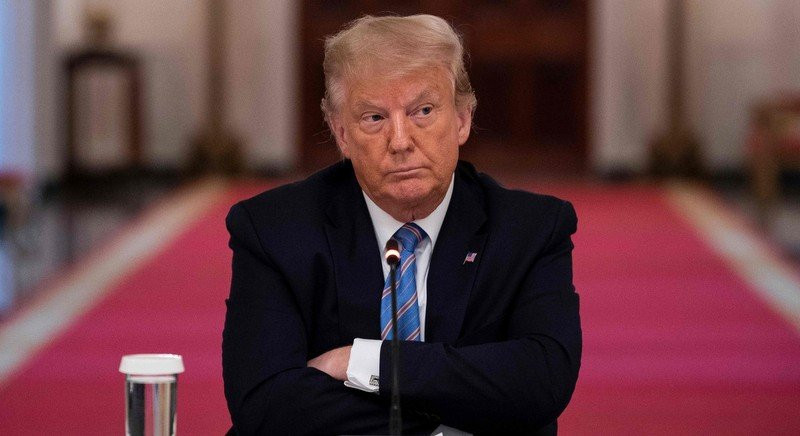
Speaking from Washington, Trump called China’s decision “shocking” and a “hostile order”, accusing Beijing of overreaching and undermining global supply chains.
“It was shocking,” Trump told reporters at the White House. “I thought it was very, very bad.” He later added, “For every element they have been able to monopolise, we have two.”
Markets reacted sharply. The S&P 500 posted its steepest decline since April, dropping over 2%, as investors digested the sudden escalation. Tech stocks were particularly hard hit in after-hours trading, while gold and US Treasury bonds surged as investors fled to safer assets. The US dollar weakened against a basket of global currencies.
Trump also cast doubt on a planned meeting with Chinese President Xi Jinping, previously scheduled to take place on the sidelines of the Asia-Pacific Economic Cooperation (APEC) summit in South Korea at the end of October.
“Now there seems to be no reason to do so,” Trump posted on Truth Social, while telling reporters later, “I haven’t cancelled. I would assume we might have it.” Beijing has yet to confirm the summit.
The president claimed he had received calls from unnamed governments “incensed” by Beijing’s rare earth restrictions and hinted that further US countermeasures may be in the pipeline. Aircraft exports and components are among the sectors under consideration, according to a source familiar with the administration’s discussions.
Trump’s unilateral measures signal the most serious breakdown in bilateral trade relations in over six months. Many observers now question whether the fragile detente forged earlier this year—after months of delicate diplomacy—can withstand this new round of economic hostilities.
Craig Singleton, a China policy expert at the Foundation for Defense of Democracies, warned that “Trump’s post could mark the beginning of the end of the tariff truce,” adding that Washington viewed China’s export controls as a betrayal. “Beijing appears to have overplayed its hand.”
On Thursday, the Trump administration had already floated a proposal to ban Chinese airlines from flying over Russian airspace on routes to and from the US. The Federal Communications Commission also announced that major American online retailers had removed millions of prohibited Chinese electronic listings from their platforms.
Beijing’s latest trade restrictions include five new elements and dozens of pieces of refining technology added to its export control list. Foreign rare earth producers using Chinese materials are also now required to comply with Chinese rules.
Analysts say both governments are ratcheting up pressure ahead of the APEC summit, possibly to strengthen negotiating positions or in anticipation that a deal is unlikely.
“Things are going to get interesting,” said Scott Kennedy, a China expert at the Centre for Strategic and International Studies in Washington. “They both are hoping that amping up pressure will lead the other to make concessions in advance of APEC—or they are now re-escalating assuming a deal is impossible and are gaining leverage for the next round of the fight.” - October11, 2025