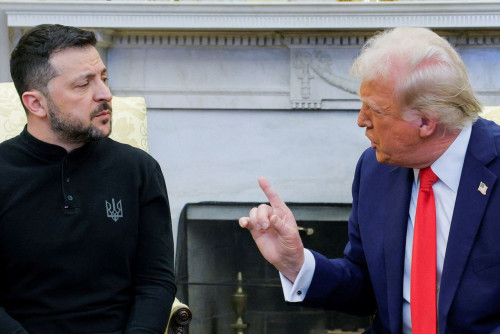
UNITED STATES President Donald Trump has confirmed that he will travel to Malaysia, Japan and South Korea later this week, in what will be his first official visit to Asia since beginning his second term in office in January.
Speaking to reporters at the White House on Monday during a press conference with Australian Prime Minister Anthony Albanese, Trump said he looked forward to engaging regional partners while continuing his push for a "fair" trade deal with China.
“We will make a fair deal. I want to be good to China. I value my relationship with President Xi very highly,” said Trump, who has repeatedly signalled interest in meeting Xi Jinping during the trip, potentially while in South Korea.
“I think we’re going to end up having a fantastic deal with China,” he added. “It’s going to be fantastic for the entire world.”
Despite persistent trade tensions between Washington and Beijing, the US president struck an optimistic tone, saying he believed both sides were prepared to work towards an agreement.
“They have to give us some things too,” Trump said aboard Air Force One on Sunday, referencing US demands including the purchase of American soybeans, curbs on fentanyl precursor exports, and the lifting of restrictions on rare earth minerals crucial to high-tech manufacturing.
The upcoming tour will begin in Malaysia, which is hosting the ASEAN regional summit that includes several Southeast Asian nations and strategic US allies. While Trump did not offer details on his itinerary, government sources in Japan have confirmed that the president will arrive in Tokyo on 27 October for a three-day visit following the summit in Malaysia. He is expected to continue on to South Korea thereafter.
AP cited today that this marks the first time Trump has publicly confirmed his intention to visit Malaysia and Japan, though reports had previously suggested he would attend the Asia-Pacific economic summit expected to be held in Seoul at the end of the month. A formal meeting with Xi has yet to be confirmed by Beijing.
The stakes for the trip are high, with the global economy hanging in the balance amid uncertainty over US-China trade relations. Trump’s use of tariffs as leverage to restructure trade terms has left many Asian economies on edge, particularly those heavily reliant on exports to the US.
“There’s some appreciation for the fact that he’s there, but I don’t think it will go far enough to quell the doubts that are pervasive in the region,” said Bonnie Glaser, Managing Director at the German Marshall Fund in Washington.
White House spokesperson Anna Kelly offered little clarification when asked about the president’s full schedule. “He will participate in meetings and events in Asia that will result in many great deals for our country,” she said. “Stay tuned!”
Trump’s improvisational style has made foreign policy unpredictable, with mixed results since his return to office. Though hostages were released in the Middle East, a stable ceasefire remains elusive, and his efforts to stem Russia’s invasion of Ukraine have yet to yield results.
Despite this, analysts say there is interest from key US allies in Asia to deepen cooperation. “Let’s sit down, talk about relevant details to make a deal,” said Anthony Kim, an international economic affairs fellow at the Heritage Foundation, describing the sentiment in Tokyo and Seoul.
Still, concerns remain over the lack of a coherent Asia strategy and the downsizing of Trump’s foreign policy team. “There’s not very many White House staff to do this kind of work,” said Rush Doshi, a former China policy adviser under President Joe Biden.
Michael Green, who served under President George W. Bush and now heads the United States Studies Centre in Sydney, said regional governments are waiting for clarity. “Everyone is waiting to see where he’s going to come down on all of this,” he noted. - October 21, 2025