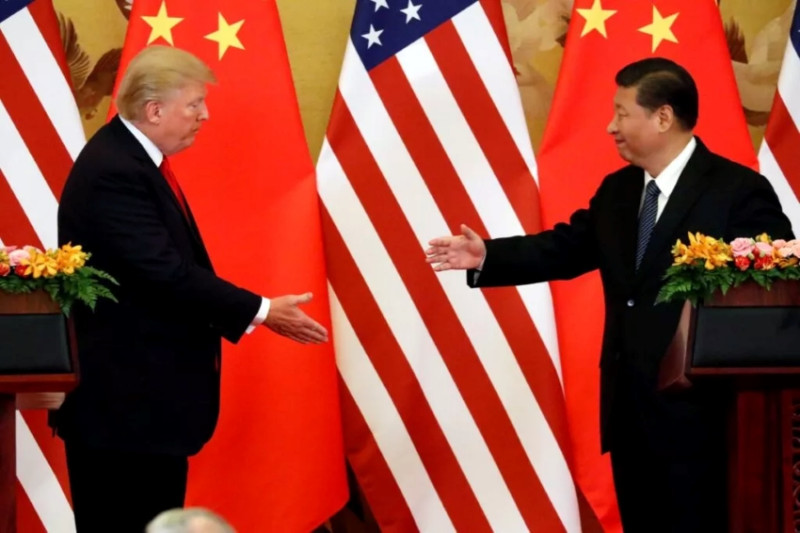
AFTER months of threats and brinkmanship, US President Donald Trump and Chinese leader Xi Jinping have reached a tentative trade truce that partially rolls back the tariffs and restrictions each imposed during the past year’s escalation of hostilities.
AP reported today that the deal, described by Trump as a “roaring success”, lowers import duties on both sides, suspends port fees for one year, and restores Chinese purchases of US soybeans. Yet analysts say the outcome largely returns trade relations to where they were before Trump reignited tensions earlier this year, offering stability rather than substantive progress.
“It is hard to see what major gains the US has made in the bilateral relationship relative to where things stood before Trump took office,” said Eswar Prasad, economist at Cornell University.
Under the agreement, tariffs that once reached as high as 145 per cent during the peak of the trade war will now be reduced to 10 per cent on both sides.
The United States will retain a 20 per cent levy on goods linked to fentanyl production, while China will maintain a 10 to 15 per cent tariff on certain US agricultural imports.
Trump said he had removed one fentanyl-related tariff in exchange for Beijing’s cooperation in combating the illicit drug trade. US Secretary of Agriculture Brooke Rollins confirmed that China would also withdraw its retaliatory duties on American farm products and resume large-scale purchases of soybeans.
“China has agreed to buy 12 million metric tonnes of US beans through January, and at least 25 million metric tonnes annually for the next three years,” Rollins said on Thursday. Beijing has yet to confirm the figures but said the two nations had reached “consensus” to expand agricultural trade.
The truce also temporarily pauses several contentious measures. Beijing will suspend for one year its export permitting regime on rare earth elements — a system it introduced in April and expanded in October — while Washington will halt its affiliate export control rule for the same period.
“The delay by Beijing provides just enough time for the United States to accelerate investment in capabilities and innovation for rare earths and permanent magnets,” said Wade Senti, president of the US company AML. “This needs to be on warp speed and at a scale never seen before since the COVID-19 response.”
Meanwhile, both countries have agreed to suspend newly introduced port fees on vessels linked to one another’s supply chains for 12 months.
Despite the limited breakthroughs, Democratic Senate Minority Leader Chuck Schumer criticised the deal as superficial. “If anything, things are worse: prices have gone up and China has agreed to nothing of substance that will improve trade between our nations,” he said. “Trump started a trade war, created a giant mess for businesses, consumers and soybean farmers, and then he celebrates for trying to clean up the very mess he created.”
Xi, however, struck a conciliatory tone, referring to “recent twists and turns” that “offered some lessons for both sides”. He called for a renewed focus “on the benefits of cooperation rather than falling into a vicious cycle of mutual retaliation.”
Sean Stein, president of the US–China Business Council, said the agreement “is very encouraging” and expressed hope that “future negotiations will address long-standing market access barriers, help level the playing field for US companies, and bring long-term predictability to the bilateral trade relationship.”
Trump is expected to visit China in April, with Xi due to make a reciprocal trip to the United States later in the year.
Yet some observers doubt whether the accord represents meaningful change. “Generally, Trump grows impatient with anything beyond the immediate, and it is the Chinese that play for longer term advantage,” said Kurt Campbell, former deputy secretary of state and chairman of The Asia Group. - October 31, 2025