MALAYSIA aims to develop 2,000 skilled workers certified under China’s professional standards by next year through collaboration between Belia Mahir and the China Global Professional and Technical Certification Centre (CGPTC).
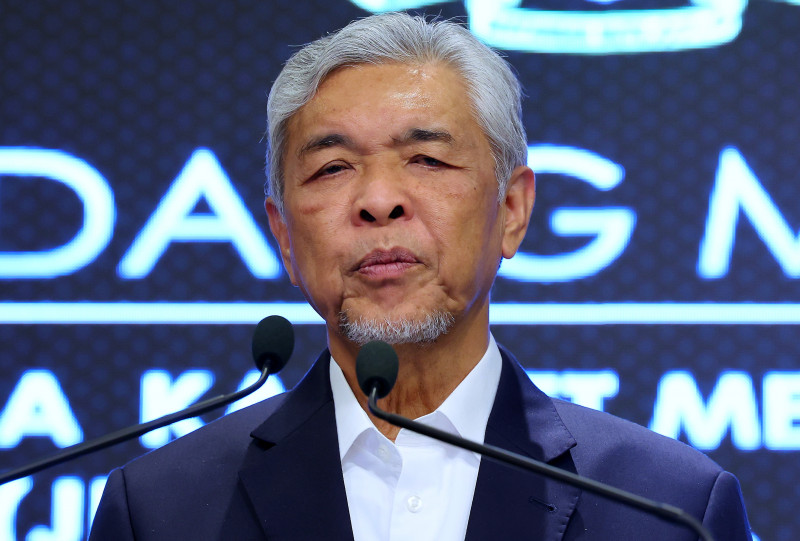
Deputy Prime Minister Datuk Seri Ahmad Zahid Hamidi said the partnership would strengthen Malaysia’s technical and vocational education and training (TVET) ecosystem and provide international recognition for Malaysian trainers and graduates.
“This collaboration allows for dual certification pathways and the accreditation of Malaysian trainers according to globally recognised Chinese industry standards,” Zahid said at the opening of the “2nd Malaysia–China International Industry–TVET Education Cooperation Forum and 4th Malaysia–China Vocational Education Fair” at the Shanghai Technical Institute of Electronics & Information this morning.
CGPTC, an international certification body based in China, recognises the professional and technical qualifications of individuals and institutions worldwide, based on Chinese industry standards acknowledged globally.
Zahid announced that both countries have agreed to establish the Malaysia–China Satellite Training Programme, involving 10 Chinese TVET institutions and three Malaysian institutions – Kolej TVET Belia Mahir, Kolej Kemahiran Pure Technic, and MCITVET.
“The programme also introduces a dual-campus learning concept, where students take theoretical lessons in Malaysia and practical training in China in areas such as Electric Vehicles (EV), Mechatronics, Artificial Intelligence (AI), and E-Commerce,” he said in Shanghai, China today.
He also welcomed an initiative by Tang International Education Group and Chinese industry partners to host the China TVET Exhibition during Malaysia’s National TVET Day 2026, which will serve as a platform for knowledge, technology, and innovation exchange.
Separately, Zahid announced the establishment of the Guangqi Institute in Shanghai, a Malaysia–China joint training hub set to accelerate the development of Malaysian talent, educators, and industry professionals in the semiconductor and electronics sectors.
The institute will train 500 Malaysian participants – including students, educators, and industry workers – under a RM10 million programme lasting between one and six months.
“This programme marks another significant milestone in Malaysia's efforts to become a regional hub for advanced semiconductor and electronics talent development,” Zahid said.
He also highlighted the Siyuan Skill Advancement & Employment Programme (SAEP), which will see 2,500 Malaysian youths undergo training and job placement programmes in China worth RM12.5 million.
The training, lasting one to six months, will focus on transit rail, e-commerce and logistics, and cybersecurity, with opportunities for placements in Chinese companies operating in Malaysia.
At the same event, Zahid launched the Malaysia–China TVET Industry–Education Alliance (MC-IEA), aimed at strengthening institutional and industrial collaboration between the two nations through a “Train–Intern–Job Placement” approach.
The co-funded training equipment under this initiative amounts to RM10 million, involving 15 Chinese TVET institutions. - November 7, 2025