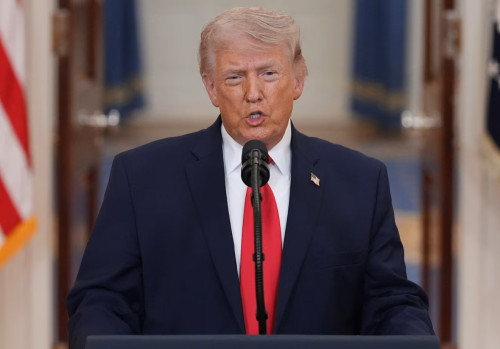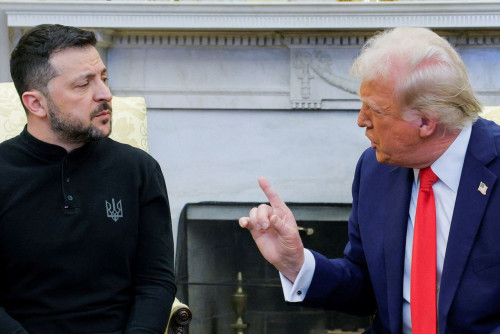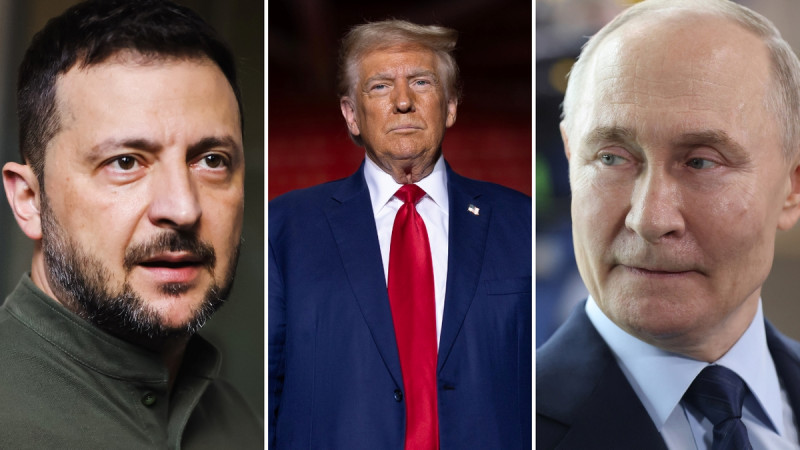
A DRAFT peace plan for ending the war in Ukraine, reportedly crafted under the direction of former U.S. President Donald Trump, has sparked concern among European leaders and Ukrainian officials for its concessions to Russia, including territorial cessions and limits on Kyiv’s military, according to documents obtained by The Associated Press.
AP reported today that the proposal, developed over the past month by Secretary of State Marco Rubio and Trump’s special envoy Steve Witkoff, envisions Russia retaining full control of the eastern Donbas region, even though about 14 per cent remains under Ukrainian control.
Ukraine’s armed forces, currently numbering around 880,000 troops, would be capped at 600,000, while sanctions on Russia could be eased, and Moscow could rejoin the Group of Eight. Russia would also retain half of the energy output from the Zaporizhzhia nuclear plant, seized early in the conflict.
Press Secretary Karoline Leavitt confirmed that the plan has involved input from both Ukrainian and Russian officials, with Witkoff and Kirill Dmitriev, an adviser to Vladimir Putin, playing key roles.
A senior U.S. official noted that Rustem Umerov, a top adviser to President Volodymyr Zelenskyy, agreed to much of the plan after modifications before presenting it to Kyiv.
Trump’s proposal would establish a “Peace Council” under his oversight to enforce compliance. If either side violates the truce, sanctions would be applied.
The plan also envisages US$100 billion in frozen Russian assets being used to rebuild Ukraine.
However, Ukrainian officials have made clear that territorial concessions are non-negotiable.
Deputy U.N. Ambassador Khrystyna Hayovyshyn told the Security Council, “There will never be any recognition, formal or otherwise, of Ukrainian territory temporarily occupied by the Russian Federation as Russian. Our land is not for sale.”
She stressed that Ukraine will not accept restrictions on its right to self-defence or the size and capabilities of its armed forces.
European diplomats have expressed alarm, noting that they and Ukraine must be fully consulted. European Union foreign policy chief Kaja Kallas said, “For any plan to work, it needs Ukrainians and Europeans on board,” adding that the draft appeared heavily tilted toward Moscow. German Foreign Minister Johannes Wadephul also voiced concern, discussing ongoing efforts with Witkoff and Turkish counterparts.
The plan has drawn sharp criticism domestically. U.S. Representative Don Bacon, an Air Force veteran, labelled it “unacceptable” on social media, likening it to the 1938 Munich Agreement, which is widely seen as enabling Nazi aggression.
Trump, who has repeatedly advocated for ending the Ukraine conflict, previously suggested that most of the Donbas region should fall under Russian control.
He said this week, “I thought that was going to be my easy one because I have a good relationship with President Putin. But I’m a little disappointed in President Putin right now.”
While Ukraine signalled willingness to engage constructively, Zelenskyy’s measured statement stressed collaboration on the plan’s provisions without yielding to Russian demands.
The proposal comes amid ongoing debate about the appropriate balance of diplomatic pressure and concessions needed to end nearly four years of war that has devastated Ukraine. - November 21, 2025