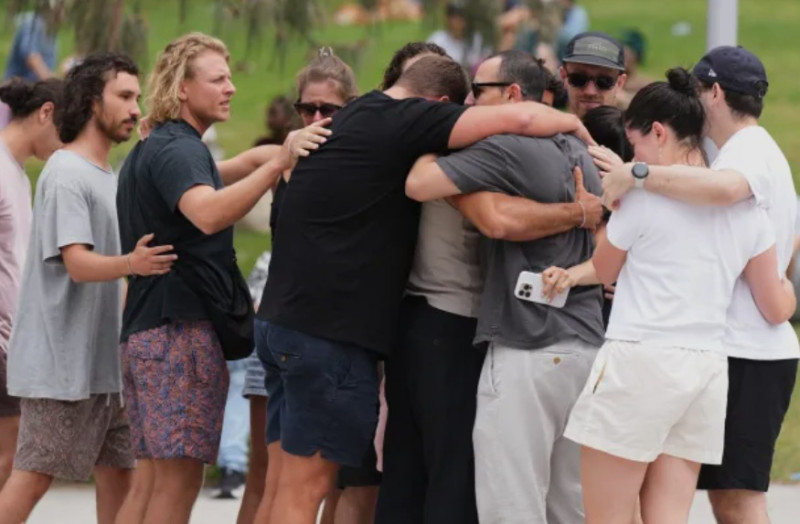
AUSTRALIA braced itself on Wednesday for the funerals of some of the 15 victims of an antisemitic mass shooting at Sydney’s Bondi Beach, as investigators intensified their probe into an attack police say was inspired by the Islamic State group.
AP reported on Wednesday that the victims ranged in age from 10 to 87. Twenty-two people injured in Sunday’s attack remained in hospital across Sydney, six of them in critical condition, authorities said.
Prime Minister Anthony Albanese said on Tuesday that investigators’ assessment of an Islamic State link was based on evidence recovered after the attack, including “the presence of Islamic State flags in the vehicle that has been seized.”
The shooting erupted as members of Australia’s Jewish community gathered at the country’s most famous beach to celebrate Hanukkah. Gunfire shattered the festivities, triggering scenes of panic and acts of extraordinary bravery.
Among those hospitalised is Ahmed al Ahmed, who has been widely hailed as a hero after video footage showed him tackling and disarming one of the attackers, pointing the weapon away from others before placing it on the ground. Three other people who attempted to stop the gunmen were shot dead.
Those killed included Boris and Sofia Gurman, identified on Wednesday as a married couple who were the first to die after confronting one of the shooters as he climbed out of his car.
Police said the suspects were a father and son aged 50 and 24. The father, identified by state officials as Sajid Akram, was shot and killed at the scene. His son, who has not been formally named by authorities, was taken to hospital.
The younger suspect emerged from a coma on Tuesday, New South Wales Police Commissioner Mal Lanyon said. Speaking to 702 ABC Radio Sydney, Lanyon said investigators expected to speak to him and lay charges on Wednesday.
As the nation grappled with grief, anger has grown over how such an attack could occur in a country known for its strict gun laws. Albanese and several state leaders pledged to tighten firearm regulations further, in what would amount to the most sweeping reforms since 35 people were killed in the 1996 Port Arthur massacre in Tasmania.
Mass shootings have been rare in Australia since that overhaul. However, Albanese announced plans to further restrict access to firearms after it emerged that the older suspect had legally amassed six weapons.
Authorities are also examining the suspects’ recent travel history. Indian police said on Tuesday that Sajid Akram was originally from Hyderabad in southern India and held an Indian passport. He married a woman of European origin and migrated to Australia in 1998 in search of work, maintaining little contact with his family in India.
“The family members have expressed no knowledge of his radical mindset or activities, nor of the circumstances that led to his radicalization,” Telangana State Police Chief, B. Shivadhar Reddy said.
Lanyon told reporters that the suspects had travelled to the Philippines last month and that investigators were examining the purpose and locations of that trip. He also confirmed that a vehicle removed from the crime scene, registered to the younger suspect, contained improvised explosive devices.
“I also confirm that it contained two homemade ISIS flags,” Lanyon said.
The Philippines Bureau of Immigration confirmed that Sajid Akram travelled to the country between Nov. 1 and Nov. 28 with Naveed Akram, 24, listing Davao as their final destination. Australian authorities have not confirmed those details or the younger suspect’s name.
Militant groups in the southern Philippines, including Abu Sayyaf, previously pledged allegiance to Islamic State and hosted small numbers of foreign fighters. Philippine military and police officials said decades of offensives had significantly weakened those groups and that there was no recent indication of foreign militants operating in the region.
Amid the trauma, stories of courage and unity continued to emerge. Albanese visited al Ahmed in hospital on Tuesday, where the 44-year-old Syrian-born Muslim shop owner was recovering from shotgun wounds to his left shoulder and upper body and facing further surgery.
“It was a great honor to met Ahmed al Ahmed. He is a true Australian hero,” Albanese told reporters after a 30-minute meeting with him and his parents.
“We are a brave country. Ahmed al Ahmed represents the best of our country. We will not allow this country to be divided. That is what the terrorists seek. We will unite. We will embrace each other, and we’ll get through this,” Albanese added.
Bondi Beach’s blue-shirted lifeguards were also praised for their actions during the chaos. One on-duty lifeguard, identified as Rory Davey, carried out an ocean rescue as people fled fully clothed into the sea. Another, Jackson Doolan, shared an image of himself sprinting barefoot from Tamarama Beach, clutching a first aid kit as the attack unfolded.
“These guys are community members and it’s not about the surf,” Anthony Caroll, a star of the television programme Bondi Rescue, told Sky News. “They heard the gunshots and they left the beach and came right up the back here into the scene of the crime, into harm’s way.”
As mourning continued, Israeli Ambassador to Australia Amir Maimon visited the scene on Tuesday, where he was welcomed by Jewish leaders.
“I’m not sure that my vocabulary is rich enough to express how I feel. My heart is torn apart because the Jewish community, the Australians of Jewish faith, the Jewish community is also my community,” Maimon said.
Thousands of people from across Sydney and beyond have gathered at Bondi to lay flowers and pay their respects at a makeshift memorial. Former prime minister John Howard, who led the landmark 1996 gun law reforms, was among those who visited.
In the days since the attack, Australians have also responded with an outpouring of generosity. A record number of people registered to donate blood, including nearly 1,300 first-time donors. Lifeblood said donation appointments at its Bondi centre were fully booked until Dec. 31, while local media reported queues of up to four hours at some Sydney donation sites.
Australian news outlets reported queues of up to four hours at some Sydney donation sites. - December 17, 2025