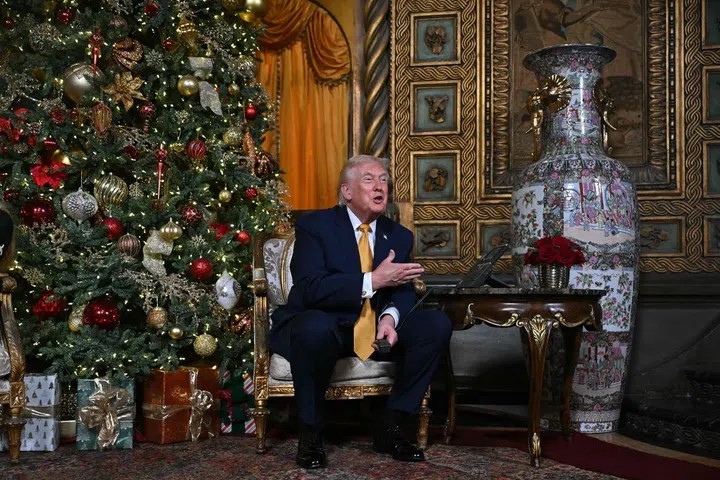
U.S. President Donald Trump spent Christmas projecting force rather than festivity, unveiling U.S, air strikes abroad while issuing combative political warnings at home and encouraging an overtly Christian tone across his administration.
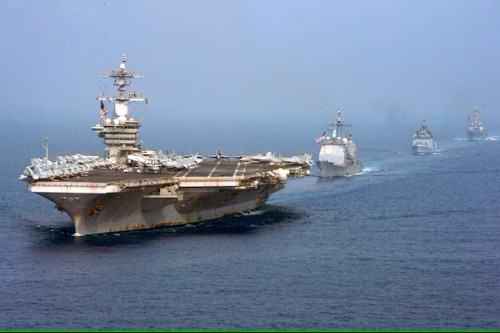
The defining moment of the holiday came with the disclosure of US military action in northern Nigeria.
AFP cited on Saturday Trump saying that the air strikes were carried out on Christmas Day itself and deliberately timed to maximise surprise. Far from presenting the operation as a sombre necessity, he cast it as seasonal symbolism.
Speaking on Dec 26, Trump said the strikes had “decimated” jihadist camps, calling them a “Christmas present”.
In an interview with Politico, he said he had personally delayed the operation until Dec 25 to catch militants off guard, insisting the US had struck “every camp” involved. He said the action was retaliation for what he described as a “slaughter of Christians” in the west African country.
The military announcement capped several days of unusually aggressive holiday messaging. On Dec 23 and Dec 24, Trump filled his Truth Social feed with posts that dispensed with customary seasonal goodwill in favour of boasts, insults and threats aimed at both foreign enemies and domestic rivals.
One Christmas message targeted political opponents directly, branding them “radical leftist scum”.
On Christmas Day, Trump followed with a darker warning: “Enjoy what may be your last Merry Christmas.” The remark appeared to allude to Democrats he believes will be implicated when files linked to sex offender Jeffrey Epstein are fully released.
Later that day, the White House sought to restore a more conventional tone. A formal statement, signed by the president and First Lady Melania Trump, leaned heavily on Christian scripture. It invoked God seven times, celebrated “the birth of our Lord and Savior, Jesus Christ” and prayed for “God’s abiding love, divine mercy, and everlasting peace”.
Trump has long argued that he restored the use of “Merry Christmas” to public life, accusing his predecessor Barack Obama of favouring “Happy Holidays”, despite Obama having frequently said “Merry Christmas”.
Yet in 2025, Trump did not attend any public religious service. The official presidential schedule shows he spent Christmas Day at his Mar-a-Lago estate in Florida without going to church.
Elsewhere in government, however, Christmas was marked by overt religious language. The Department of Homeland Security urged Americans to “remember the miracle of Christ’s birth”, while Secretary of State Marco Rubio posted a nativity scene and wrote of “the hope of Eternal Life through Christ”.
The Pentagon also stepped into new territory, hosting its first-ever Christmas Mass on Dec 17.
Religious rhetoric has long been embedded in American political life, even as the First Amendment bars the establishment of an official religion in a country that describes itself as “one nation under God”.
Vice-President J.D. Vance has pressed that boundary forcefully, arguing that Christian doctrine should shape public policy at every level. At a recent rally organised by the conservative group Turning Point USA, he said: “A true Christian politics, it cannot just be about the protection of the unborn... It must be at the heart of our full understanding of government.”
“We have been, and by the grace of God, we always will be, a Christian nation,” he added, drawing loud applause. Vance, who converted to Catholicism in 2019, has articulated a more systematic vision of Christian nationalism than the president.
Trump’s own religious language has been more personal and more dramatic. In his January inauguration speech, he said God had saved him from assassination so that he could fulfil America’s destiny.
Since returning to office, he has promoted US$60 “God Bless The USA” Bibles, established a White House Office of Faith led by televangelist Paula White, and shared images of himself praying at his desk with pastors gathered around him.
Although he was long known as an infrequent churchgoer, Trump now speaks openly about salvation. “I want to try and get to heaven if possible,” he told Fox News in August, suggesting that helping to broker peace in Ukraine might improve his chances.
At other times, he has expressed doubt. “I hear I’m not doing well – I hear I’m really at the bottom of the totem pole!” he has said, again linking his spiritual standing to the prospect of a peace deal in Ukraine.
His bleakest reflection came on Oct 15, when he remarked: “I don’t think there’s anything that’s going to get me into heaven.” - December 27, 2025