IN a deserted compound near the Thai-Cambodian border, rooms were left meticulously arranged to resemble police stations from Singapore and Australia, and even a Vietnamese bank office, their interiors littered with documents and papers detailing the operations of an industrial-scale fraud network.
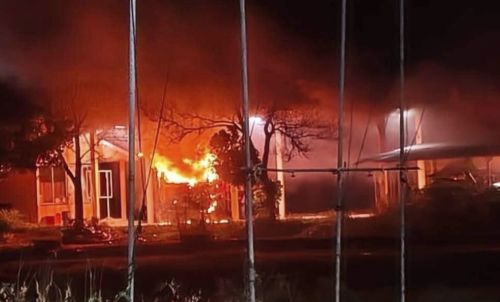
The site, known as Royal Hill, was abandoned hastily after a combination of Thai military air strikes and Cambodian police raids disrupted its operations.
Reuters reporters, given rare access to the bombed compound on Monday, documented the remnants of a sophisticated scam infrastructure that had targeted victims worldwide.
Among the materials were detailed personal profiles, including bank account information of a 73-year-old Japanese retiree and an American woman who had confided she was a victim of domestic abuse.
Scripts to conduct romance scams, impersonate police officers, and manipulate victims were scattered across desks, while rooms had been carefully staged to lend authenticity to the schemes.
“The documents show that the scams were organised like a business, with detailed plans, target lists, and strict operational rules,” said a Reuters correspondent on site.
Verification of one Japanese victim’s file confirmed that he had been contacted by scammers posing as an electricity company, warning of a power cut unless he supplied bank details.
“If the power was cut off, that would be a real problem as I live up in the mountains,” he said. “I let details slip out without thinking and later thought that was a bad idea.”
The compound’s management structure remains opaque, though Chinese-language documents indicated that space was leased to multiple scamming groups, some of which failed to pay rent on time.
Financial records also referenced cryptocurrency wallets connected to high-risk platforms, including gambling and cash-conversion services.
Security protocols at the site included military-style anti-riot drills, restrictions on loitering and delivery services, and behavioural rules for workers to maintain the appearance of order.
The December strikes, which the Thai military justified by alleging the centers were also staging drone attacks during a border conflict, combined with Cambodia’s ongoing crackdown, have forced more than 100,000 people to flee similar compounds across the country.
Many are now seeking consular assistance to return home, with Amnesty International describing the situation as a “humanitarian crisis.” Victims often include trafficked individuals forced to work under harsh conditions.
Southeast Asia has emerged as a global hub for organised cyberfraud, largely orchestrated by Chinese criminal gangs. Countries such as Cambodia, Laos, the Philippines, and the lawless Myanmar-Thailand border region have seen compounds proliferate, exploiting trafficking victims to staff elaborate scams. T
he U.S. estimates American citizens lost US$10 billion to such operations in 2024 alone.
Delphine Schantz of the United Nations Office on Drugs and Crime explained that the disruption of Royal Hill is unlikely to end the threat.
“We see those scam centers now kind of mushrooming all over the world in different places in the same model as what we've seen in Southeast Asia,” she said. Former workers corroborate the reports of strict control and severe conditions.
One Malagasy victim recounted being able to leave the compound only after the Thai strikes prompted his captors to return his passport.
Royal Hill offers a rare glimpse into the industrialised nature of global fraud, revealing a complex system of target management, operational security, and psychological control.
Authorities in Cambodia have pledged to eradicate cyberfraud by April, but the dispersed and mobile nature of these networks suggests the challenge is far from over.
The abandoned compounds, papers, and operational manuals at Royal Hill underscore the lengths criminal syndicates will go to maintain control and profit, highlighting the intersection of organised crime, human trafficking, and the rapidly evolving landscape of digital fraud. - February 6, 2026