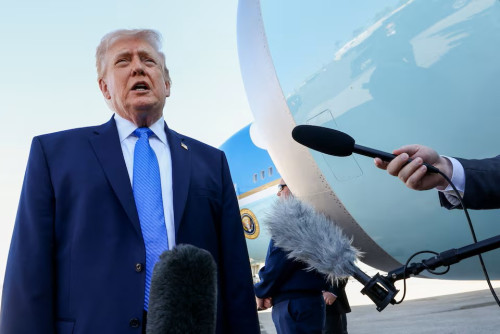
THE United States has significantly reinforced its military presence in the Middle East, positioning a substantial fleet of warships, combat aircraft, and aerial refuelling tankers in readiness for a potential sustained campaign against Iran, should President Donald Trump give the order.
AFP reported on Thursday that Trump, who authorised a strike on Iran last year, has repeatedly warned Tehran of military action if ongoing negotiations fail to produce a replacement for the nuclear deal he withdrew from in 2018 during his first term.
Reports from CNN and CBS indicate that US forces could be prepared to launch operations as early as this weekend, although the president has yet to make a final decision.
“Having so much firepower in the region creates its own momentum,” said Susan Ziadeh, senior adviser at the Center for Strategic and International Studies. “Sometimes that momentum is hard to stop and just say, that’s it, we will do nothing.”
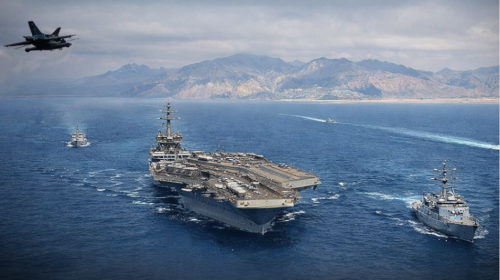
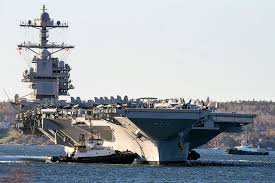
Current deployments include 13 warships, a nuclear-powered aircraft carrier — the USS Abraham Lincoln — nine destroyers, and three littoral combat ships, with additional vessels en route, according to a US official.
The USS Gerald R. Ford, the world’s largest aircraft carrier, is travelling from the Caribbean to the Middle East, accompanied by three destroyers, under orders from Trump earlier this month.
It is rare for two US carriers, carrying thousands of personnel and dozens of aircraft, to be present simultaneously in the region.
The United States has also positioned a large contingent of aircraft in the Middle East, including F-22 Raptor stealth fighters, F-15 and F-16 combat jets, and KC-135 aerial refuelling planes essential to sustaining operations.
Open-source intelligence platforms such as X and Flightradar24 indicate ongoing flights of KC-135s, E-3 Sentry early warning aircraft, and cargo planes in the region.
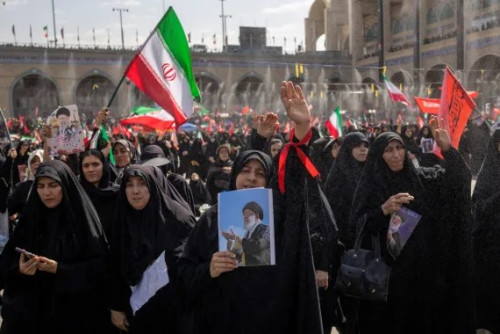
The Lincoln was deployed amid widespread protests in Iran, initially sparked by economic grievances but evolving into a broader movement challenging the Islamic Republic.
Iran’s clerical leadership, in power since the 1979 revolution, responded with lethal force while maintaining tight control, leaving opponents to view potential foreign intervention as the most plausible catalyst for change.
Trump has repeatedly threatened military action if Iran continued to target protestors, even encouraging Iranians to “take over” national institutions with assurances that “help is on the way.” Although he recently suspended a strike after Tehran reportedly halted more than 800 executions under US pressure, tensions remain elevated with renewed threats against Iran.
Diplomatic efforts continue, with US and Iranian officials meeting in Geneva last Tuesday to avert military confrontation. Both sides reported agreement on “guiding principles” for a potential deal, though White House Press Secretary Karoline Leavitt cautioned that while “some progress” has been made, the parties remain “very far apart on several issues.”
She added that “there are many reasons and arguments that could be made to strike Iran” but that “Iran would be wise to reach an agreement.” - February 19, 2026
.jpeg)
.jpg)