AUSTRIA’S decision to transform the birthplace of Adolf Hitler into a police station has reignited debate over how the country confronts its Nazi past, with residents of the border town of Braunau am Inn expressing sharply differing views over the building’s future.
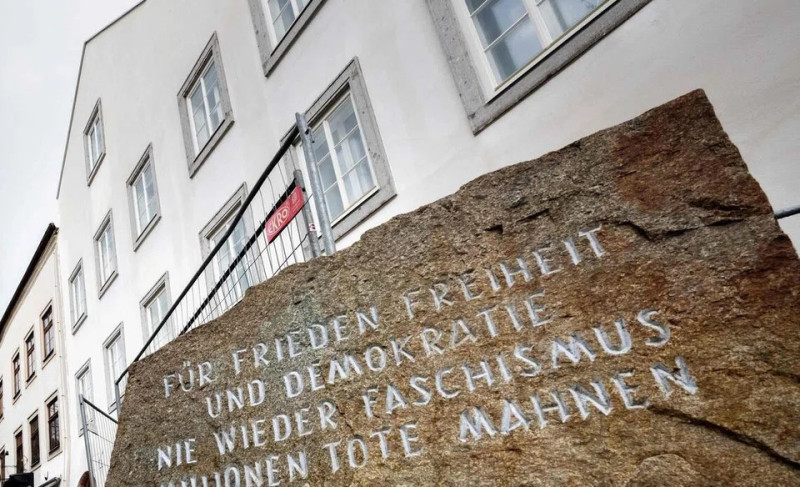
The pale-yellow house in which Hitler was born on April 20, 1889, stands on a narrow street in the centre of town, marked by a memorial stone bearing the words: “For Peace, Freedom and Democracy. Never Again Fascism. Millions of Dead Warn.”
After years of legal wrangling, the government passed legislation in 2016 to seize control of the dilapidated property from its private owner, declaring its intention to “neutralise” the site and prevent it from becoming a place of pilgrimage for extremists.
Interior Ministry officials have confirmed that police officers are scheduled to move into the refurbished building in the second quarter of 2026. When reporters visited this week, workers were completing the final touches to the façade of the €20 million redevelopment.
Yet in Braunau, a town on the German border, opinion remains divided.
“It’s a double-edged sword,” AFP reportred Sibylle Treiblmaier, a 53-year-old office assistant, saying outside the house. While the move might discourage far-right extremists from congregating there, she felt it could have “been used better or differently”.
Others question the symbolism of housing law enforcement in a building so closely associated with dictatorship. Ludwig Laher, an author and member of the Mauthausen Committee Austria, which represents Holocaust victims, argued that “a police station is problematic, as the police... are obliged, in every political system, to protect what the state wants”. He noted that an earlier proposal to convert the premises into a centre dedicated to peace-building and dialogue had “received a lot of support”.
Jasmin Stadler, a 34-year-old shop owner born in Braunau, said she would have preferred a more explicitly educational approach. It would have been worthwhile, she suggested, to place Hitler’s birth in the house within a clearer “historic context”, explaining more about the building itself. She also criticised the €20 million cost of the renovation.
Others, however, see the police presence as a pragmatic solution. Wolfgang Leithner, a 57-year-old electrical engineer, said the change would “hopefully bring a bit of calm”, ensuring the property does not evolve into a shrine for extremists.
“It makes sense to use the building and give it to the police, to the public authorities,” he said.
The controversy unfolds against a broader national reckoning. Austria, annexed by Nazi Germany in 1938, has long faced criticism for failing fully to acknowledge its role in the Holocaust, during which around 65,000 Austrian Jews were murdered and some 130,000 forced into exile.
Debate over how to commemorate that history continues to surface periodically.
In 2025, two streets in Braunau am Inn previously named after Nazis were renamed following years of complaints from activists. Meanwhile, the far-right Freedom Party, founded by former Nazis, topped the poll in the 2024 general election for the first time, though it ultimately failed to form a government.
For many in Braunau, the transformation of Hitler’s birthplace into a police station represents an attempt to close a troubling chapter.
For others, it risks replacing one uncomfortable symbol with another, leaving unresolved questions about memory, responsibility and the most appropriate way to confront a dark past. - February 21, 2026