THE war in Ukraine has been radically reshaped by the proliferation of drones, with small, agile, “first-person-view” (FPV) aircraft now dominating the skies and making traditional armoured manoeuvres increasingly hazardous, according to Ukrainian tank commanders and frontline soldiers.
Valentyn Bohdanov, a senior sergeant with the 127th Separate Heavy Mechanised Kharkiv Brigade, recalls a time when tank platoons engaged in large-scale battles resembling boxers trading blows in the ring.
“They won't enter an open field: they'll be peppered by FPV drones and stronger ones,” Reuters reported Bohdanov saying, adding that, who goes by the military call sign “Bodia.”
His T-72 tank, captured from Russian forces, now remains largely immobile beneath camouflaging netting near the snowy Kharkiv frontline, functioning more as stationary artillery than a manoeuvrable strike vehicle.
The conflict, now four years old, has witnessed an exponential increase in drone activity.
Thousands of low-cost drones patrol the 1,200-kilometre front daily, accompanied by larger, long-range models capable of carrying heavier payloads.
Drone-inflicted casualties among Ukrainian and Russian forces have surged from less than 10% of total casualties in 2022 to nearly 80% last year, according to a report by the French Institute of International Relations.
The study described the phenomenon as an “air battle of mutual denial,” emblematic of a broader technological shift in modern warfare defined by rapid innovation, adaptation, and integration of advanced systems including artificial intelligence.
Mobile drone-hunting units have become a frontline necessity.
Near the eastern city of Kostiantynivka, Reuters observed a team patrolling roads lined with anti-drone netting and the charred remains of vehicles.
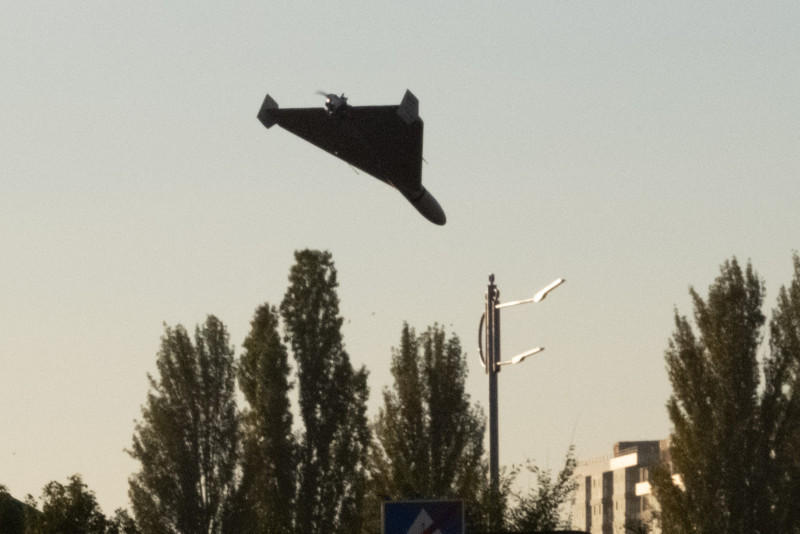
Their mission is to protect critical supply routes from constant aerial threats, from nimble FPVs to larger Shahed drones.
One drone-hunter, who identified himself by the call sign “Marine” of the 93rd Mechanised Brigade, recalled a single target being assaulted by 54 drones in just one hour.
“Three would circle, another would attack while the others join,” he said. “They're in the air like that all the time, not letting anyone get away.”
Soldiers caught under drone fire describe the overwhelming speed and precision of FPVs. Andriy Meskov, a 42-year-old drone pilot with the 151st Separate Reconnaissance-Strike Battalion, recounted being chased by a drone while attempting to take cover.
“The speed of a human being doesn't compare to the speed of an FPV drone, so I didn't even have time to pick up my rifle to shoot at it,” he said.
He sustained a severe knee injury when a drone exploded near his leg and was evacuated on an unmanned ground vehicle, part of a growing use of robotic systems for logistics and casualty evacuation.
Defence Minister Mykhailo Fedorov reported that unmanned ground vehicles completed over 7,000 missions in January, with plans to increase production and deployment throughout 2026.
The drone threat has also dramatically delayed medical evacuations. Col. Viacheslav Kurinnyi, chief doctor at the Kharkiv hospital where Meskov was treated, noted that average evacuation times have stretched beyond three days, undermining the traditional “golden hour” of battlefield medicine.
“Any countries that are preparing for war at home need to realise that there will be no 'golden hour,'” he said. “Maybe a 'golden day' if they're lucky.”
Despite the dominance of drones, some Ukrainian commanders still see a role for traditional armour in specific scenarios.
Bohdanov indicated that tanks remain useful in urban engagements or adverse weather but conceded that armour-led assaults have largely been replaced by smaller infantry operations.
Military analyst Rob Lee of the Foreign Policy Research Institute cautioned against writing off tanks entirely. “Right now, the current role is diminished, and I think we're waiting for the next technological breakthrough that will enable manoeuvring again,” he said.
The evolution of drone warfare in Ukraine underscores a broader transformation in military strategy, where agility, speed, and technological integration now define battlefield effectiveness, while traditional heavy armour must adapt or risk obsolescence. - February 24, 2026