IRAN has intensified pressure in the Gulf region by showcasing its capacity to disrupt one of the world’s most critical shipping lanes, following the breakdown of ceasefire talks with the United States.
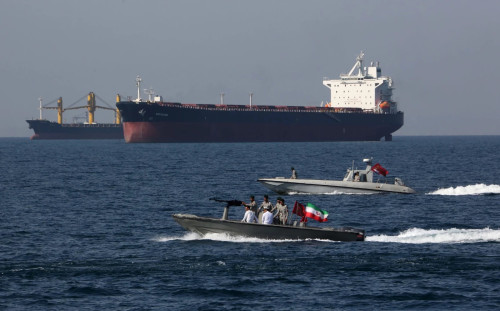
State media broadcast footage of Iranian commandos storming cargo vessels in the Strait of Hormuz, underlining Tehran’s insistence that it will not reopen the route unless Washington lifts its blockade on Iranian shipping.
Reuters reported on Friday that the video showed masked troops boarding the MSC Francesca from a grey speedboat, climbing aboard with rifles drawn in a sequence presented without commentary but styled like an action film.
Iranian authorities said the vessel and another ship, the Epaminondas, were seized for attempting to transit the strait without permits.
The move highlights Iran’s enduring leverage over a passage through which roughly a fifth of the world’s oil and liquefied natural gas once flowed, despite repeated claims from Washington that Tehran’s naval capabilities had been severely degraded.
US President Donald Trump played down the threat posed by Iranian patrol craft, referring to them as “little wise-guy ships”, while suggesting that Tehran ultimately seeks an agreement.
“Don't rush me,” he said when asked how long he was willing to wait for a long-term peace deal. “I want to make the best deal. I could make a deal right now ... but I don't want to do that. I want to have it everlasting.”
At the same time, he warned of escalation if diplomacy fails. “I'll finish it up militarily,” he said, adding that US forces could neutralise Iran’s capabilities within a day if required.
Trump also ruled out deploying nuclear weapons, despite earlier rhetoric about overwhelming force. “No, I wouldn't use it. A nuclear weapon should never be allowed to be used by anybody,” he said.
The latest developments follow a fragile pause in hostilities that began on 8 April after a war launched by the US and Israel in late February.
Talks held in Pakistan shortly afterwards failed to produce an agreement, and no further negotiations have been scheduled.
Tehran has made clear it will not consider reopening the Strait of Hormuz until the United States ends what it describes as an illegal blockade imposed during the ceasefire. Iranian officials have also cited ongoing Israeli strikes in Lebanon as a barrier to renewed diplomacy.
Meanwhile, Israel and Lebanon have agreed to extend their ceasefire by three weeks after talks in Washington. Announcing the development, Trump said: “I look forward in the near future to hosting the Prime Minister of Israel, Bibi Netanyahu, and the President of Lebanon, Joseph Aoun. It was a Great Honor to be a participant at this very Historic Meeting!”
Despite the extension, tensions remain high. Israeli Defence Minister Israel Katz said Israel was awaiting a “green light” from Washington to resume strikes on Iran, warning that any renewed campaign would escalate rapidly.
In parallel, the United States has stepped up maritime enforcement operations. Washington said its forces had boarded another tanker, the Majestic, in the Indian Ocean and redirected dozens of vessels since the blockade began.
Trump insisted that US forces maintained dominance over the critical waterway, describing it as “‘Sealed up Tight,’ until such time as Iran is able to make a DEAL!!!”
Yet the latest Iranian actions suggest a continued ability to challenge that claim, raising fears of prolonged disruption to global energy supplies.
Surveys released on Thursday indicated the conflict is already placing visible strain on the world economy, with rising production costs and weakening activity across multiple sectors.
Iran’s leadership has rejected suggestions of internal divisions, with Supreme Leader Ali Khamenei accusing foreign media of attempting to undermine national unity and security.
As both sides harden their positions, the struggle for control of the Strait of Hormuz appears set to remain a decisive front in a conflict with far-reaching global consequences. - April 24, 2026