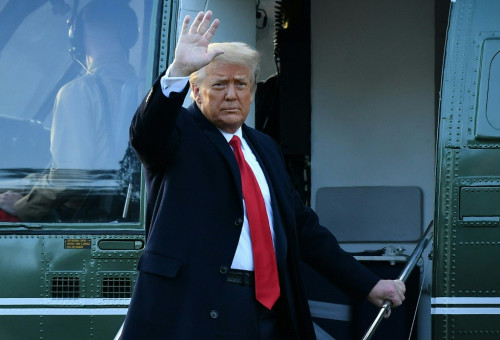
US President Donald Trump has indicated that a naval blockade on Iran could be sustained for months, a stance that has driven oil prices to their highest levels in more than four years and heightened fears of prolonged global economic disruption.
Speaking after discussions with energy executives, Trump argued that restricting Iranian ports was proving more effective than direct military strikes, even as Tehran insists the blockade must be lifted before any negotiations can resume.
“They are choking like a stuffed pig. And it is going to be worse for them,” AFP reported Trump saying in remarks to Axios, underscoring his administration’s hardline approach.
A White House official said Trump had explored measures “to alleviate global oil markets and steps we could take to continue the current blockade for months if needed and minimize impact on American consumers.”
The escalation comes amid stalled diplomacy between Washington and Tehran, with Trump also holding talks with Russian President Vladimir Putin, who warned of “damaging consequences” should the United States and Israel resume full-scale military operations against Iran.
Energy markets reacted sharply, with Brent crude jumping 7.6 per cent to US$119.69 a barrel, the highest since the early phase of the Ukraine war in 2022.
The surge reflects mounting concerns over supply disruptions, particularly around the strategically vital Strait of Hormuz, through which roughly one-fifth of the world’s oil supply typically passes.
Iran has sought leverage by tightening its grip on the waterway, while proposing a partial easing of restrictions in exchange for the lifting of the US blockade and broader negotiations, an offer Washington has viewed with scepticism.
The conflict is increasingly reverberating beyond the battlefield. The United Nations Development Programme has warned that the war could push more than 30 million people into poverty across 160 countries, as surging fuel and fertiliser costs strain fragile economies.
“It’s development in reverse,” said UNDP chief Alexander De Croo.
Domestically, Trump is facing mounting political pressure as rising fuel prices and inflation weigh on American households.
The conflict has also unsettled US allies, with tensions flaring between Washington and Berlin after German Chancellor Friedrich Merz declined to support the war effort or contribute to a proposed peacekeeping force in the Gulf.
Meanwhile, uncertainty persists over Iran’s internal leadership dynamics following Israeli strikes that killed several senior figures, complicating diplomatic channels. US officials have acknowledged difficulty in determining whether authority lies with Tehran’s diplomats or the increasingly influential Revolutionary Guards.
On the ground, violence continues to spill across the region despite fragile ceasefires. In Lebanon, clashes between Israeli forces and the Iran-backed group Hezbollah have intensified, with the Lebanese army reporting casualties from recent strikes.
Lebanese President Joseph Aoun urged restraint, saying: “Israel must finally realise that the only path to security is through negotiations, but it must first fully implement the ceasefire in order to move on to negotiations,” adding that “Israeli attacks cannot continue as they are.”
Within Iran, the economic toll is becoming increasingly severe, with the national currency hitting record lows and citizens expressing deep frustration over prolonged sanctions and stalled diplomacy.
Iranian parliamentary speaker Mohammad Bagher Ghalibaf accused Washington of seeking to destabilise the country internally, saying the blockade was intended to “make us collapse from within.”
As geopolitical tensions deepen and economic strains widen, the prospect of a prolonged standoff threatens to further unsettle global markets and humanitarian conditions alike. - April 30, 2026