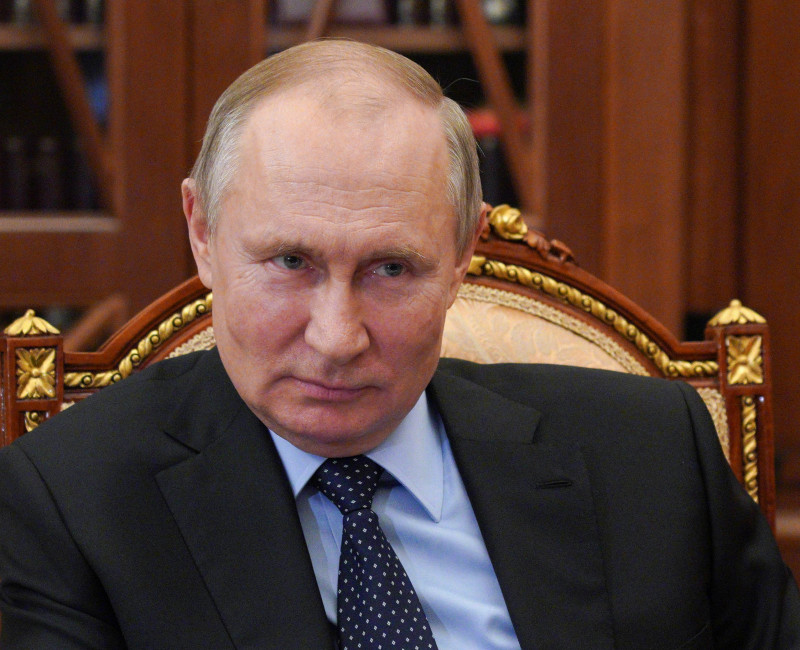
RUSSIAN President Vladimir Putin has coupled a fresh appeal for a negotiated settlement in Ukraine with an uncompromising defence of Russia’s battlefield objectives, declaring that Moscow’s military momentum leaves Kyiv with little choice but to accept concessions if it wants the conflict to end.
Speaking to international news editors on the sidelines of Russia’s flagship economic forum in St Petersburg, Putin said Russian forces were making gains every day and had established control over vast swathes of territory claimed by Moscow, while arguing that a diplomatic settlement remained possible if Ukraine agreed to compromises previously discussed with United States President Donald Trump.
Reuters, on Friday, reported that the remarks came as Ukrainian President Volodymyr Zelenskyy publicly renewed calls for a direct meeting with Putin, urging the Russian leader to negotiate an end to a war that has entered its fifth year and become Europe’s deadliest conflict since the Second World War.
Rather than indicating any willingness to retreat from Russia’s territorial demands, however, Putin portrayed Moscow’s military position as increasingly favourable and suggested that continued Ukrainian resistance would only prolong the conflict.
"The offensive is ongoing on a daily basis. At present, the Russian Federation has taken full control of the Luhansk People’s Republic — 100%. And Russia has brought over 85% of the territory of the Donetsk People’s Republic under its control. (And) 80% of the territory of the Zaporizhzhia region."
Putin argued that Ukraine's desire to halt Russian advances should instead be channelled into accepting a negotiated settlement.
"Naturally, under these circumstances, the Ukrainian side would like us to halt the advance. But rather than stopping that, it would be better to bring the war to an end altogether by agreeing to the compromises that were discussed in Anchorage."
The Russian leader repeatedly referenced discussions held with Trump in Anchorage, describing them as a viable framework for ending hostilities and insisting Moscow remained committed to any understandings reached during those talks.
"We are certainly prepared and willing to reach an agreement with Ukraine through peaceful means. Specifically, on the basis we discussed during our meeting with President Trump in Anchorage. Russia agrees to those compromises we discussed in Anchorage. The Ukrainian side must also agree to these compromises. Then the conflict will quickly come to a natural conclusion."
While presenting diplomacy as the preferred route forward, Putin made clear that Russia would not abandon its strategic objectives, particularly in eastern Ukraine, where Moscow continues to demand full control of the Donbas region.
Those demands remain unacceptable to Kyiv, which argues that surrendering additional territory would leave the country permanently vulnerable to future Russian aggression and effectively reward military occupation.
Zelenskyy, in an open letter addressed to Putin, urged the Kremlin leader to make what he described as a historic decision to end the war, warning that Russia itself was paying an increasing price through economic strain, inflation, fuel shortages and sustained Ukrainian drone attacks deep inside Russian territory.
Despite growing international calls for dialogue, the gap between the two sides appears as wide as ever, with Moscow insisting on territorial concessions and Kyiv refusing to legitimise what it regards as an illegal annexation of sovereign Ukrainian land.
Putin also delivered a stark reminder of Russia’s military capabilities, revealing that the Kremlin had yet to deploy its Oreshnik hypersonic missile in full combat operations despite testing the weapon against Ukrainian targets.
The nuclear-capable missile, which has a reported range exceeding 5,000 kilometres, remains one of Russia’s most closely watched strategic weapons and has been presented by Moscow as virtually impossible to intercept.
At the same time, Putin acknowledged that Russia must strengthen its air defence systems in response to increasingly sophisticated Ukrainian drone attacks, which have exposed vulnerabilities far from the front lines.
The Russian president also declined to speculate extensively about his political future beyond the end of his current term in 2030, although he noted that the constitution would permit him to seek another mandate extending his rule until 2036.
"The country faces a lot of large-scale and pressing issues. They need to be solved without thinking about it, but thinking about the future of Russia."
As military operations continue and diplomatic efforts remain stalled, Putin’s latest comments suggest that any future peace initiative will depend less on whether negotiations occur and more on whether either side is willing to accept conditions that currently remain politically and strategically unacceptable. - June 5, 2026