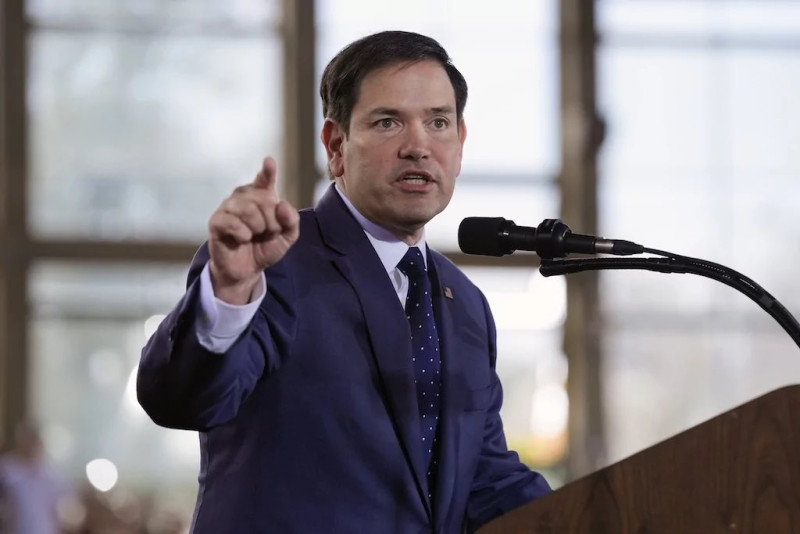
UNITED STATES Secretary of State Marco Rubio began a crucial diplomatic mission across the Gulf on Wednesday, seeking to calm concerns among key regional allies who believe elements of President Donald Trump's newly agreed deal with Iran are overly favourable to Tehran.
Rubio arrived in Abu Dhabi on Tuesday night for a three-day visit that marks his first major diplomatic engagement since the United States and Iran reached an agreement last week that brought an end to the four-month conflict involving Iran, Israel and the United States.
Reuters cited the visit comes amid growing unease among Gulf governments over provisions contained in the memorandum of understanding, including a proposed US$300 billion reconstruction fund that critics fear could strengthen Iran's regional influence.
Asked whether he intended to address concerns raised by America's regional partners, Rubio indicated the issue would feature prominently in discussions.
"That most certainly will come up in these discussions," he told reporters upon arrival.
He added that talks would also cover regional issues that fall outside the scope of the memorandum.
Rubio's comments are expected to be closely scrutinised, particularly given his longstanding reputation as a foreign policy hawk on Iran before joining the Trump administration.
In recent weeks, Vice President JD Vance has emerged as the leading American figure in negotiations with Tehran, including participating in talks with Iranian representatives in Switzerland over the weekend, leaving Rubio largely absent from the diplomatic spotlight.
The secretary of state's balancing act is expected to prove delicate. While he must defend an agreement strongly backed by Trump, he also faces the challenge of addressing the reservations of Gulf allies who supported efforts to end the conflict but remain wary of the deal's long-term implications.
Among the principal concerns is the possibility that Iran could use the proposed reconstruction fund to rebuild military capabilities damaged during the conflict.
Regional governments are also troubled by the absence of provisions addressing Iran's ballistic missile programme, a longstanding security concern for Gulf nations that came under missile and drone attacks during the war.
Tehran, meanwhile, has noted that several Gulf states provided logistical support to Washington's military operations while hosting American military facilities that played a central role in the conflict.
Rubio's itinerary includes the United Arab Emirates and Kuwait, both of which host major U.S. military bases and were among the countries struck by Iranian missile attacks during the hostilities.
For the United Arab Emirates, security concerns have been compounded by economic fallout. The conflict prompted the departure of thousands of expatriate workers who form a critical part of the country's non-oil economy, raising broader questions about the resilience of one of the region's leading financial centres.
The diplomatic mission also unfolds against a backdrop of heightened security concerns following reports that Iran established covert operational cells in Iraq to target Gulf states. According to reports, those networks were linked to multiple drone attacks against locations in Kuwait, the UAE and Saudi Arabia during April and May.
Rubio's meetings over the coming days are expected to focus not only on defending the agreement with Iran but also on reassuring Gulf partners that Washington remains committed to their security interests despite the changing diplomatic landscape. - June 24, 2026

.JPG)