VENEZUELA was plunged into crisis on Wednesday after two powerful earthquakes struck within less than a minute of each other, collapsing buildings in the capital Caracas, injuring scores of people and prompting authorities to declare a state of emergency amid warnings that the final death toll could be severe.
Reuters reported on Thursday that the twin earthquakes, measuring magnitude 7.2 and 7.5 respectively, struck west of Caracas during a national public holiday, sending terrified residents fleeing into the streets as buildings swayed violently and sections of the capital suffered significant structural damage.
Scientists and emergency officials warned that the full scale of the disaster may not yet be known, with the United States Geological Survey issuing an initial assessment indicating that "high casualties and extensive damage are probable and the disaster is likely widespread."
The agency's preliminary modelling suggested fatalities could ultimately range between 10,000 and 100,000 people.
As rescue teams raced against time to search collapsed structures, interim President Delcy Rodriguez announced that the government would invoke emergency powers and seek international financial assistance to support recovery operations.
"We extend our condolences to those who have unfortunately suffered the loss of a family member," she said in a national address, without providing an official nationwide casualty figure.
The declaration came as reports emerged from multiple regions of collapsed buildings, trapped residents and mounting numbers of injured survivors.
“We have buildings, homes and houses which have collapsed and we are taking care of things with everything we have available in terms of security, civil assistance," Interior Minister Diosdado Cabello said earlier on state television.
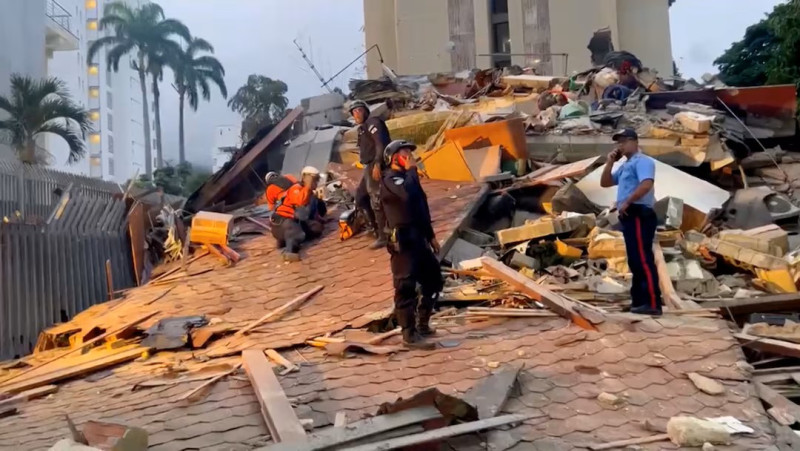
In Caracas, dramatic scenes unfolded as emergency workers searched through piles of concrete and twisted steel under fading daylight while anxious relatives gathered nearby awaiting news of missing loved ones.
Authorities in Chacao municipality reported several building collapses.
Mayor Gustavo Duque said rescue workers had already pulled 18 survivors from a single collapsed structure and warned residents to remain away from damaged buildings because of the continuing threat posed by aftershocks.
"We're going to do everything we can to rescue the most people possible," he said.
The earthquakes were followed by nearly two dozen aftershocks, heightening fears among emergency officials and residents alike.
In Falcon state, Governor Victor Clark reported at least 22 injuries and confirmed that search teams were still attempting to locate 15 missing adults.
The disaster struck during celebrations marking the anniversary of the military victory that paved the way for Venezuela's independence from Spain, meaning many citizens were at home when the ground began shaking.
Residents described moments of panic as buildings trembled and household objects crashed to the floor.
"As soon as it started, we began hearing people screaming," said Astrid Ramirez, a 41-year-old publicist living in western Caracas. "Everyone was running down the stairs."
"There was a very loud crash. Things fell in the house, jugs inside the refrigerator. I've never experienced anything like it," said Coro Martinez, 56, from eastern Caracas.
Maria Romero, an 80-year-old pensioner, compared the earthquake to one of the country's most devastating modern disasters.
"This earthquake was horrible, even worse than the one in 1967," she said after being assisted from her home by police officers.
Another resident recalled receiving an earthquake warning on her mobile phone moments before the strongest shaking began.
"As I picked it up and started listening to what it was saying, I first felt light shaking. Then, in less than two seconds, everything started moving."
The emergency has also disrupted key infrastructure across the country.
Rodriguez confirmed that Venezuela's largest airport in Maiquetia, north of Caracas, had been closed due to damage, while authorities cancelled classes nationwide for the remainder of the week as inspections continued.
Hospitals in the capital activated emergency procedures, with medical staff at Hospital de Clinicas instructed to reinforce overnight shifts to cope with an expected influx of casualties.
Despite widespread destruction in urban centres, there was tentative relief for Venezuela's critical energy sector.
Initial assessments suggested that major oil production facilities had escaped significant damage because the worst-affected regions were largely outside the country's principal oil-producing zones.
However, energy companies operating in Venezuela began accounting for personnel and inspecting facilities amid concerns that prolonged electricity outages could eventually affect crude production.
International concern also briefly intensified after the U.S. Tsunami Warning System issued alerts for Puerto Rico, the United States Virgin Islands and the British Virgin Islands, while warning that hazardous waves could affect Aruba, Curacao and Bonaire.
The tsunami threat was later withdrawn.
Venezuela sits within a highly active seismic zone where the Caribbean and South American tectonic plates converge, making earthquakes a recurring threat.
The country remains haunted by the memory of the catastrophic 1812 earthquake that devastated Caracas and Merida and is estimated to have claimed around 30,000 lives.
As darkness fell across parts of the country, emergency crews continued searching collapsed buildings while authorities struggled to determine the scale of the catastrophe, raising fears that the coming hours could reveal a far higher human toll from one of Venezuela's most destructive earthquakes in modern history. - June 25, 2026