VIETNAM is widely regarded as one of Asia’s great economic success stories of the past four decades.
From the launch of Đổi Mới in 1986, the country has transformed itself from a war-scarred, isolated, centrally planned economy into a major manufacturing and export platform deeply integrated into global value chains.
Rapid growth has lifted millions out of poverty, turned Vietnam into a strategic partner for competing powers, and made it a preferred destination for firms seeking alternatives to China.
Yet success has changed the question. The challenge is no longer simply about whether Vietnam can attract foreign investment, expand exports, and absorb rural labour into factories.
Vietnam now faces the harder task of constructing a new development model based on domestic productive capability, technological learning, institutional reform, private-sector dynamism, and social upgrading.
Major decisions will be required to set the economy on new trajectories in the coming two years.
Vietnam’s Position in ASEAN
In 2025, Vietnam’s GDP reached approximately US $514 billion, ranking it fourth in ASEAN behind Indonesia, Singapore, and Thailand, and ahead of the Philippines and Malaysia.
This represents a dramatic expansion from just 3.1 per cent of ASEAN’s total GDP when it joined the bloc in 1995 to around 12 per cent today.
Growth has been among the strongest in the region, with 7.09 per cent in 2024 and 8.02 per cent in 2025, leading the ASEAN-6. Population stands at roughly 102 million, giving a GDP per capita of about $5,026, which is still lower-middle to upper-middle income territory and below Malaysia’s higher levels, though rising steadily from under $700 in 1986.
The Gini coefficient remains moderate at around 0.37, indicating relatively contained inequality by regional standards, though rural-urban and regional disparities still widely persist.
Services contribute the largest share of GDP, with around 42–43 per cent, followed by industry and construction ranging about 37–38 per cent, and agriculture, forestry, and fisheries(roughly 11–12 per cent).
The engines of growth have been export-oriented manufacturing with electronics, phones, garments, footwear, furniture, and seafood, generally powered by foreign direct investment (FDI), industrial parks, and insertion into global production networks. Agriculture’s earlier transformation into a major export sector provided the initial foundation, while services and construction have expanded with rapid urbanisation and rising incomes.
A Young Workforce and the Role of Education
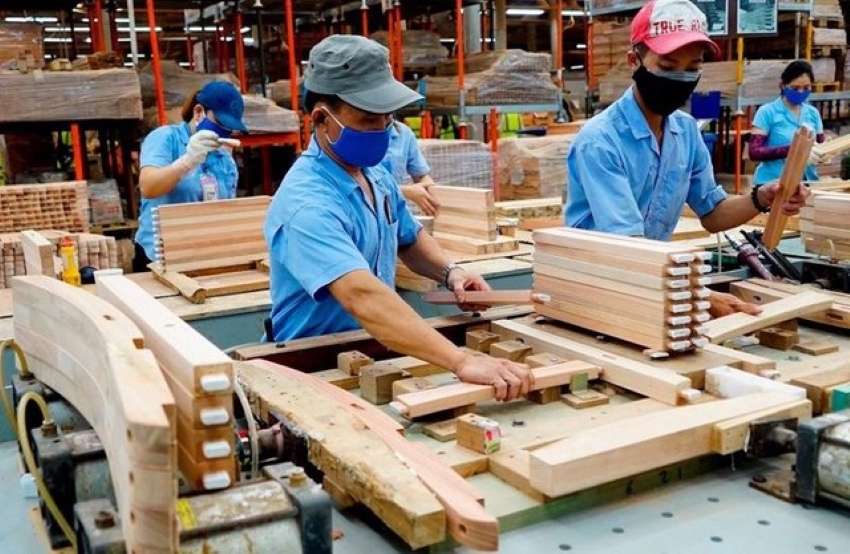
Vietnam benefits from a relatively young workforce.
The median age is around 33 years, younger than Thailand or Singapore but older than parts of Cambodia or Laos.
The labour force exceeds 53 million, with high participation rates and unemployment remaining very low at around 2.1–2.3 per cent.
This demographic profile has underpinned the labour-intensive export model and continues to offer advantages relative to ageing peers in East Asia, though the population is beginning to age and the “dividend” window is finite.
Education has been a quiet strength. Vietnamese students perform strongly in international assessments relative to income level.
In PISA 2022, scores in mathematics, reading, and science were close to the OECD average and second only to Singapore in ASEAN.
Primary students lead the region in reading and mathematics under SEA-PLM evaluations.
High enrolment, discipline, and foundational skills have supported industrial absorption of labour.
Challenges remain in higher-order skills, vocational training aligned with industry needs, university-industry linkages, and quality variation between urban and rural areas.
Building a capability-based economy will require deeper investment in technical education, lifelong learning, and innovation ecosystems.
Market Regulation, Government Enterprises, and Competitiveness
Vietnam operates a hybrid “socialist-oriented market economy.”
It is neither a pure free market nor is it highly command-driven.
The state retains significant influence through land allocation, industrial zones, infrastructure, education, and strategic sectors, while market opening, trade agreements, and private activity have expanded dramatically since Đổi Mới.
State-owned enterprises (SOEs) and the broader state economy contribute roughly 20–29 per cent of GDP, down from over 40 per cent in the early reform years, yet they dominate energy, telecoms, banking, and certain strategic industries.
Private domestic firms and FDI now form the dynamic core of growth, especially in manufacturing and services.
Competitiveness has improved markedly. In the 2026 IMD World Competitiveness Ranking, Vietnam debuted at 27th globally, ahead of Japan (30th) and close to Thailand. This reflects the strengths in business efficiency and economic performance, though infrastructure development lags behind.
Development trails Singapore, South Korea, and advanced ASEAN peers such as Malaysia in overall rankings, particularly in innovation, institutional quality, and higher-value capabilities.
Cost competitiveness, political stability, and trade openness remain key attractions, but moving up the value chain requires stronger domestic firms, skills, and technology absorption.
Corporate income tax stands at a standard 20 per cent, with incentives of 10–15 per cent for priority sectors and zones.
VAT is normally 10 per cent, which has been temporarily reduced to 8 per cent for many goods through 2026, with preferential and special rates.
Customs duties are generally low under WTO MFN and numerous free-trade agreements, where average preferential rates are around 7–8 per cent or less for many partners, supporting the export platform, though special consumption taxes apply to luxury and sensitive goods.
Cronyism, Corruption, and Economic Diversity
Corruption and cronyism remain major concerns in Vietnam.
Vietnam’s score on Transparency International’s Corruption Perceptions Index is around 41 (out of 100) in recent years, placing it mid-range globally.
The government has pursued a vigorous anti-corruption campaign that has removed senior figures and signalled intolerance of rent-seeking, land speculation, and abuse of office.
This has improved perceptions of seriousness but has also created administrative caution that can slow decision-making.
The challenge is to strengthen legality and transparency without inducing paralysis, an issue recognised in recent resolutions on law-making and enforcement.
The economy has diversified beyond pure labour-intensive assembly into electronics, components, renewable energy, and emerging digital services.
Large private groups such as Vingroup, FPT, and THACO illustrate growing domestic capacity in vehicles, technology, and industry.
Growth centres include the Red River Delta (Bắc Ninh, Hải Phòng), the Southeast (Bình Dương, Đồng Nai, Ho Chi Minh City), and coastal industrial corridors.
The Mekong Delta remains vital for agriculture and aquaculture exports and holds potential as a major growth centre if climate resilience, logistics, high-value processing, tourism, and renewable energy are scaled up.
Its fertile lands, waterways, and proximity to ASEAN markets could support regional food and green-economy leadership, provided infrastructure, skills, and adaptation investments accelerate.
The new major airport being built just out of Ho Chi Minh City could become a potential new aviation hub in the region, being fed by both rising tourism and exports.
Infrastructure, Political Stability, and Food Security
Infrastructure has expanded rapidly, with ports, roads, industrial parks, and power network development.
However, bottlenecks persist in logistics efficiency, urban transport, and energy reliability.
The government prioritises major projects, including expressways, high-speed rail ambitions, ports, and digital infrastructure, as foundations for the next growth phase. Political stability under the Communist Party of Vietnam has been a cornerstone advantage, with policy continuity, disciplined labour mobilisation, and strategic balancing among great powers underpinning investor confidence.
Vietnam is a net food exporter, especially in rice, seafood, and coffee, enjoying a high self-sufficiency in staples, in contrast to more import-dependent peers such as Malaysia or the Philippines.
Vietnam imports certain feed grains, soybeans, and specialised products, but overall dependence is lower than in several ASEAN neighbours that rely more heavily on external supplies for key commodities.
This agricultural strength provides a food security buffer and enhanced export earnings.
Reasons for Growth, Government Role, Wages, Unemployment, and Debt
Growth has certainly been driven by FDI and export manufacturing, a young and relatively educated labour force, political stability, trade liberalisation, and the timely insertion into expanding Asian production networks.
The government remains extensively involved through SOEs, industrial policy, land and infrastructure provision, and coordination, even as private and foreign sectors have grown.
Wage growth has generally tracked or supported rising productivity and living standards, where average monthly incomes have risen steadily, with recent figures around VND 8–9 million, though the link to higher-productivity jobs remains incomplete.
Unemployment stays structurally low at about 2 per cent.
Public debt is moderate and declining as a share of GDP, around 30–35 per cent in recent years, well below the 60 per cent ceiling.
This is financed largely through domestic bonds and managed carefully.
Private and corporate debt has risen with credit expansion, warranting vigilance.
Fiscal deficits have been contained (typically 1.5–3.5 per cent of GDP in recent estimates), supported by revenue growth and disciplined borrowing, though larger public investment plans will require stronger revenue mobilisation and public investment management.
The Challenges Ahead
Vietnam is not only growing, but it is debating what kind of growth should come next.
After nearly four decades of Đổi Mới, the country is no longer the poor, isolated nation that began market-oriented reform. It has become one of Asia’s most successful late developers.
But success has changed the fundamental question.
The issue is no longer simply attracting investment, expanding exports, building parks, absorbing rural labour, and integrating into global value chains. Vietnam has done these with remarkable effectiveness.
The harder task is constructing a new development model based on domestic productive capability, technological learning, institutional reform, private-sector dynamism, and social upgrading.
This is increasingly the language of Vietnam’s own national debate. Recent resolutions explicitly address the renewal of the development model, place science, technology, innovation, and digital transformation at the centre, elevate the private economy as a central force, and link the new era to the renewal of law-making and enforcement.
Taken together, they show an effort to rethink the architecture of development itself.
The key distinction is between integration and capability.
The first model succeeded at integration focused on opening markets, attracting capital, expanding exports, mobilising labour, and inserting the country into global networks.
Capability means something much deeper. The activities domestic firms, workers, engineers, universities, financial institutions, and public agencies can actually do inside those networks.
A country may export sophisticated products without controlling the technology, design capacity, supplier depth, or strategic decisions that create value.
FDI builds factories and jobs; it does not automatically create national technological depth or strong domestic firms.
Vietnam has reached the second kind of problem. Integration can be achieved by entering value chains; capability requires changing what a country can do inside them.
The OECD has noted that stronger supplier development, better firm matching, improved training, and domestic innovation capacity are needed to gain larger productivity spillovers.
High technology matters, but so does upgrading in garments, furniture, and seafood through design, standards, branding, and learning.
The private sector is being asked to become a carrier of national capability, yet private capital can also flow into speculation or rents.
Large groups can build scale and brands, but national champions are developmental only if capabilities spill over.
Institutions must evolve from a disciplinary state into a learning state.
This transformation must be strong enough to set direction and discipline rent-seeking, yet flexible enough to experiment, receive feedback, and protect honest initiative.
Anti-corruption enforcement is totally essential, but administrative fear can weaken implementation.
Labour and social upgrading are central, as workers cannot remain primarily a cost advantage. Workers must become carriers of skill and learning.
Housing, childcare, training, social insurance, and voice on the shop floor become productive conditions, not afterthoughts.
Women workers, central to industrialisation, require particular attention to care responsibilities and equality.
Geopolitics offers opportunity through supply-chain diversification and semiconductor opportunities and ambitions, but opportunity is not autonomy. Vietnam can become strategically important without gaining strategic command. Partnerships must be selected for what they help the country learn, build, and accumulate.
Many other countries in ASEAN have failed to yield this principle.
The first development model of Vietnam focused on transforming a poor, postwar country to enter the world economy.
That objective has largely been achieved, and still continues today.
The new development model must transform a globally integrated country and increase its command over production, technology, institutions, and social development.
Government resolutions highlight the issues.
In the future, construction requires firms that learn, workers who acquire skills, provinces that build ecosystems, banks that finance productive investment, and institutions that distinguish experimentation from corruption.
Capability is not proclaimed; it is accumulated.
Vietnam needs to transform economic actors into instruments of domestic learning and productive power.
The outcome remains open. That openness is precisely what makes Vietnam so important to watch as it searches for its own architecture under twenty-first-century conditions. – August 31, 2026







.jpeg)