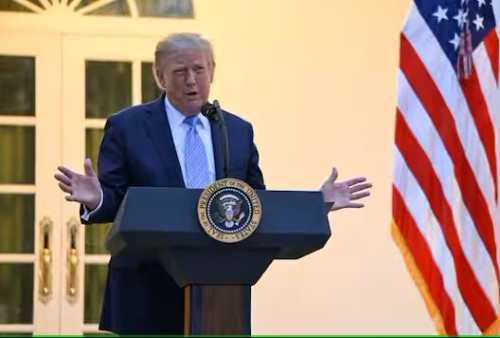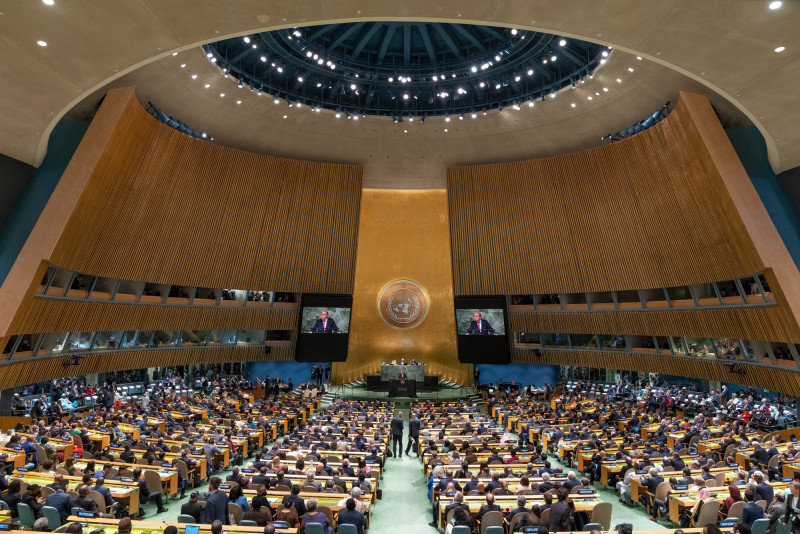
THE United Nations faces mounting financial and political pressure as world leaders gather in New York for its annual General Assembly, with President Donald Trump returning to the rostrum amid wars in the Middle East and Ukraine and growing concern over the risks posed by artificial intelligence.
Nearly 130 heads of state are expected at the week-long gathering, as the post-World War Two international order comes under strain and the 80-year-old organisation confronts reduced US funding, demands for reform and questions over its ability to respond to major global crises.
Trump's return for a second consecutive year will put the US relationship with the UN under renewed scrutiny. Washington avoided losing its vote at the General Assembly by paying $725 million in contributions to the regular budget this week, but still owes the organisation more than $1 billion while pressing for cuts and reforms.
China's President Xi Jinping, who last addressed the diplomatic gathering by video in 2021, will skip New York and instead hold one-on-one talks with Trump in Washington on Thursday, further highlighting the challenges facing the UN as major powers pursue diplomacy outside the organisation.
"We would no longer say that the UN is in freefall, but we would say that it's stuck in an open-ended crisis," Reuters cited Richard Gowan of the International Crisis Group saying.
"The UN may not be in emergency care like it was last year, but it seems to be trapped in a trauma center for the foreseeable future," Gowan said.
Adding to the uncertainty is the race to replace Secretary-General Antonio Guterres, whose term ends at the end of 2026, with no clear frontrunner yet to succeed him.
The 15-member UN Security Council may hold high-level meetings on Ukraine, artificial intelligence and the Middle East, including talks with Arab leaders, diplomats said.
Growing AI Risks
Artificial intelligence is expected to feature prominently at the assembly, coming shortly after several AI industry leaders called for a coordinated slowdown in the development of the technology, warning that it could soon improve on its own and escape human control.
Guterres has said AI will be a major topic, arguing that countries leading its development should establish "common guardrails in order to avoid this race to the bottom that could lead one day to a gigantic disaster at the global level."
The secretary-general has long called for global governance of AI. In 2023, the UN created an advisory body on the technology, bringing together tech executives, government officials and academics.
The issue has put Guterres at odds with Trump, who has dismissed AI risks as a "hoax," saying there is a "sick conspiracy" against the technology and that China would benefit from doubts being cast on its development.
Middle East Escalation
The Middle East will remain a central focus, as the US-Israeli war on Iran continues to fuel global inflation and destabilise the region. Recent gains by Houthi militants threaten shipping through the vital Bab el-Mandeb Strait and could further push up energy prices.
"It's very difficult to have a military solution for that problem, and the experience of fighting in Yemen demonstrated how complicated it is to have successful interventions," Guterres said, adding that the UN envoy on Yemen was making a "huge effort" to advance talks.
Peace talks remain stalled, however, as Iran and the United States continue to exchange strikes and Trump threatens a major escalation in the war.
Iranian President Masoud Pezeshkian is scheduled to address the assembly on Wednesday.
Israeli Prime Minister Benjamin Netanyahu, who is wanted by the International Criminal Court over alleged war crimes and crimes against humanity in Gaza that Israel denies, is due to speak on Thursday.
Palestinian President Mahmoud Abbas will for the second year running not attend the gathering in person after the United States again denied him a visa. On Thursday, the General Assembly voted to allow Abbas to appear by video.
A high-level meeting on the conflict in Sudan is also likely to be held on the sidelines, diplomats said, although a diplomatic breakthrough is unlikely.
Ukraine, Food Security
Russia's more than four-year-old war in Ukraine will also be high on the agenda.
Ukrainian President Volodymyr Zelenskiy and Russian Foreign Minister Sergei Lavrov will address the General Assembly. Zelenskiy will likely seek to shore up Ukraine's position ahead of what diplomats expect to be another tough winter.
The Security Council has been unable to take action to end the conflict because Russia, a permanent member, holds a veto.
Trump has at times appeared frustrated that he has been unable to broker an end to the war, a goal he declared a priority when he began his second term in January last year. The US president spoke with Russian President Vladimir Putin earlier this month, but it was unclear whether he plans to meet Zelenskiy in New York.
Guterres highlighted the war's impact on civilians as well as food security and energy prices.
"The effective blockade existing in the Black Sea is creating enormous problems that add to the problems generated by the Middle East crisis, and I think it would be very important to find a way to allow Ukrainian exports and Russian exports of food, fertilizers and energy to take place in a safe way through the Black Sea," he said. - September 20, 2026