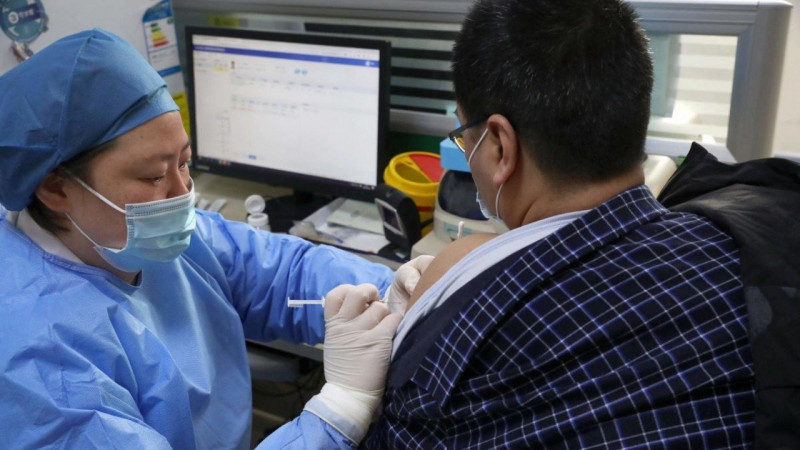
BEIJING – Shirley Shi has received three offers to be vaccinated against Covid-19 – through her home town, her residential area here and her office area – but the human resources manager is in no rush.
“I’d like to keep an eye out for any adverse effects first,” said Shi, who like many Chinese seems happy to take a wait-and-see approach.
Through aggressive lockdowns and mass testing of millions, China has had success controlling the virus that first surfaced on its soil in late 2019.
But vaccinating the world’s most populous country is a different story.
China is still working to ramp up production of its four domestically produced vaccines and has yet to approve any foreign-made shots in a global race for bragging rights.
For Shi, the problem is not accessibility, but a lack of urgency.
“With China’s control of the epidemic domestically and my lack of plans to go abroad in the near term, there is no need for now,” she said.
Chinese experts have signalled the vaccination rate could soon quicken.
Zhong Nanshan, a respected pulmonologist and key national figure in the fight against Covid-19, said recently that China plans to immunise 40% of its 1.4 billion people by June.
That would require massively increasing the number of jabs given in China, where currently only around 3.5% of the population is inoculated.
That’s far behind the UK’s 32.99 jabs per 100 people and the US’ 25.42, according to Our World in Data, a collaboration between Oxford University and a charity.
“The sense of urgency that exists in the West, where vaccination is no less than an expected game-changer, is not present in China,” said Mathieu Duchâtel, director of the Asia Programme at Institut Montaigne, a Paris-based think-tank.
Health risks
The slower pace could pose risks for China by delaying herd immunity.
There is no globally accepted standard for the percentage of a population that needs to be jabbed – or to develop the necessary antibodies through infection – for herd immunity against Covid-19 to kick in.
A November paper in medical journal Lancet estimated that percentage at 60-72 for a 100% effective vaccine, while Gao Fu, the head of the Chinese disease-control agency, put it at 70-80% for China in comments this week.
China would need to administer 10 million doses every day for seven months to reach such thresholds, Chinese infectious-disease specialist Zhang Wenhong told a recent forum. Only around 52.5 million doses had been administered as of end-February, according to Zhong.
The current pace is of “great concern”, Zhang added.
Besides quickening production, China has also committed to shipping vaccines overseas as it works to blunt foreign criticism of the initial spread of the virus from its shores.
Chinese companies are set to export nearly 400 million doses, state media has reported, and the government said it is providing free vaccines to 53 countries.
China is caught between “both the vaccination requirement of achieving herd immunity... and the demand associated with its vaccine diplomacy,” said Yanzhong Huang, a global health fellow at the US Council on Foreign Relations.
Huang said delays in herd immunity could mean China falls behind in reopening its borders – now largely closed to all but Chinese citizens – while other economies forge ahead.
This “might make China look bad”, he said.
Scepticism
In China, public take-up of the vaccine may also be slowed by trust issues in a country with a history of drug-safety scandals.
Market research firm Ipsos found in January that 85% of adults in China said they were willing to get jabbed, but it was unclear how soon they would do so.
At one Beijing clinic, a doctor said jabs had been offered to all staff, but many demurred until more data on vaccine efficacy was available.
Chinese producers are yet to release detailed data, unlike their foreign rivals.
China’s vaccinations started last year with key groups like medical staff and state workers headed overseas. This has been expanded to other citizens, although largely in the biggest cities.
With its resources and demonstrated ability to mobilise for a mass effort, China may well catch up on vaccination rates once supplies increase.
Zhang Yutong, a dental clinic employee, was among a steady flow of people streaming in to one Beijing clinic after her employer arranged for jabs.
She told AFP nearly two-thirds of her colleagues had also taken the offer.
“The epidemic has become a regular part of life. It’s better to have antibodies,” she said. – AFP, March 7, 2021