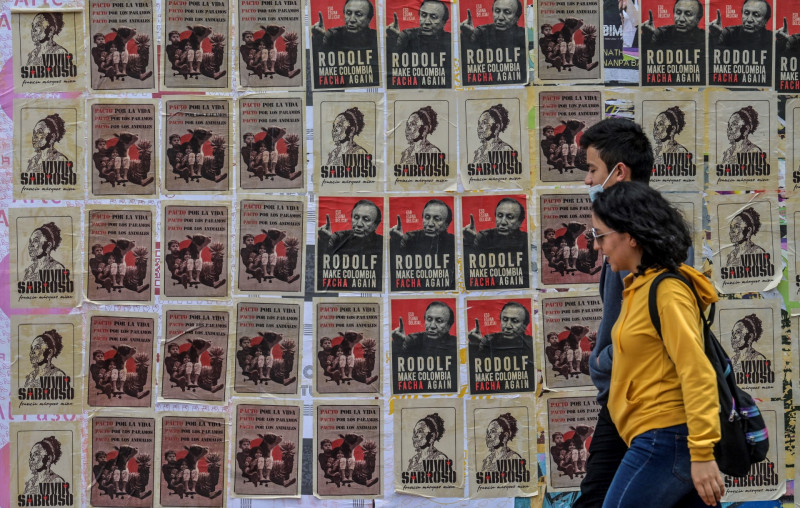
BOGOTA – Colombians vote Sunday in a presidential run-off that features promises of radical change in a country saddled with widespread poverty, violence and other woes.
After a tense campaign marked by claims of death threats against several candidates, opinion polls have leftist Gustavo Petro and businessman Rodolfo Hernandez neck-and-neck.
Should he win, former guerrilla Petro would become Colombia’s first left-wing president.
If not, the independent Hernandez, a millionaire construction magnate and former mayor of the northern city of Bucaramanga, will be given the opportunity to carry out his promise to rid the country of the “thieves” and “bureaucracy” that he blames for political corruption.
The only certainty is that whoever wins the new vice-president will be a woman of African heritage.
It will be environmental activist Francia Marquez, 40, should Petro win or conservative academic Marelen Castillo, 53, if Hernandez prevails.
Former mayor of Bogota Petro was well clear in last month’s first round with 40% compared to Hernandez, who surged from seemingly nowhere to finish with 28% and knock out right-wing establishment candidate Federico Gutierrez.
But the first round results are deceptive, according to analysts, who say it was an “anti-establishment” vote to rebuke the political elites.
The “change” offered by Petro, and Hernandez’s vow to tackle corruption, struck a chord with voters and left the conservative and liberal powers in the doldrums.
Whoever wins will have to tackle poverty of 39% and unemployment at 11%.
“Both are equally uncertain and risky (candidates) because they have shown themselves to be impulsive in taking decisions,” said German Prieto, a political scientist at Javeriana University.
‘Bellicose attacks’
The last four years under President Ivan Duque – who is constitutionally barred from standing for re-election – have been a disappointment.
He will leave office with rock bottom popularity after a four-year mandate marked by the Covid-19 pandemic, recession, mass anti-government protests that were brutally quashed by security forces and a rise in violence linked to criminal gangs involved in drug-trafficking in the world’s largest producer of cocaine.
Colombia is a country often described as a volcano on the brink of eruption.
Progressive Petro has promised to beef up the state apparatus, increase taxes on the rich and accelerate the green energy transition.
Hernandez has made superficial and surprising commitments, such as getting rid of the fleet of cars serving government officials or legalising marijuana.
However, there are questions lingering over each man’s ability to govern.
Petro would likely face defiant elites – possibly including the military – determined to thwart him, while Hernandez would be almost without allies in Congress.
And while presenting himself as a champion of the fight against corruption, he faces a graft trial himself next month over the attribution of a public works contract to a company linked to his son during his mayorship in Bucaramanga.
Petro has had to deal with leaked recordings of his campaign team discussing how to “discredit” opponents, including by using defamation – an embarrassment for the candidate who promised on the campaign trail he would deliver a “policy of love.”
“The road leading to this presidency has been nothing but bellicose attacks, scandals, dubious support, spying, infiltrations, denunciations and death threats, amongst others,” wrote major daily newspaper El Espectador.
‘Worst scenario’
Petro has cast doubt on the software being used in the presidential vote count following some errors during legislative elections in March.
“We have no guarantee that we will be able to tell the people it is reliable,” he said earlier this week.
These “doubts” have added to the “challenge of the second round with a result that is too close...in a context of extreme aggression,” added El Espectador.
For one diplomatic source, the razor-close race is “the worst scenario” and means there is the “risk of outbreaks and violence” following the announcement of results.
The last time a president was elected by the skin of his teeth – Misael Pastrana in 1970 – accusations of fraud and the frustrations of many voters led to the creation of a new urban guerrilla movement.
Another tight result “could provoke a social problem with consequences in the streets,” said Luisa Lozano, a political scientist at La Sabana University.
Lozano is particularly wary of “certain Petro supporters” should he lose. – AFP, June 17, 2022