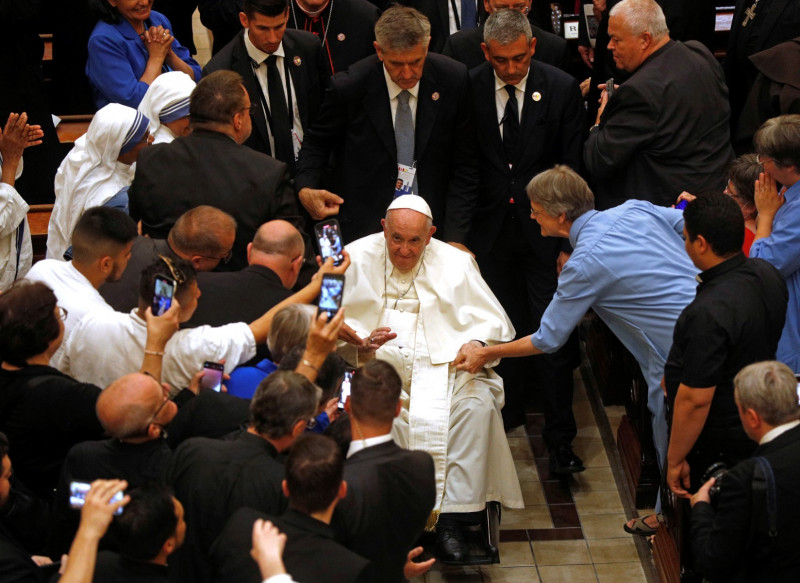
SAINTE-ANNE-DE-BEAUPRÉ – Indigenous women briefly protested as Pope Francis celebrated mass during his visit to Canada today, demanding that he retract centuries-old Church doctrine that empowered Europeans to colonise non-Christian native lands.
The brief incident at the shrine of Sainte-Anne-de-Beaupre in Quebec province – North America’s oldest Catholic shrine – came as the 85-year-old pontiff attempts to reset the Church’s fraught relationship with Indigenous people.
The two women unfurled a banner in front of the altar, just a few feet away from Francis, which read: “Rescind the doctrine.”
It referred to the Doctrine of Discovery, the 15th century papal edicts that legitimised the seizure of non-Christian lands and people. Calls for the pope to rescind it have followed him on his visit, where he is apologising for the abuse of Indigenous children in Catholic-run schools.
The writing on the banner was only on the side facing away from the pope, and it was calmly and quickly removed while mass continued uninterrupted.
Later, during a homily at the Notre Dame Cathedral in Quebec City, the pope used the words “sexual abuse” for the first time on his visit – something he has been criticised by Indigenous people for failing to address.
But he did not specifically mention Indigenous people specifically in his comments.
“The Church in Canada has set out on a new path, after being hurt and devastated by the evil perpetrated by some of its sons and daughters. I think in particular of the sexual abuse of minors and vulnerable people, scandals that require firm action and an irreversible commitment,” he said.
“Together with you, I would like once more to ask forgiveness of all the victims.”
From the late 1800s to the 1990s, Canada’s government sent about 150,000 children into 139 residential schools run by the Catholic Church, where they were cut off from their families, language and culture in a failed policy of forced assimilation.
Many were physically and sexually abused, and thousands are believed to have died of disease, malnutrition or neglect.
Indigenous leaders have drawn a straight line between the Doctrine of Discovery and the formation of the residential schools centuries later.
Francis apologised for the abuse Monday in the western Indigenous community of Maskwacis.
While survivors have said his words were overwhelming, many have pointed out that he did not specifically mention the sexual abuse of First Nations, Metis and Inuit children in his comments.
‘Deep dismay’
“Personally, it wasn’t enough,” said Abigail Brook, a 23-year-old member of Saint Mary First Nations, said today.
“Nothing was said about the sexual abuses,” she said, speaking before the pope gave his homily in Quebec City. “We can’t accept reconciliation until he acknowledges that.”
Nevertheless, Desneiges Petiquay said his visit offered a “message of hope.”
The 54-year-old housewife from the Manawan reserve was in the front row at Sainte-Anne-de-Beaupre.
“This pope, he knows we exist here, he recognises us,” she said. “Yesterday, I saw him up close, it touched me here,” she added, putting her hand on her heart.
During the mass at Sainte-Anne-de-Beaupre, on the shores of the St Lawrence River some 30km from Quebec City in Canada’s east, the pope said the Church was asking “burning questions... on its difficult and demanding journey of healing and reconciliation.”
“In confronting the scandal of evil and the Body of Christ wounded in the flesh of our Indigenous brothers and sisters, we too have experienced deep dismay; we too feel the burden of failure,” he said.
“Why did all this happen? How could this happen in the community of those who follow Jesus?”
Today, the last day of his six-day trip, the pope will stop in Iqaluit, in the Arctic territory of Nunavut.
Francis has appeared weakened since the beginning of this trip, and is using a wheelchair because of knee pain. – AFP, July 29, 2022



_.png)