BEIJING – China said today its military spending would rise at the fastest pace in four years, warning of “escalating” threats from abroad at a meeting of its rubber-stamp Parliament that is set to hand Xi Jinping a third term as president.
The increase in the world’s second-largest defence budget came as Beijing announced an economic growth goal of around 5% for this year – one of its lowest in decades.
The country’s planned budgets for the year put defence spending at CN¥1.55 trillion (RM1.004 trillion), a 7.2% rise and the quickest rate of increase since 2019. It officially rose 7.1% last year.
Outgoing Premier Li Keqiang told delegates to the National People’s Congress (NPC) that “external attempts to suppress and contain China are escalating”.
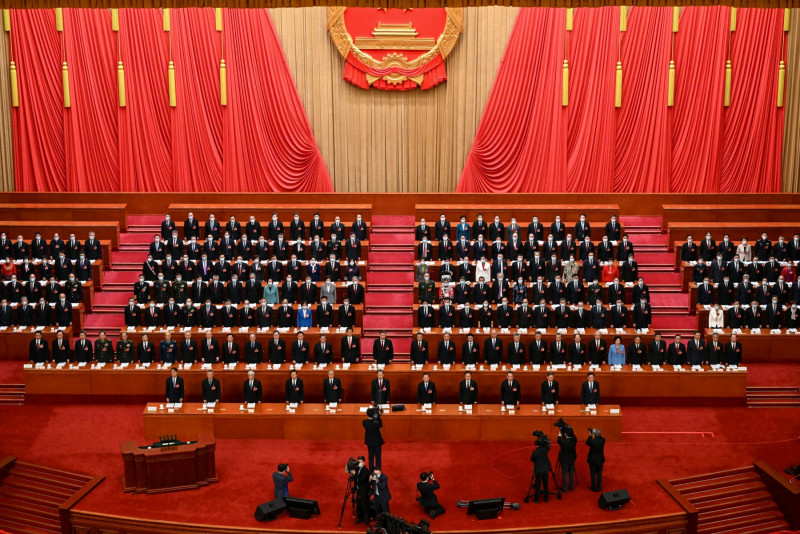
“The armed forces should intensify military training and preparedness across the board,” he said as he presented the government’s annual work report to thousands of amassed delegates in Beijing’s Great Hall of the People.
The military must “devote greater energy to training under combat conditions, and... strengthen military work in all directions and domains”, he added.
China’s defence spending still pales in comparison with the United States, which has allotted over US$800 billion (RM3.58 trillion) for its military this year.
But analysts have said Beijing spends much more money than the officially announced sums.
The ramped-up spending comes during a low point in relations between China and the United States.
Beijing and Washington have butted heads in recent years over trade, human rights and other issues, but relations soured even further last month when the US shot down a Chinese balloon it said was being used for surveillance – a claim strenuously denied by Beijing.
Top American officials have also repeatedly warned that China may invade Taiwan in the coming years, pointing to Beijing’s increasingly assertive military moves around the self-ruled island, which it sees as its own territory and has vowed to bring under its control.
Niklas Swanstrom, director of the Stockholm-based nonprofit the Institute for Security and Development Policy, said Beijing appeared to be “investing in its capacity to take over Taiwan and keep the US out of the region”.
“We have a military arms race in Northeast Asia, and Chinese armaments are driving this forward,” he added.
James Char, an expert on China’s military at Singapore’s Nanyang Technological University pointed out that several countries across Asia were boosting their defence spending, in part due to “their respective threat perceptions of the regional security landscape”.
‘Steady recovery’
Experts expect few surprises at this week’s carefully choreographed NPC, with thousands of politicians coming from across China to vote on laws and personnel changes pre-approved by the ruling Communist Party.
Today’s conservative economic goals followed China posting just 3% growth last year, missing its stated target of around 5.5% by a wide margin as the economy strained under the impact of strict Covid-19 containment policies and a property crisis.
“The growth target came in at the low end of the market expectation. But it should be taken as a floor of growth the government is willing to tolerate,” said Zhiwei Zhang, president and chief economist at Pinpoint Asset Management.
“Given the very low base of economic activities last year, it is unlikely to see growth drop below 5%,” he said.
Li struck a bullish tone in his speech, saying China’s economy “is staging a steady recovery and demonstrating vast potential and momentum for further growth”.
He lauded Beijing’s growth-suppressing Covid-19 curbs – abruptly abandoned late last year – and “effective and well-coordinated” economic and social development.
“Overcoming great difficulties and challenges, we succeeded in maintaining overall stable economic performance,” he said.
Xi dominant
Also top of the NPC’s agenda will be Friday’s norm-busting reappointment of Xi as president, after he locked in another five years as head of the party and the military – the two most significant leadership positions in Chinese politics – at an October congress.
Since then, the 69-year-old Xi’s leadership has faced unexpected challenges and scrutiny, with protests over his zero-Covid-19 policy and a deadly coronavirus surge after it was subsequently dropped.
But those issues are almost certain to be avoided at this week’s Beijing conclave, which will also see the unveiling of a Xi confidant and former Shanghai party chief Li Qiang as the new premier.
Delegates to the NPC – and to the concurrent “political consultative conference” (CPPCC) that began yesterday – will also discuss issues ranging from the economic recovery to improved sex education in schools, according to state media reports.
The meetings serve as a forum for attendees to present pet projects, but they have little say in broader questions of how China is run. – AFP, March 5, 2023




.JPG)