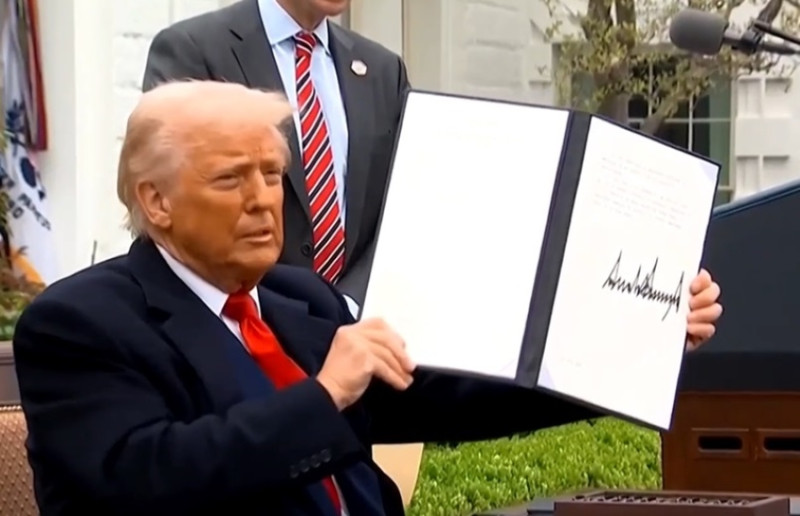
THERE is a paradox emerging in global trade: the very tariffs introduced by Donald Trump to protect American interests may have inadvertently strengthened cooperation among others.
Bernama cited today that, according to Chris Humphrey, Executive Director of the EU-ASEAN Business Council, Trump’s controversial trade policies—widely derided for their economic disruption—could prove a turning point in how Europe engages with Southeast Asia.
“Trump is clearly determined to disrupt the entire global economy, for which you can have different views about his motives and the economic case behind his tariffs,” Humphrey said during an interview with *Bernama* at the sidelines of the 46th ASEAN Summit in Malaysia.
“I personally think his tariffs are completely nonsensical and the approach is just strange and probably going to do more damage to the US,” he remarked.
Yet, what some see as reckless economic nationalism, Humphrey sees as a necessary wake-up call.
“One of the big silver linings is that he is waking up the whole world, with countries realising they need to approach what they've been doing previously in a different way. That’s particularly true for Europe, which is now realising it has been in an abusive (trade) relationship with the United States.”
The EU’s long-dormant interest in ASEAN appears to have been reawakened. “ASEAN has suddenly leapt up the agenda in Brussels as a result of that,” he said, noting a visible shift in thinking during his recent visit to the European capital.
The EU is currently negotiating bilateral trade deals with Indonesia, Malaysia, Thailand and the Philippines. Talks on a broader EU-ASEAN Free Trade Agreement, suspended since 2009, may finally gain traction. Humphrey disclosed that during a recent meeting with European Commissioner for Trade and Economic Security Maros Sefcovic in Singapore, the urgency was made plain.
“He made it clear the EU needs to get these trade deals over the line fast and that there has to be give and take on both sides.”
What binds the two regions, Humphrey argued, is a mutual belief in rules-based trade and a shared interest in economic greening—areas where cooperation is not only feasible, but overdue.
“Both blocs believe in a global rules-based trading order and want to do things about greening their economies as well. They are a natural fit when it comes to trading and complementing each other. They’re not competing with each other.”
And in a world increasingly fractured by protectionism and strategic rivalry, the case for like-minded alliances has rarely been stronger.
“It’s not going to get better; it’s going to get worse, which is why Europe needs to find more friends out there in the world who have the same mindset. That points you towards Southeast Asia and automatically the ASEAN grouping,” he observed.
In practical terms, Humphrey predicts “a lot more interaction, more high-level visits and more European businesses looking to Southeast Asia.”
It is not hard to see the appeal. ASEAN’s economic fundamentals remain robust, with GDP growth projected to rise from 4.2 per cent in 2024 to 4.7 per cent in 2025. Add to that the region’s rapid urbanisation, youthful and tech-savvy population, expanding middle class, strong manufacturing base and access to critical raw materials, and it becomes clear why European interest is surging.
“Potential areas for increased cooperation include energy cooperation, support for the ASEAN Power Grid, automotives, electric vehicle development, pharmaceuticals and semiconductors without a doubt,” Humphrey said.
If Trump’s tariffs have accomplished anything beyond sowing economic uncertainty, they may well have accelerated a long-overdue strategic realignment—one in which ASEAN and the EU recognise each other not just as trade partners, but as vital pillars of a more balanced global economic order. - May 26, 2025