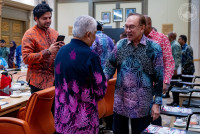
PRIME Minister Datuk Seri Anwar Ibrahim's overseas visits and trade missions throughout 2025 successfully generated exports totalling RM45.4 billion, thus contributing to the country's increased trade performance.
He said this was the result of strategic trade relations with several major countries, including the United Kingdom, Thailand, Russia, Italy, France, Brazil, China and the Republic of Korea, as well as those on the African continent.
"Overseas trade visits and missions have generated export sales of RM45.4 billion, involving major trading partners in Europe, Asia and Africa," he said.
He said this when answering a question from Petaling Jaya Member of Parliament (PH) Lee Chean Chung on the performance and value of trade for 2025 and the results of the Prime Minister's overseas visits and trade missions throughout the period, which contributed to the increase in Malaysia's exports.
According to Anwar, the trade missions focused on high-value sectors that are Malaysia's strengths, including liquefied natural gas (LNG), palm oil, electrical and electronic goods (E&E), especially the semiconductor industry, as well as the aerospace and furniture sectors.
“The open and free trade approach has enabled Malaysia to penetrate 240 international markets and expand export opportunities to new markets,” he explained.
Meanwhile, he said, Malaysia also managed to record a trade volume of RM3.061 trillion, an increase of 6.3 per cent compared to 2024, while the export value reached RM1.603 trillion, an increase of 6.5 per cent in the same period.
“The country’s trade surplus also increased by 9.2 per cent to RM1.580 billion, reflecting strong trade performance despite facing global economic uncertainties and international geopolitical tensions,” he explained.
Meanwhile, answering a supplementary question from Kubang Pasu Member of Parliament (PN) Datuk Dr Ku Abd Rahman Ku Ismail on the performance of the ringgit, the Prime Minister said the ringgit had been weakening for a long time, and its strengthening now shows confidence in the country’s economic system.
“It needs to be seen as a whole, along with increased investment, income and reduced unemployment.
“Ideally, the strengthening of the ringgit should occur prudently and gradually, but sometimes investor confidence is unexpected and cannot be fully controlled.
“In addition, attention needs to be given to domestic measures to ensure that economic policies and frameworks are well controlled, including the ability to manage the country’s deficit and continue to attract investment,” he said. – January 27, 2026