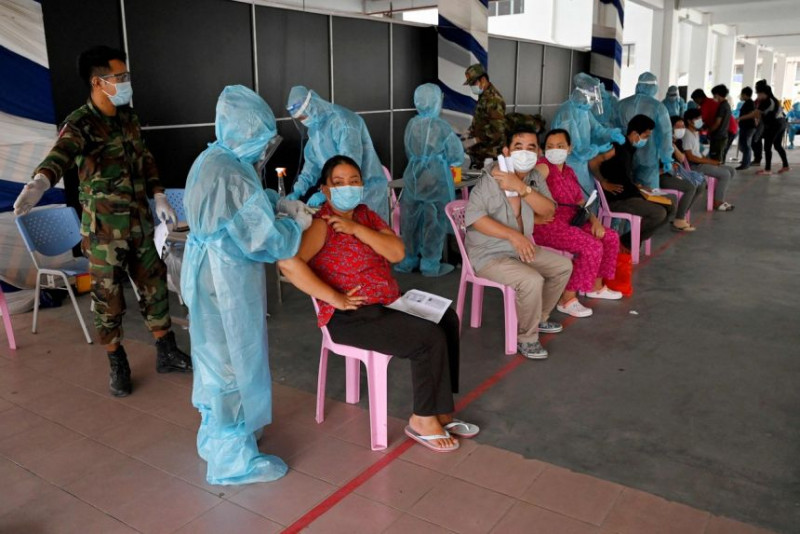
PARIS – The slow roll-out of coronavirus vaccines will cost the global economy US$2.3 trillion (RM9.6 trillion) in lost output, a report released today found.
The Economist Intelligence Unit’s study found that emerging and developing economies, whose vaccine roll-outs are far behind those of wealthier countries, will bear the brunt of those losses.
The report comes as advanced nations move towards providing booster shots to their populations while the international effort to provide vaccines for poorer nations remains inadequate.
The study calculated that countries, which fail to vaccinate 60% of their populations by mid-2022, will suffer the losses, equivalent to €2 trillion over the 2022-2025 period.
“Emerging countries will shoulder around two-thirds of these losses, further delaying their economic convergence with more developed countries,” the EIU said.
It warned the delayed roll-out of vaccines could fuel resentment, increasing the risk of social unrest in developing economies.
The Asia-Pacific region will be the worst hit in absolute terms, accounting for nearly three-quarters of the losses.
But as a percentage of GDP, sub-Saharan Africa will suffer the worst losses.
Around 60% of the population of higher-income countries received at least one dose of the coronavirus vaccine as of late August, compared with just 1% in poorer nations, according to the study. Two doses are required to be fully vaccinated for most shots.
“Vaccination campaigns are progressing at a glacial pace in lower-income economies,” it said.
The report’s author, Agathe Demarais, said the international effort to provide coronavirus vaccines to poor nations, Covax, has failed to live up to its even modest expectations.
“There is little chance that the divide over access to vaccines will ever be bridged”, with rich countries providing only a fraction of what is needed, she said in a statement.
“Finally, the focus in developed economies is shifting towards administering booster doses of coronavirus vaccines, which will compound shortages of raw materials and production bottlenecks,” she added.
The EIU said its study was conducted by combining its in-house forecasts for vaccination timelines in around 200 countries with GDP growth forecasts. – AFP, August 25, 2021