
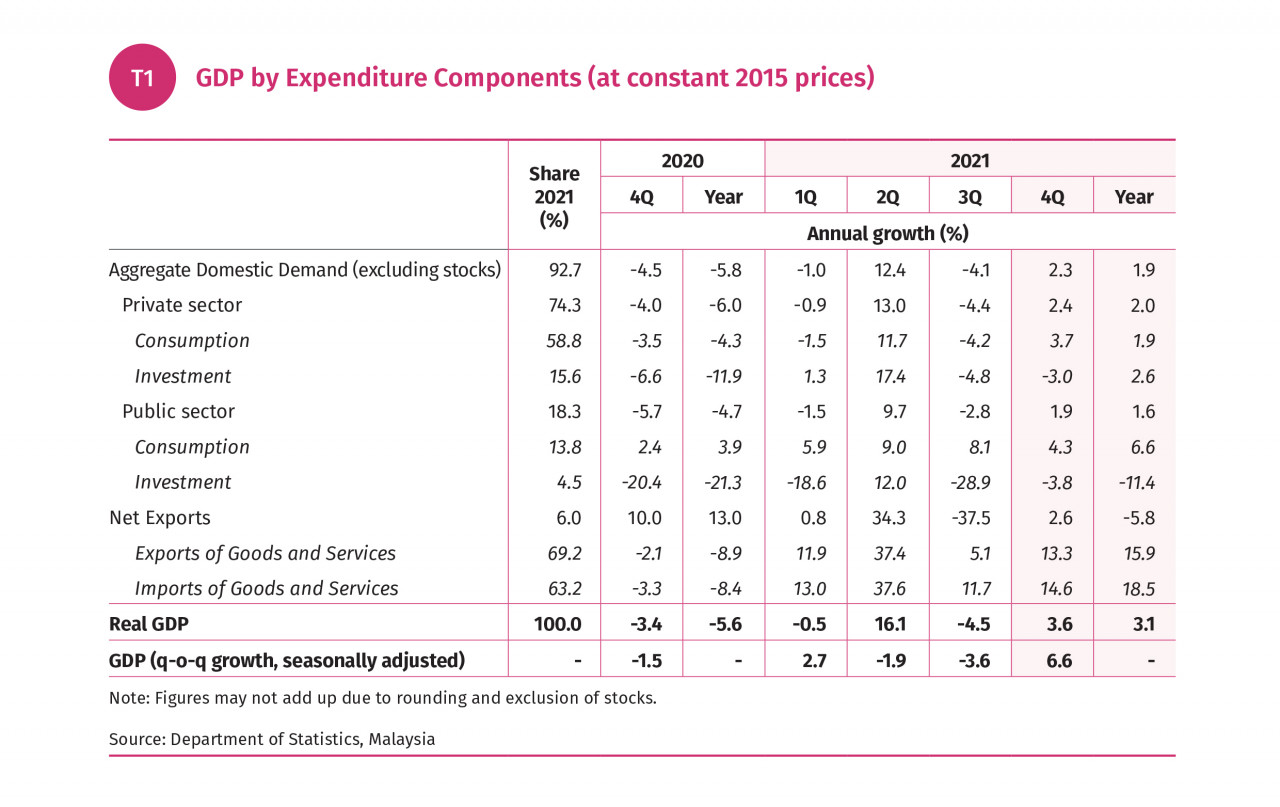
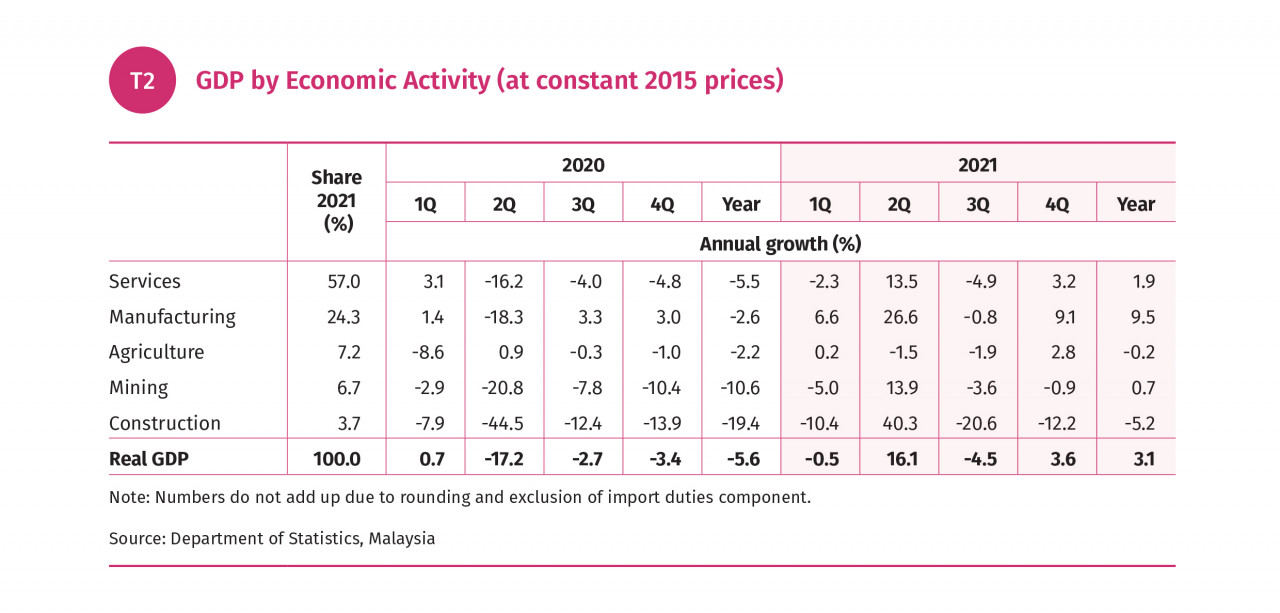
KUALA LUMPUR – The Malaysian economy registered a positive growth of 3.6% in the fourth quarter of 2021 compared with -4.5% in the third quarter of 2021, as economic activities resumed with the easing of containment measures.
The rebound in economic activity was aided by recovery in the labour market as well as continued policy support. In addition, strong external demand amid the continued upcycle in global technology provided a further lift to growth.
On the supply side, all economic sectors recorded improvements in growth, led by the services and manufacturing sectors while on the expenditure side, growth was driven mainly by the improvement in household spending and trade activity.
On a quarter-on-quarter seasonally adjusted basis, the economy registered an increase of 6.6% (3Q 2021: -3.6%). With the turnaround in growth in the fourth quarter, the economy grew by 3.1% for 2021 as a whole, and the unemployment rate declined to 4.6%.
Increased inflation
As expected, headline inflation increased to 3.2% during the quarter (3Q 2021: 2.2%). The higher inflation during the quarter was due mainly to the normalisation in electricity prices following the lapse of the three-month electricity bill discount implemented in July 2021.
Core inflation increased marginally to 0.8% during the quarter (3Q 2021: 0.7%) as economic reopening gathered momentum. For 2021 as a whole, average headline inflation was 2.5% (2020: -1.2%), while core inflation averaged at 0.7% (2020: 1.1%).
Exchange rate developments
The ringgit appreciated by 0.3% against the US dollar in the fourth quarter of 2021. This was supported by improved sentiment from the easing of Covid-19 restriction measures and accelerated Covid-19 vaccine booster inoculations.
Financing conditions
Growth in net financing to the private sector increased to 4.7% (3Q 2021: 3.9%), due mainly to higher outstanding loan growth (4.4%; 3Q 2021: 2.9%) as economic activity picked up.
Outstanding household loan growth grew by 4.2% (3Q 2021: 3.2%) with higher growth across most loan purposes. Loan applications and disbursements were substantially higher following the easing of movement restrictions, particularly for purchasing houses and passenger cars.
For businesses, outstanding loan growth increased to 4.8% (3Q 2021: 2.4%) and continued to be driven by higher working capital loans.
Economy expected to remain on recovery path
For 2022, the domestic economy is expected to remain on its recovery path, supported by the continued expansion in global demand and higher private sector expenditure given improving labour market conditions and on-going policy support.
The continuation of major investment projects in both private and public sectors will also support growth.
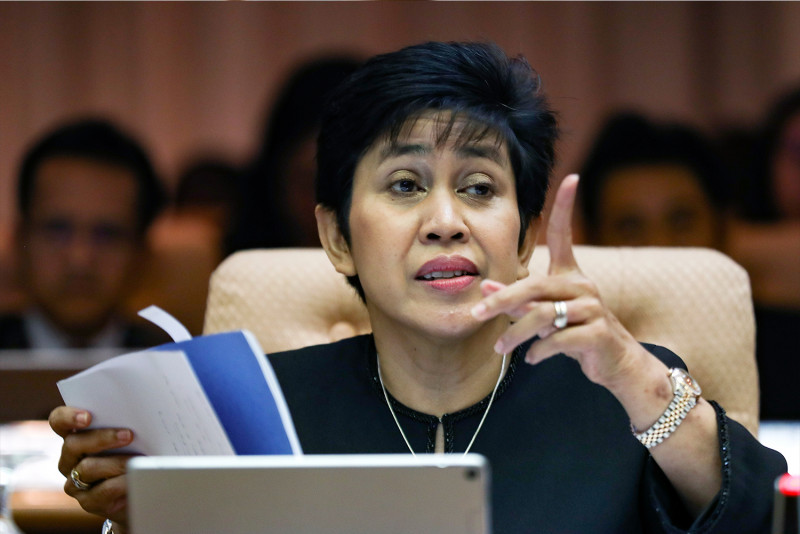
Bank Negara Malaysia governor Tan Sri Nor Shamsiah said that Malaysia “is well-positioned to continue benefitting from the expansion in global economic and trade activities”.
The acceleration of the Covid-19 booster vaccination programme and vaccination of children above 5 years old, coupled with sufficient capacity in the healthcare system, would improve domestic economic activities, thus strengthening the recovery momentum.
“However, the balance of risks remains tilted to the downside, mainly from development surrounding Covid-19, both globally and domestically.”
Average headline inflation for 2022 is likely to remain moderate as the base effect from fuel inflation dissipates.
Core inflation is expected to edge upwards as economic activity normalises amid the environment of high input costs.
“Nevertheless, core inflation is expected to be modest, with upside risk contained by the continued slack in the economy and labour market. The outlook, however, continues to be subject to global commodity price developments amid risks from prolonged supply-related disruptions,” Nor Shamsiah added.
BNM is expected to publish the Annual Report 2021 (AR 2021), Economic and Monetary Review 2021 (EMR 2021), and Financial Stability Review for Second Half 2021 on March 30, 2022. - The Vibes, February 11, 2022