Business

Pandemic no setback for Bangladesh’s soaring ship industry

Country’s gross domestic product grew by 8.2% last year and the hit from the coronavirus pandemic is expected to be less severe than in other developing economies

Updated 5 years ago · Published on 22 Nov 2020 11:00AM

Pandemic no setback for Bangladesh’s soaring ship industry
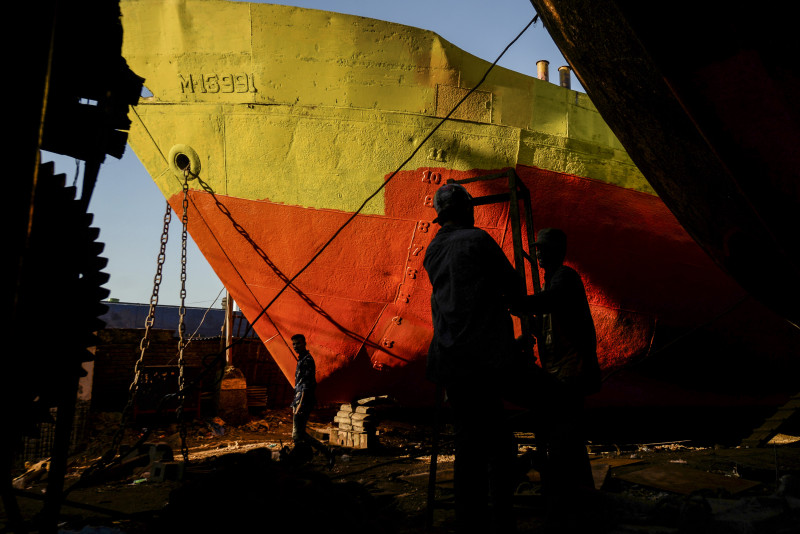
In this picture taken on November 16, 2020 dockyard workers carry maintenance works on ships in the banks of the Buriganga River in Char Kaliganj on the outskirts of Dhaka.  – AFP Pic, November 22, 2020

CHAR KALIGANJ, Bangladesh – Work is booming at Bangladesh's largest shipyard – quite literally. It’s difficult to hear anything over the cacophony of banging hammers and crackling sparks, proof the industry has withstood the economic shockwaves wrought by the coronavirus pandemic.

In this nation of 168 million people, much of the low-lying land is accessed via boat. Rivers are Bangladesh's lifeblood, and strong economic growth in recent years has fueled more investments in new and bigger ships.

Every corner of the Char Kaliganj yard is filled with vessels under repair, and the air is thick with the acrid smell of oil and chemicals. 

“The dockyards were closed in... the coronavirus lockdown. But now business is booming,” worker Abul Kashem, 66, told AFP, saying he has never seen the yard south of Dhaka busier.

The 15,000 workers sometimes toil seven days a week to meet the demand, said Masud Hossain Palash, who heads the Bangladesh Dockyard and Shipyard Owners Association.

“Well into the 1980s, these dockyards would only make... one-storey or one-and-a-half storey wooden ferries,” Kashem recalled. Now their work includes oil tankers and bulk carriers. 

The shipyard sector has soared on the back of the strong economy, together with the textile industry which has made Bangladesh the world’s second-largest garment exporter. 

Gross domestic product grew by 8.2% last year and the hit from the coronavirus pandemic is expected to be less severe than in other developing economies.

Bangladesh’s gross domestic product per capita is also expected to surpass that of its giant neighbour India this year, according to the International Monetary Fund.

But there is a dark side, with campaigners warning of the continued use of child workers and poor labour law enforcement.

Children in the shipyards are paid just a fraction of the wages that adults receive and also face the risk of injury and death, activists said. – AFP, November 22, 2020

Related News

World / 4d

Bangkok floods: The real pain starts when waters recede

Malaysia / 2w

Anutin’s first year: Restoring Thailand’s political status quo

Malaysia / 3w

Northern Malaysia must prepare for the consequences of lower rainfall

Opinion / 1mth

Massive attacks in the Thai Deep South aimed at destroying the economy

Malaysia / 1mth

Malaysia records 6% GDP growth in Q2 despite global headwinds, says Sim

Malaysia / 1mth

Six per cent growth proves Malaysia's economy remains resilient - PM

Spotlight

Diary

Penang reaffirms commitment to preserve heritage sites across the state

By Ian McIntyre

Opinion

AI: A Godsend for those with dyslexia in education and careers

Malaysia

Malaysia prepares for aged nation status by 2036

Malaysia

Mentally disabled suspect remanded for 7 days over fatal hammer attack in Marang

Malaysia

Masidi urges Putrajaya to address Sabah doctor shortage in upcoming Budget 2027

Malaysia

Police rearrest motivational speaker as second woman files harassment report in Perlis

Malaysia

Anwar vows zero compromise on school safety after alleged murder of teen Irene Sofiya

Malaysia

Classmates arrested as police probe fatal assault of 16-year-old Irene Sofiya

Malaysia

Loneliness, social media drive elderly pensions into hands of cyber scammers

Malaysia

Another desperate attempt by Nadzaruddin and former Undangs

You may be interested

Business

Tabung Haji posts record RM4.64b profit on stronger investment performance

Business

Oil supply risks mount as Brent tops US$102 on threat of Middle East shipping routes disruption