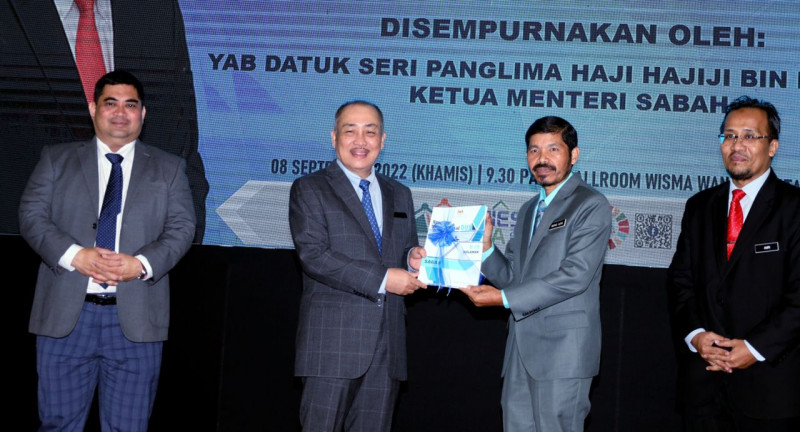

KOTA KINABALU – Sabah’s economy is in recovery mode but has not achieved the performance that was seen prior to the pandemic in 2019, said Sabah Chief Minister Datuk Seri Hajiji Noor today.
The Statistics Department record shows that the state’s gross domestic product (GDP) grew 1.1% to RM78.7 billion from January to June this year compared to RM77.8 billion over the same period in 2020, he said.
Hajiji said the growth was experienced despite the coronavirus pandemic nationwide.
“The services sector dominated Sabah’s GDP contribution with 47.3%, followed by the mining and quarry sector with 26%,” he said during the briefing and launching of the Malaysian census findings for 2020 held at Wisma Wanita here today.
This is the first time the Sabah Statistics Department has held such a briefing in the state and Hajiji expressed hope the department will continue to provide reliable information in the future.
He said that the data shows the real picture of Sabah’s demographic situation.
Towards this end, he said the state government will be using the 2020 census report to efficiently run the state’s administration and the implementation of the Sabah Maju Jaya five-year plan.
Hajiji also said that the state’s GDP per capita has increased from RM26,674 in 2021 to RM21,706 in 2020. It still falls below the national level which is RM47,324 in 2021, he added.
Meanwhile, Hajiji said the population census shows that there were 3.418 million people in Sabah in 2020 compared to 3.117 million ten years ago.
The population growth in Sabah is sliding from 2.3% in 2010 to 0.9% in 2020.
Children up till the age of 14 constituted 26.5% of the total population, while the gender ratio stood at 109 men to 100 women.
Hajiji said there are 600 “sub-national” publications within the Malaysian Census 2020 report and the figures can be used by Sabah assemblymen to plan their constituencies’ socioeconomic development and strategise their services to their respective constituents.
For instance, he said the Karambunai state constituency has the largest number of population and residentials, with 164,000 people and 35,463 residentials.
He said the Banggi constituency is the lowest in terms of both, with only 9,000 people and 2,588 residentials.
“Kota Kinabalu district has the biggest population with 500,421 people, followed by Sandakan with 439,050 people.
“In terms of population age composition, Putatan recorded the highest number of young individuals with 34.5%,” he added. – The Vibes, September 8, 2022